
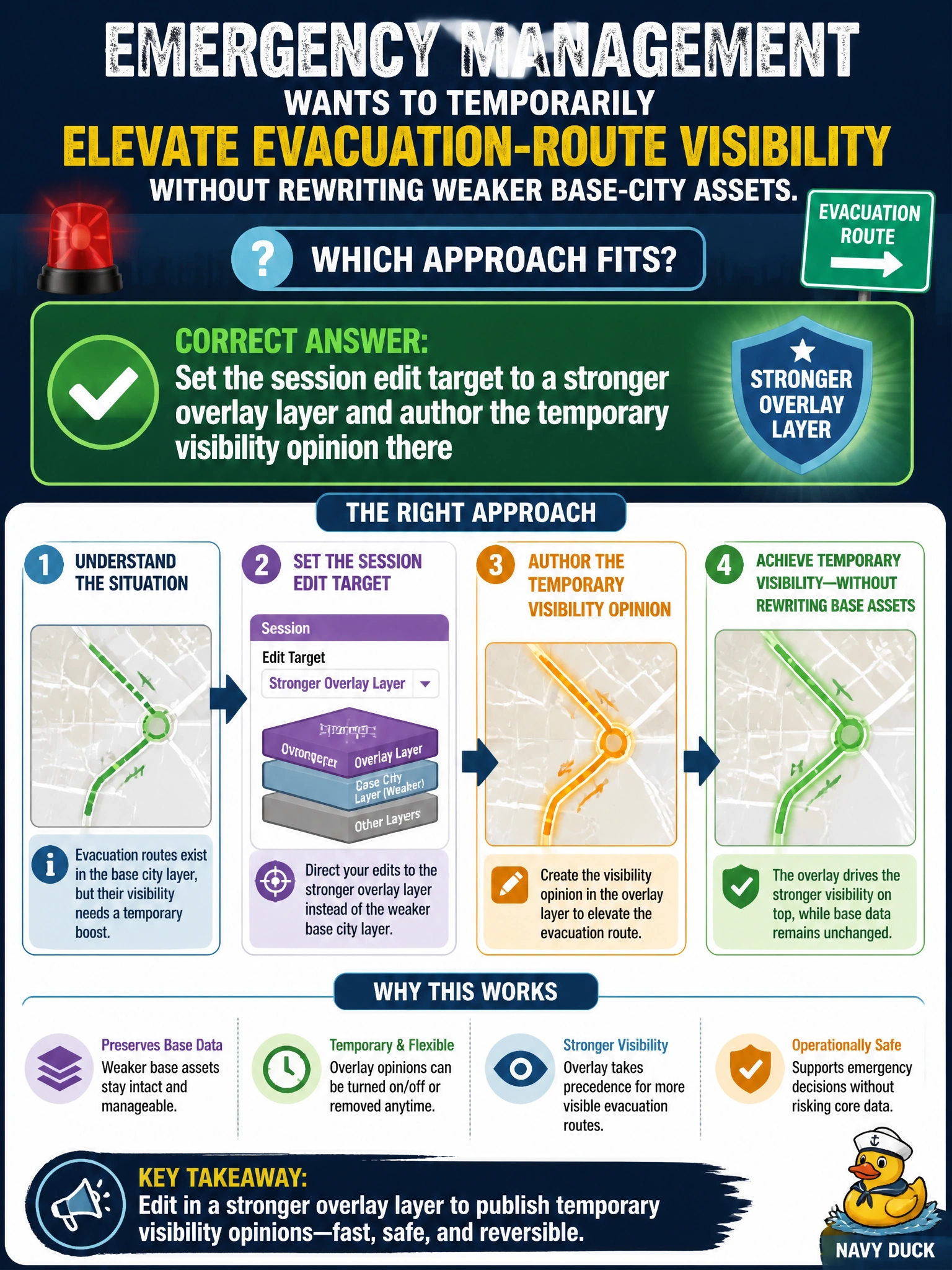
Emergency management wants to temporarily elevate evacuation-route visibility without rewriting weaker base-city assets. Which approach fits?
Select an answer to reveal the explanation.
Short Explanation
Picture a drill overlay sheet laid on the city map for one afternoon—you don’t redraw the whole atlas. Point the edit target at a stronger session overlay, flip route visibility there, and peel it off later. Baking or deleting base layers is permanent overkill.
Full Explanation
Temporary operational overlays belong on stronger session or overlay layers, not in durable base assets. Emergency management that wants to elevate evacuation-route visibility for a drill without rewriting weaker base-city assets should set the session edit target to a stronger overlay layer and author the temporary visibility opinion there. Targeting a stronger overlay concentrates ephemeral civic opinions where they can be enabled for the drill and removed afterward, preserving neighborhood references and base layers for day-to-day twin use.
Permanently baking visibility into every referenced neighborhood layer fails conceptually: baking makes a temporary drill state durable, pollutes shared neighborhood assets, and complicates rollback. Deleting all weaker layers for the duration of the drill fails because deletion is destructive, blocks other municipal consumers of those layers, and is not a reversible overlay pattern. Converting evacuation paths to pointInstancer prototypes so they auto-strengthen fails because point instancing is a scale/reuse mechanism, not a strength elevator for visibility opinions.
Exam caveat: temporary civic drills map to session/overlay edit targets; permanent bake or mass deletion is overkill and exam-wrong. Operational check: during the drill, verify evacuation routes show with visibility from the overlay; after the drill, remove or mute the overlay layer and confirm base-city assets are unchanged and routes return to their non-drill visibility state.