
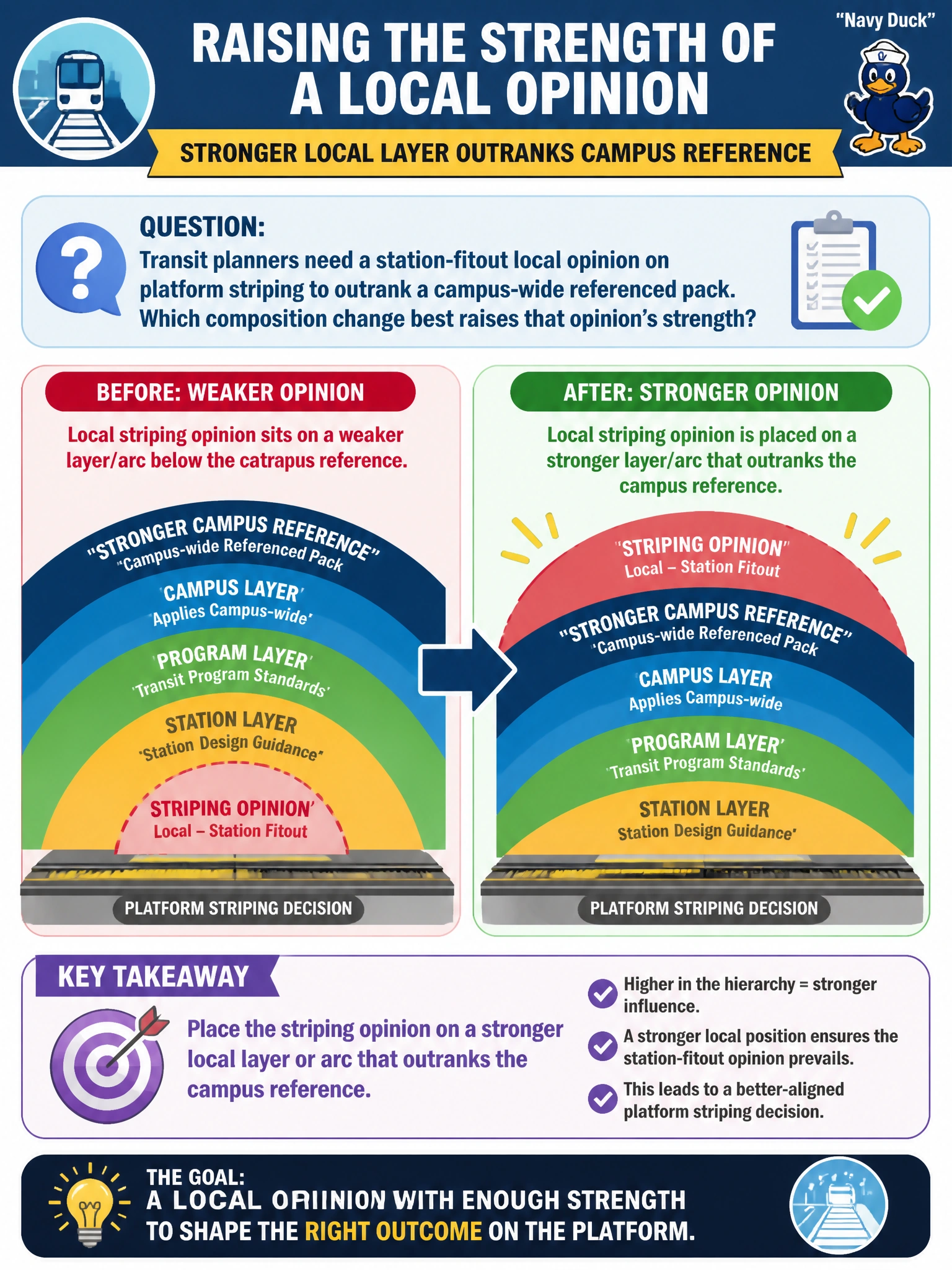
Transit planners need a station-fitout local opinion on platform striping to outrank a campus-wide referenced pack. Which composition change best raises that opinion’s strength?
Select an answer to reveal the explanation.
Short Explanation
Strength isn’t about sharper textures or fancy URLs—it’s about which composition seat you sit in. Put the station striping on a stronger local layer above the campus reference and LIVERPS does the rest. Lighting and CDNs don’t change opinion order.
Full Explanation
Opinion strength in OpenUSD follows composition arcs and layer ordering (LIVERPS), not renderer settings or path style. Transit planners who need a station-fitout local opinion on platform striping to outrank a campus-wide referenced pack should place that striping opinion on a stronger local layer or arc that outranks the campus reference. Elevating the opinion into a stronger composition seat correctly makes the station-specific civic striping win while leaving the shared campus pack reusable elsewhere.
Increasing the striping texture resolution so the renderer treats it as stronger fails by concept: texture resolution affects visual fidelity, not composition strength. Moving the campus reference path to an absolute URL on a CDN fails because asset locator style (relative vs absolute, local vs CDN) does not reorder LIVERPS; path resolution is orthogonal to opinion strength. Enabling UsdLux shadows on the platform so lighting opinions win fails because lighting schema and shadow settings do not promote striping opinions above a campus reference.
Exam caveat: distractors often blend rendering quality, networking, or lighting with composition—reject those. Operational check: author striping on the stronger local layer, compose the station stage, confirm the winning striping opinion’s layer/arc is the local fitout (not the campus pack), and spot-check another campus consumer that still receives the pack’s default striping when the local overlay is absent.