
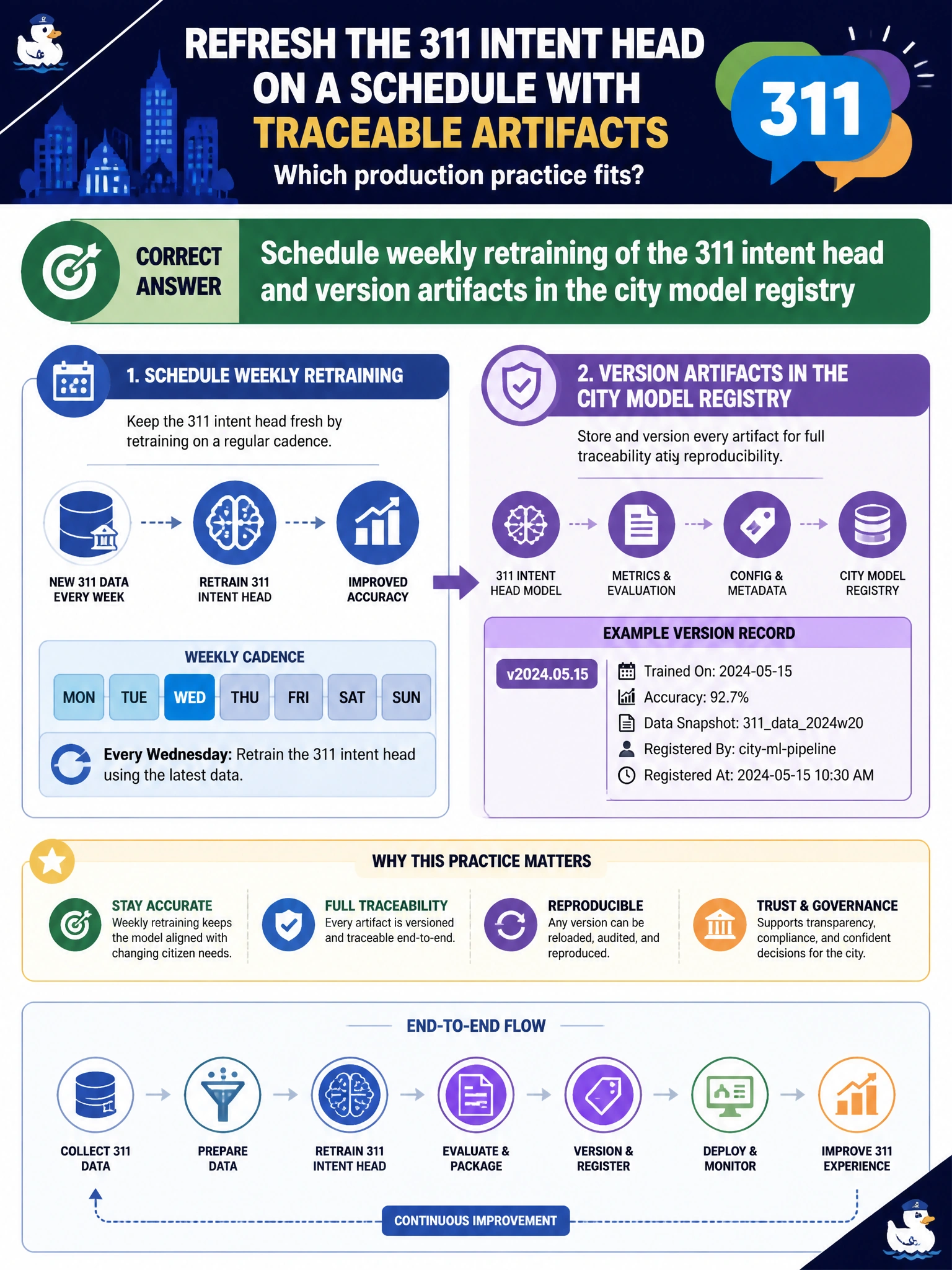
The city wants the 311 intent head refreshed on a schedule with traceable artifacts. Which production practice fits?
Select an answer to reveal the explanation.
Short Explanation
Treat the 311 intent head like a bus schedule: refresh it on a clock, and stamp every artifact in the model registry. No mystery overwrite files and no ‘we will retrain when Twitter complains.’
Full Explanation
The city wants the 311 intent head refreshed on a schedule with traceable artifacts, which fits scheduling weekly retraining of the 311 intent head and versioning those artifacts in the city model registry. Scheduled retraining keeps intent classification aligned with evolving civic phrasing (new program names, seasonal complaint types) while registry versioning preserves lineage for rollback, audit, and A/B comparison. That combination is production reliability for municipal NLP components: clock-driven refresh plus immutable artifacts, not mystery files. Retraining only when a resident tweets a complaint and never registering versions is reactive, inequitable (Twitter is not the whole city), and leaves no reproducible artifact trail. Overwriting the same unlabeled file each night with no registry entry destroys prior versions and makes “what intents did we serve Tuesday?” unanswerable. Disabling retraining permanently after the first go-live checkpoint freezes the intent head while 311 language drifts, guaranteeing silent accuracy decay. Exam caveat: scheduled jobs still need data quality checks, evaluation gates, and human approval for high-impact intent taxonomy changes; cadence alone does not equal safe promotion. Operational check: put the weekly retrain on the ops calendar, push each intent-head artifact with a registry version and metrics, require eval pass before serving swap, and retain prior registry versions for rapid 311 rollback.