
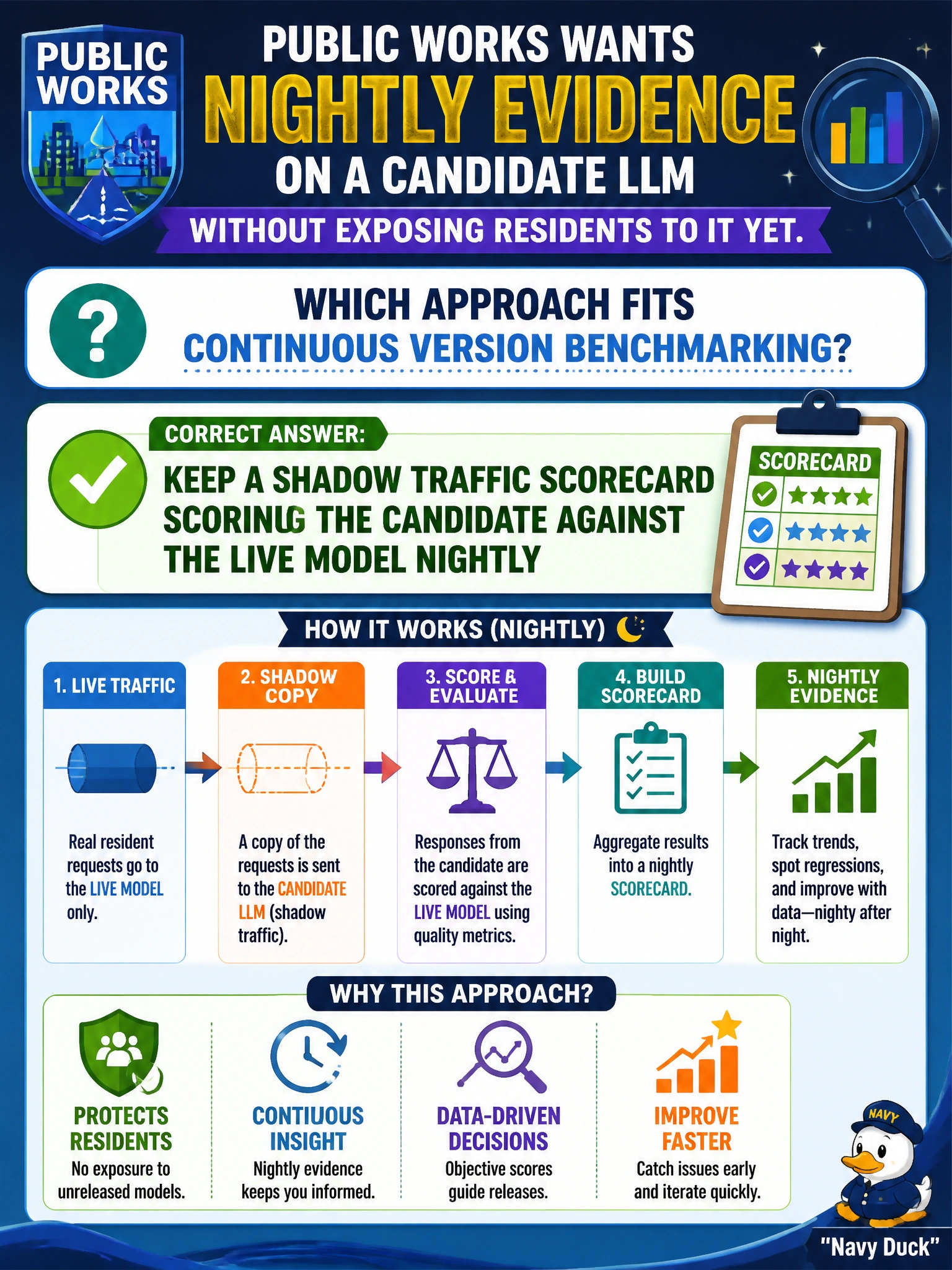
Public works wants nightly evidence on a candidate LLM without exposing residents to it yet. Which approach fits continuous version benchmarking?
Select an answer to reveal the explanation.
Short Explanation
Shadow traffic is like running a spare bus on the same route with no passengers—score the candidate against the live public-works model every night before anyone rides the new one.
Full Explanation
Public works wants nightly evidence on a candidate LLM without exposing residents to it yet, so continuous version benchmarking fits a shadow traffic scorecard that scores the candidate against the live model nightly. Shadowing mirrors production-like public-works prompts to the candidate while residents still receive answers from the live baseline; nightly scorecards compare quality, latency, and failure modes before any cutover. That gives continuous prior-version comparison without putting unproven weights on the resident path. Sending all resident traffic to the candidate with no live baseline is a full cutover, not a shadow eval, and exposes the city if the candidate fails. Publishing the candidate only on social media for unstructured feedback yields anecdotal, non-comparable noise and may leak unfinished civic answers. Disabling scoring until after a full irreversible cutover removes the evidence that should decide whether cutover is safe. Exam caveat: shadow traffic must respect privacy and retention rules for public-works tickets, and scorecards need the same frozen metrics as live monitoring so night-over-night comparisons are valid. Operational check: route mirrored requests to the candidate with zero resident visibility, write nightly candidate-versus-live scorecards to the ops store, gate promotion on scorecard thresholds, and keep the live public-works model as sole resident-facing path until gates pass.