
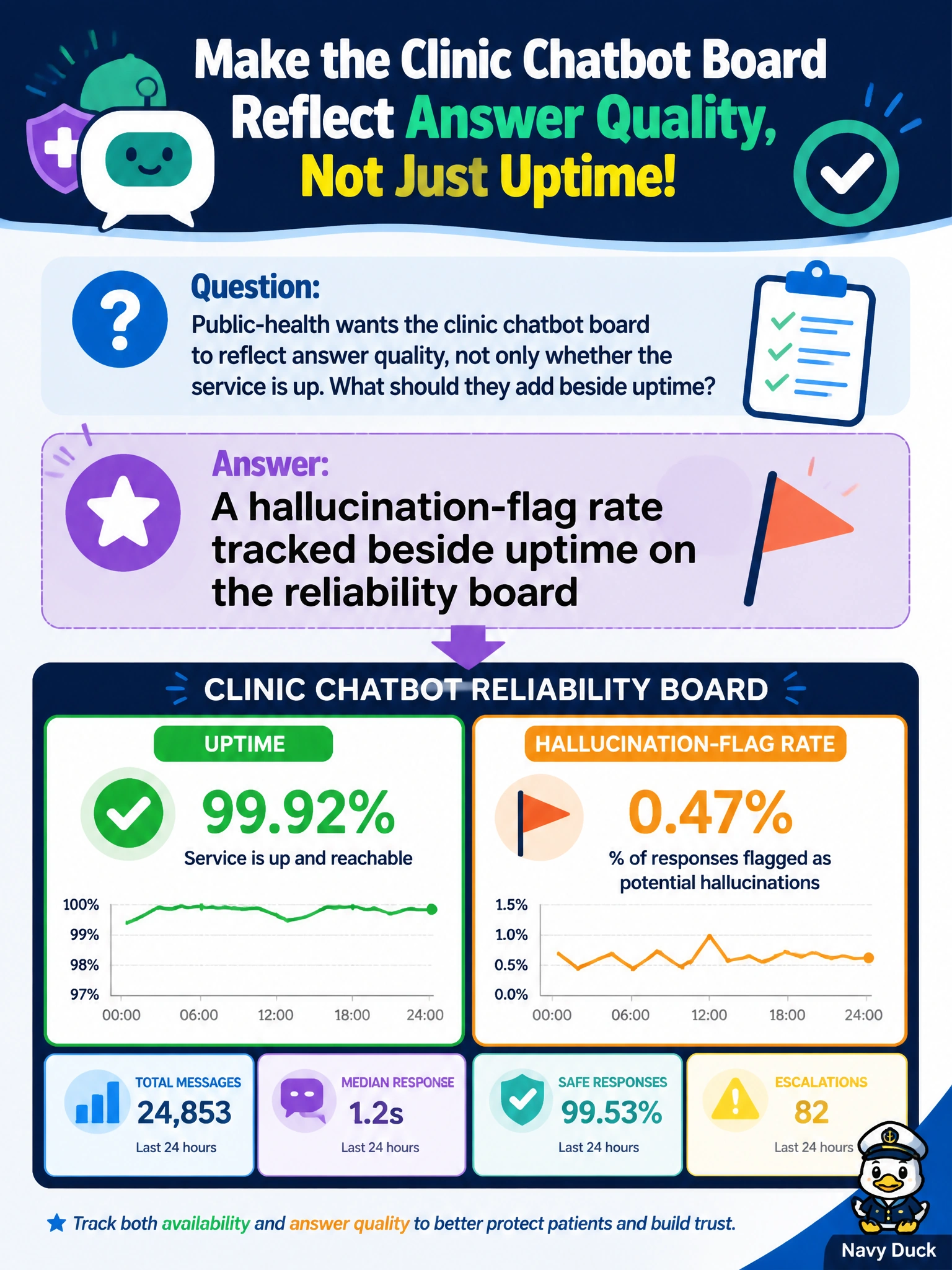
Public-health wants the clinic chatbot board to reflect answer quality, not only whether the service is up. What should they add beside uptime?
Select an answer to reveal the explanation.
Short Explanation
Uptime just says the lights are on. For a clinic chatbot you also need a hallucination-flag rate on the board so inventing medical-ish answers gets noticed as fast as a hard outage.
Full Explanation
Public-health wants the clinic chatbot reliability board to reflect answer quality, not only whether the service process is up. Tracking a hallucination-flag rate beside uptime captures the civic failure mode where the endpoint responds 200 OK while inventing medical-ish guidance that clinics cannot stand behind. Uptime alone says the lights are on; hallucination flags say whether answers remain grounded, refused when appropriate, or escalated. Putting both on the same board treats quality regressions as first-class reliability events for resident health communications. Only printer ink levels in the clinic lobby are facilities metrics with no bearing on LLM answer fidelity. Solely counting building badge swipes at the data center measures physical access, not chatbot truthfulness. Weekly cafeteria menu ratings as a proxy for model quality are unrelated noise that would greenwash a hallucinating clinic bot. Exam caveat: hallucination flags need a defined detector (human review sample, groundedness score against approved health content, or refusal/escalation policy checks); a vague “quality vibe” is not an operational metric. Operational check: define what counts as a hallucination flag for the clinic domain, stream the rate next to uptime on the reliability board, alert when flags spike even if uptime stays high, and sample flagged turns for clinician review before declaring the public-health chatbot healthy.