
Courts see memory-bound attention GEMM timelines on DGX. Which kernel choice is appropriate?
Select an answer to reveal the explanation.
Short Explanation
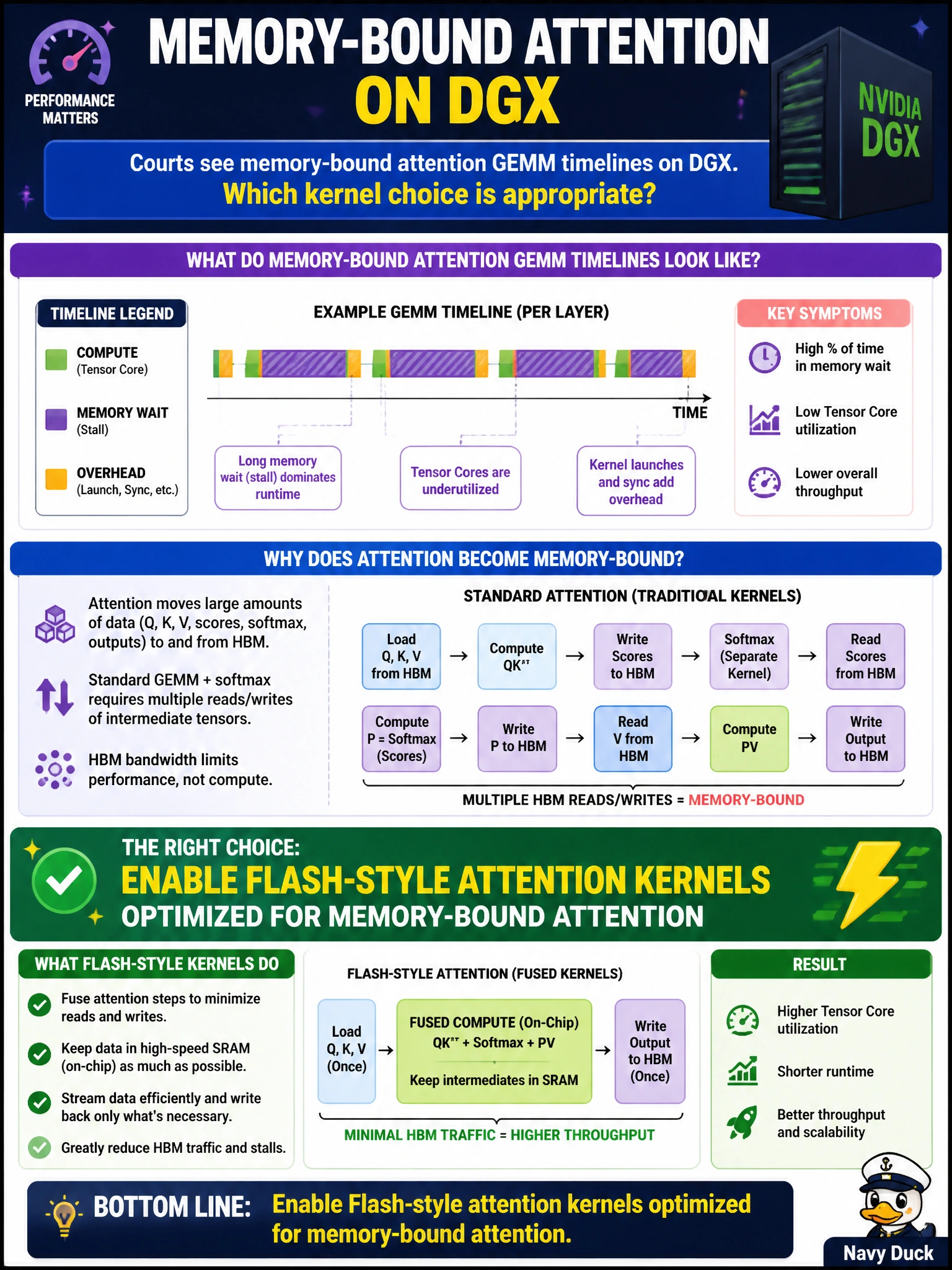
Nsight says attention is memory-bound on the courts DGX—switch on Flash-style kernels that stream Softmax/MatMul more efficiently. Naive kernels and host Python will not fix that timeline.
Full Explanation
When courts see memory-bound attention GEMM timelines on DGX, enabling Flash-style attention kernels optimized for memory-bound attention is appropriate: they restructure Softmax and MatMul to reduce high-bandwidth memory traffic and improve efficiency on long or wide attention common in judicial NLP workloads. A memory-bound profile means the GPU is stalling on memory movement more than on pure arithmetic, which is exactly what IO-aware attention kernels target. Keeping naive attention kernels despite the memory-bound profile leaves HBM traffic and step time untouched. Moving all attention math to single-threaded host code abandons GPU bandwidth and collapses court-workload throughput to unacceptable levels. Increasing head count without changing attention kernel efficiency adds work and can worsen memory pressure without fixing the kernel’s memory-bound behavior. Exam caveat: a memory-bound attention profile points to FlashAttention-style IO-efficient implementations, not to host fallbacks or naive head scaling as a performance fix. Operational check: enable Flash-style kernels in the courts training or serving stack, re-collect Nsight or equivalent timelines to verify attention is less memory-stall dominated, confirm judicial NLP quality metrics hold on the regression suite, and standardize the kernel setting in the DGX image so every court job inherits the optimization.