
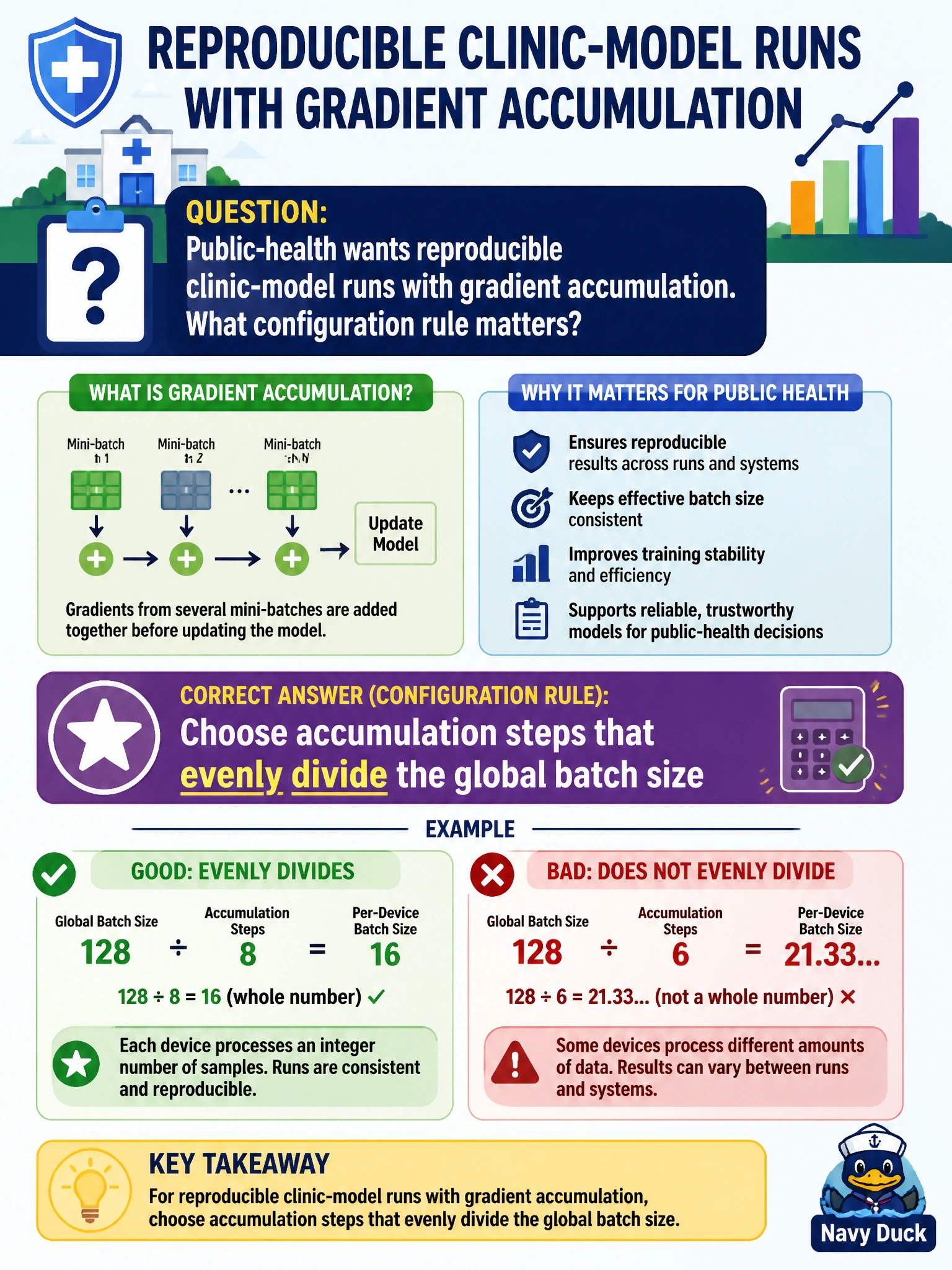
Public-health wants reproducible clinic-model runs with gradient accumulation. What configuration rule matters?
Select an answer to reveal the explanation.
Short Explanation
For clinic-model reproducibility, accumulation steps have to divide the global batch cleanly—no leftovers. Randomizing accumulation each step is how you get unreproducible chaos.
Full Explanation
Public-health clinic-model runs that must be reproducible with gradient accumulation require accumulation steps that evenly divide the global batch size so every optimizer step sees a consistent number of samples and no orphan remainder microbatches scramble effective batch arithmetic. Clean divisibility keeps the training distribution stable across reruns required for clinic validation. Picking accumulation steps that leave a remainder versus the global batch creates uneven final steps or silent truncation of samples, which harms reproducibility and can bias gradients in hard-to-spot ways. Randomizing accumulation each step to increase stochasticity deliberately breaks run-to-run consistency and is inappropriate when public-health stakeholders need repeatable clinic-model training. Ignoring batch math because reproducibility never depends on it is false: global batch, microbatch, accumulation, and data-parallel world size jointly define how many examples update the weights each step. Exam caveat: effective batch equals microbatch × accumulation × data-parallel degree as configured—all factors must divide cleanly for deterministic civic runs. Operational check: choose global batch and accumulation so division has no remainder, freeze seeds and dataloader ordering policies, rerun the clinic job twice under the same config, and confirm matching loss trajectories within the framework’s expected nondeterminism bounds before sign-off.