
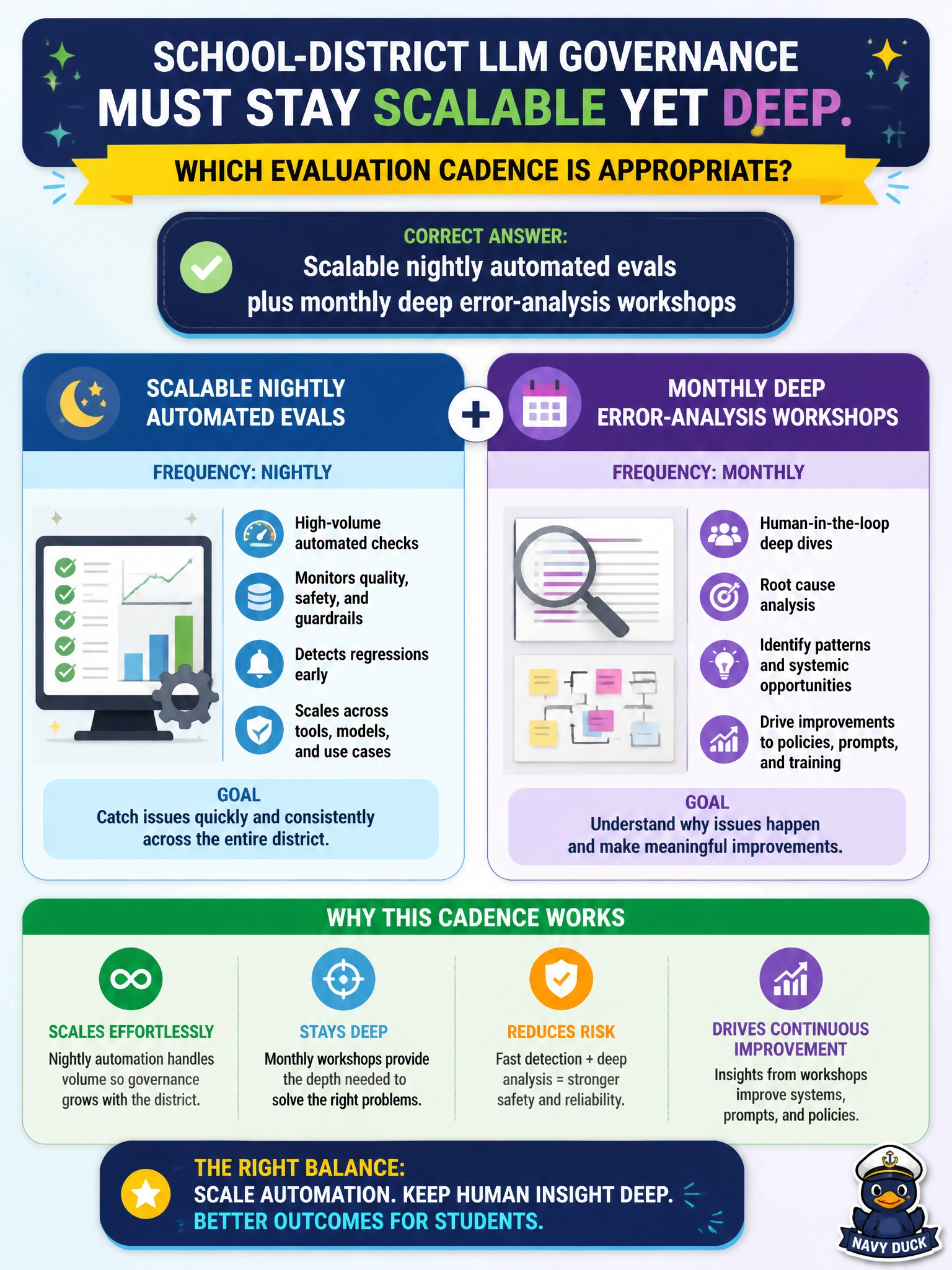
School-district LLM governance must stay scalable yet deep. Which evaluation cadence is appropriate?
Select an answer to reveal the explanation.
Short Explanation
Nightly bots keep score; monthly workshops dig into why the school assistant stumbled. You need both the cheap continuous check and the deep error autopsy—not just one.
Full Explanation
School-district LLM governance that must stay both scalable and deep pairs nightly automated evaluation with monthly deep error-analysis workshops. Nightly suites provide continuous, low-cost regression detection across curriculum assistants and policy bots; monthly workshops dig into failure clusters, update rubrics, and drive remediation that automation alone cannot invent. Annual-only deep workshops without nightly automated runs leave long blind windows where a broken school assistant can serve students for months before anyone notices. Nightly evals only, with no periodic deep error workshops, produce dashboards without diagnosis—scores move, but staff never systematically learn why. Random teacher polls with no automated metrics at all are neither scalable nor rigorous: they lack repeatable metrics, coverage guarantees, and trend lines required for district governance. Exam caveat: scalable civic evaluation is a cadence design problem—combine continuous automation with scheduled human depth rather than choosing one extreme. Operational check: schedule nightly metric jobs with alerting on threshold breaches, book monthly error workshops with fixed agendas and taxonomy owners, and require both signals in the district LLM governance packet before major model changes.