
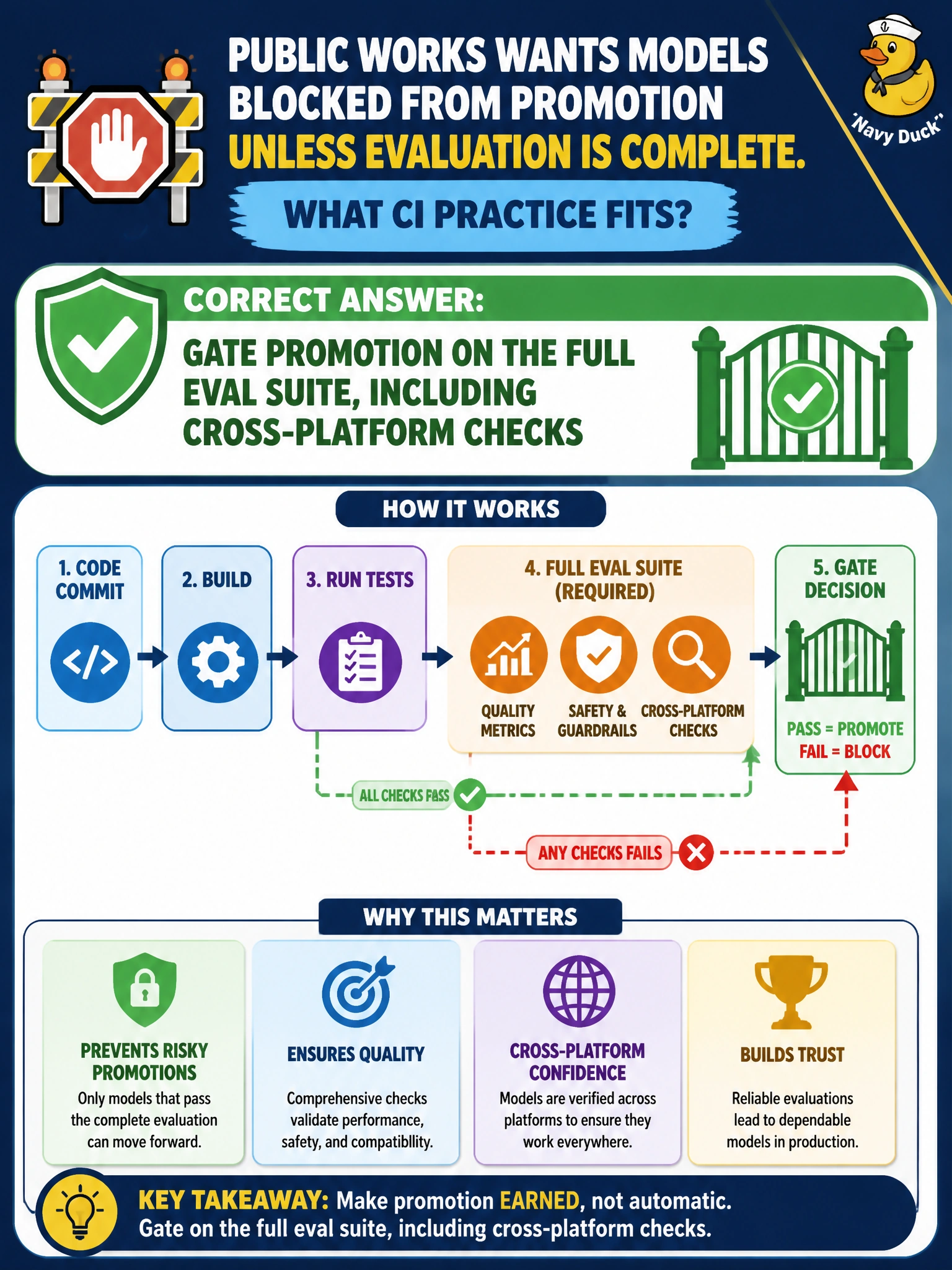
Public works wants models blocked from promotion unless evaluation is complete. What CI practice fits?
Select an answer to reveal the explanation.
Short Explanation
No green light until the whole public-works eval suite—including cross-platform checks—passes. Peeking at one BLEU number or promoting on Friday hope is not a gate.
Full Explanation
Public-works release discipline treats comprehensive evaluation as a hard CI promotion gate: the build must not advance until the full eval suite—including cross-platform checks—passes. That practice keeps incomplete or host-skewed models out of production channels that affect streets, permits, and resident services. Allowing promotion when a single offline BLEU peek looks fine substitutes one proxy for the suite and can miss toxicity, factual, or cross-host regressions the rest of the suite would catch. Skipping eval gates for Friday afternoon hotfixes institutionalizes risk at the worst time for on-call coverage and often becomes the permanent exception path. Promoting first and running the suite only if residents complain inverts the control: harm discovery shifts from pre-release measurement to public incident response. Exam caveat: gates exist to fail closed; partial peeks and post-complaint evaluation are not substitutes for a completed suite. Operational check: wire the municipal eval suite into CI so the promotion job waits on all required checks (quality, safety, cross-platform), deny override without documented risk acceptance, and retain green/red artifacts with the release record for auditors.