
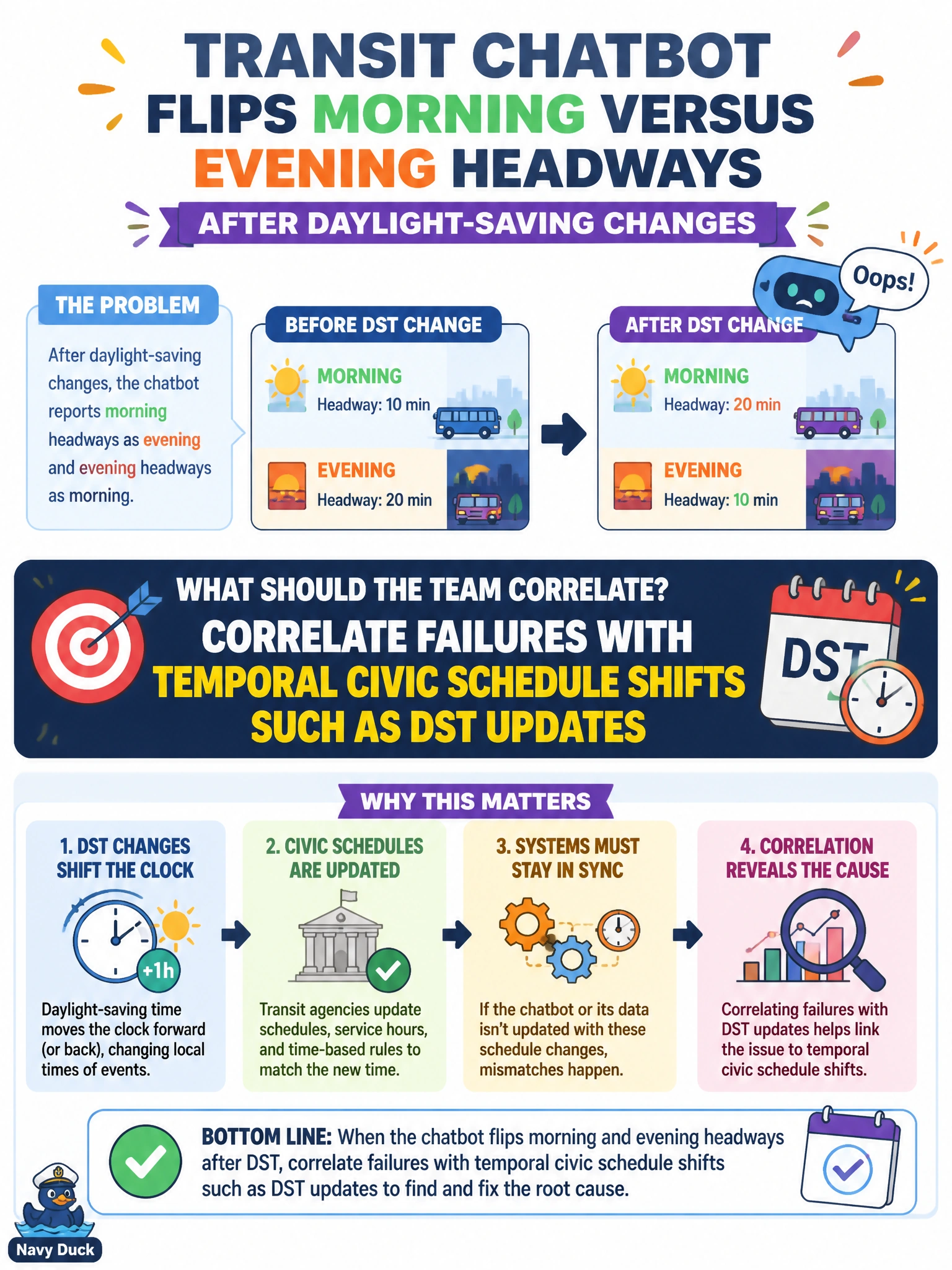
A transit chatbot flips morning versus evening headways after daylight-saving changes. What should the team correlate?
Select an answer to reveal the explanation.
Short Explanation
Clocks spring forward, headways get swapped, and the bot starts quoting the wrong rush hour. Tie those misses to the DST schedule shift—time changed, knowledge didn’t.
Full Explanation
When a transit chatbot flips morning versus evening headways after daylight-saving changes, the team should correlate failures with temporal civic schedule shifts such as DST updates. Error analysis links the behavioral bug to a data/time boundary: clocks changed, published headways swapped relative to local time, and the model’s stale temporal knowledge or cached schedule slice did not. That correlation drives schedule-refresh jobs and time-zone-aware eval packs instead of irrelevant UI tweaks.
Correlating failures exclusively with logo color choices on the agency site fails by concept: branding pixels do not invert headway tables. Correlating successes only with unrelated library catalog outages fails as spurious association that explains nothing about transit times. Claiming schedule timezones cannot affect LLM outputs fails because civic answers grounded in clock-facing schedules absolutely break across DST and timezone shifts.
Exam caveat: distinguish DST bugs from mere weekend/holiday service patterns—both are temporal, but fixes differ (clock offset versus service calendar). Operational check: tag headway errors against DST transition windows, replay the same origin–destination prompts with pre/post DST schedule truth, and verify the bot tracks the updated timetable after a schedule sync.