
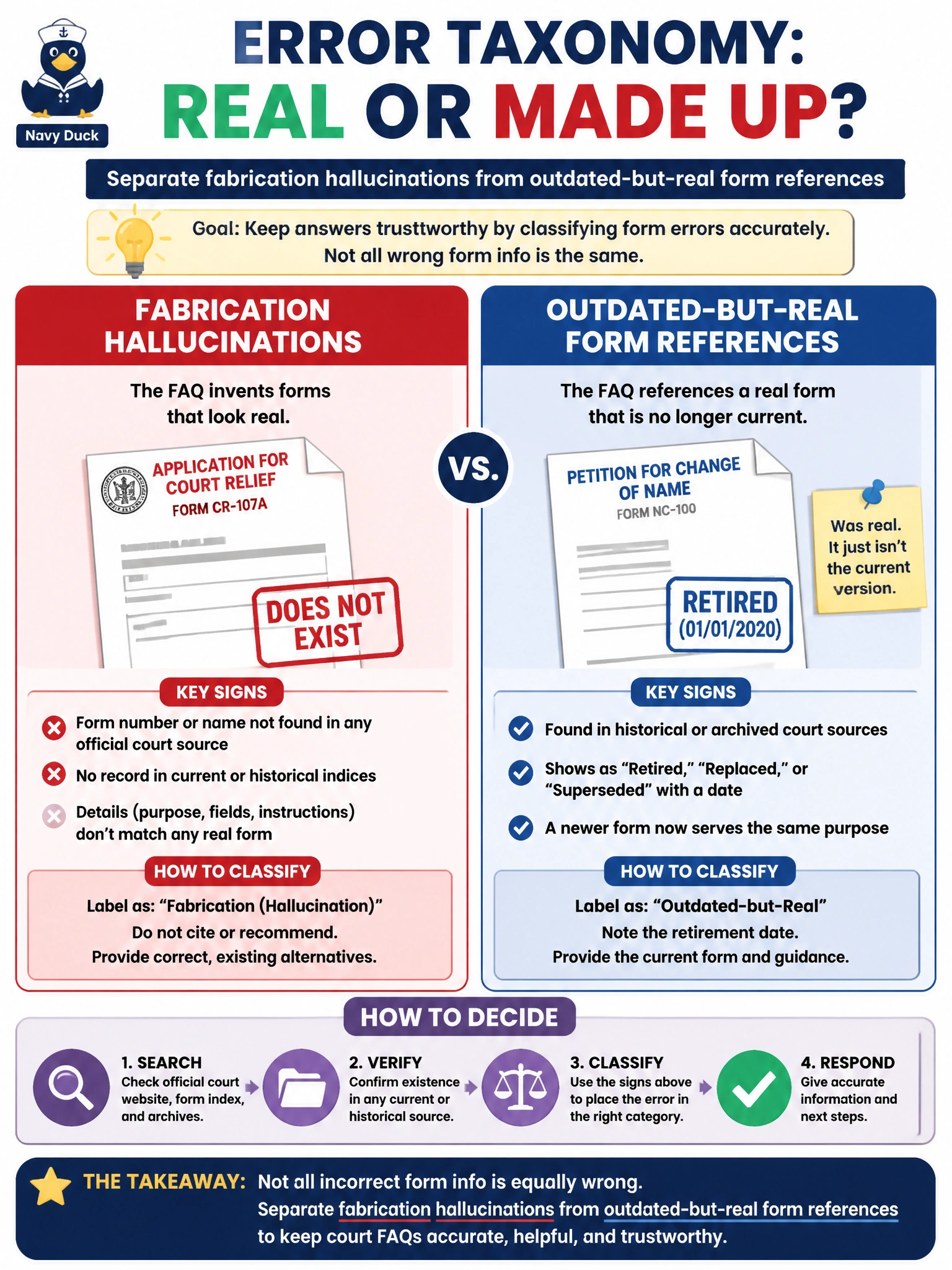
A court FAQ invents forms that look real. How should error taxonomy handle that versus outdated-but-real forms?
Select an answer to reveal the explanation.
Short Explanation
Inventing a form that never existed isn’t the same as pointing at last year’s real form. Split those buckets in the error taxonomy so the court FAQ team knows which fix to grab.
Full Explanation
A court FAQ that invents forms that look real should be handled in the error taxonomy by separating fabrication hallucinations from outdated-but-real form references. Inventing a form that never existed is a different municipal failure—and needs different fixes (grounding, refusal, registry checks)—than citing last year’s real form that has since been superseded (catalog freshness, redirect maps). Splitting those buckets tells the court team which remediation to grab for each error class.
Merging fabrication and outdated forms into one unlabeled bucket fails by concept: it obscures distinct root causes and metrics. Counting only latency when forms are wrong fails because speed metrics do not classify content errors. Rewarding invented forms if residents click them fails as safety and legal process: click-through on a fake form is harm, not success.
Exam caveat: “outdated-but-real” still harms filers—track it as a severity class, just not the same class as pure fabrication. Operational check: dual-label FAQ errors as fabricated versus stale-real form IDs against the forms registry; trend each rate separately; apply grounding/refusal work to fabrications and catalog-sync work to stale references.