
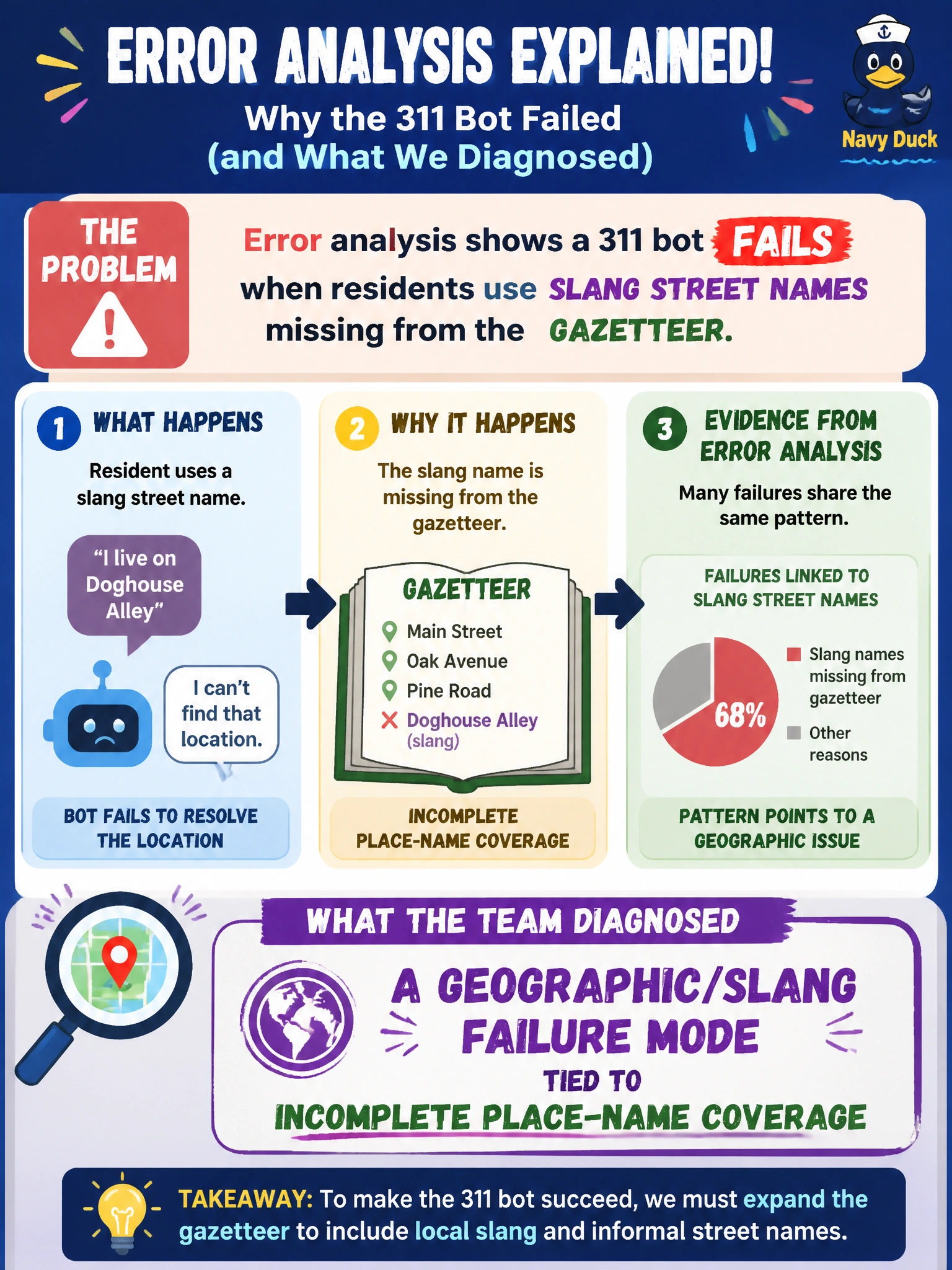
Error analysis shows a 311 bot fails when residents use slang street names missing from the gazetteer. What did the team diagnose?
Select an answer to reveal the explanation.
Short Explanation
Residents say ‘the old mill road’ and the gazetteer only knows the official name—boom, 311 misses. That’s a geographic/slang failure mode, and error analysis is how you spot the pattern.
Full Explanation
Error analysis that shows a 311 bot failing when residents use slang street names missing from the gazetteer diagnoses a geographic/slang failure mode tied to incomplete place-name coverage. The behavioral pattern is systematic: informal or historical street aliases do not resolve to the official gazetteer entries the bot relies on, so routing and lookup fail even when the resident’s intent is clear. Naming that failure mode points to gazetteer expansion, alias tables, or fuzzy geo-linking—not random model tweaks.
Calling it a tokenizer vocabulary that is necessarily infinite for all slang fails by concept: the issue is missing place-name coverage/linking, not a philosophical need for infinite vocab. Treating it as proof that BLEU cannot be computed on municipal chat logs fails because BLEU computability is unrelated to diagnosing slang-geo misses. Blaming GPU mixed precision for street-name errors fails as misattribution: precision mode does not selectively erase informal toponyms from a gazetteer-backed pipeline.
Exam caveat: confirm the failures cluster on alias gaps with log tagging before rebuilding models—some “slang” misses are ASR/transcription issues upstream. Operational check: sample 311 failures, tag slang/alias versus official-name successes, measure failure rate on a held-out alias list, then add aliases to the gazetteer and re-test the same utterances.