
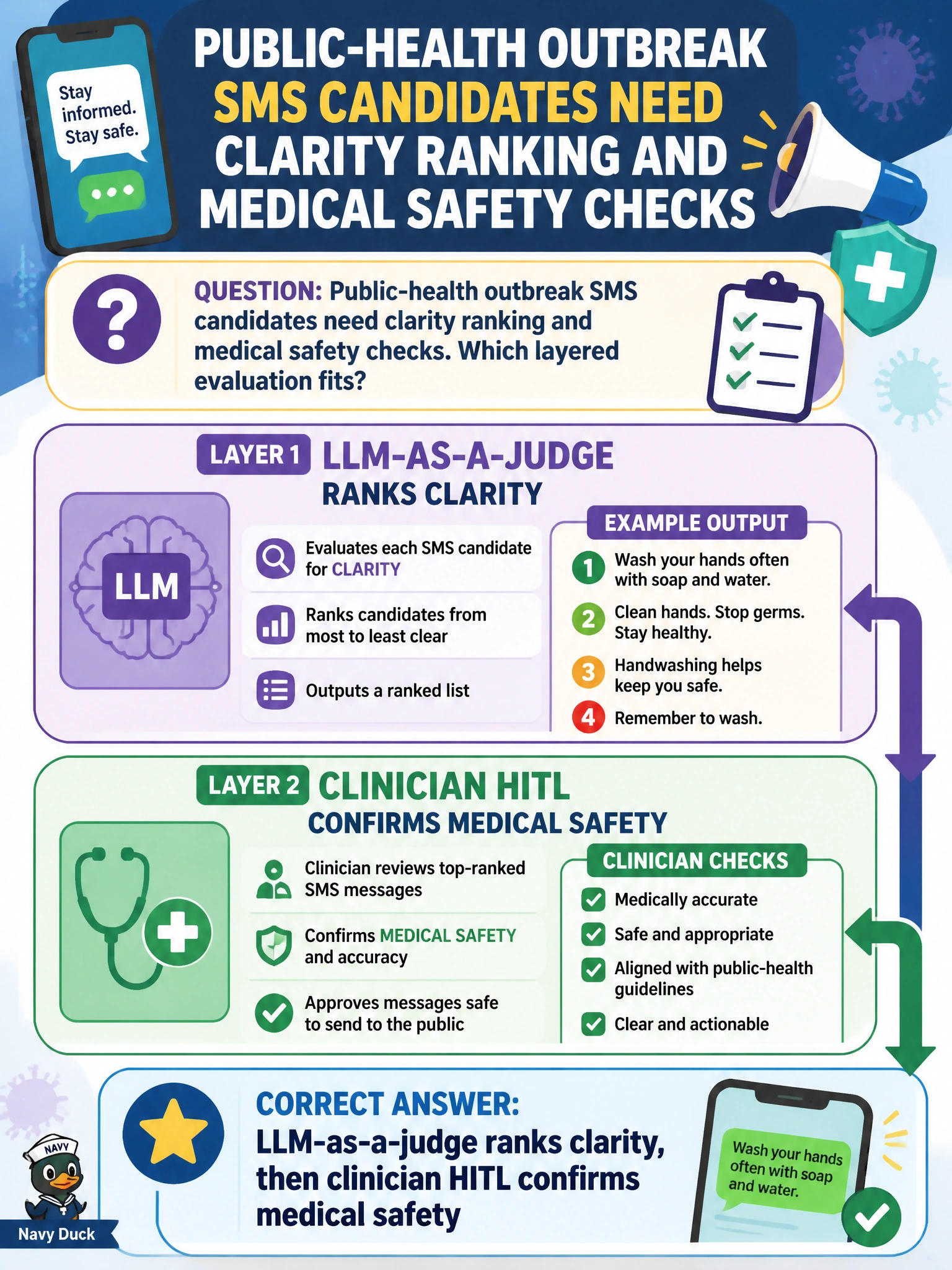
Public-health outbreak SMS candidates need clarity ranking and medical safety checks. Which layered evaluation fits?
Select an answer to reveal the explanation.
Short Explanation
First let a judge model sort which outbreak texts read clearly, then put clinicians on the final whistle for medical safety. Clarity without clinical HITL is how bad advice slips into an SMS.
Full Explanation
Public-health outbreak SMS candidates that need clarity ranking and medical safety checks fit a layered evaluation: an LLM-as-a-judge ranks clarity first, then clinician human-in-the-loop confirms medical safety. Clarity ranking cheaply sorts readable civic messages; clinicians gate clinical correctness, contraindication risk, and appropriate urgency. Separating the layers prevents a fluent but unsafe SMS from winning on prose alone before any mass send.
Skipping clinicians because clarity scores imply medical correctness fails by concept: readability is not medical validity. Using only character-count limits without content review fails because length caps do not catch dangerous advice. Relying on residents to report unsafe SMS after mass send fails as ethics and ops—harm discovery after broadcast is not an evaluation strategy for outbreak messaging.
Exam caveat: lock the judge prompt and clinician checklist so clarity and safety criteria do not drift between campaign waves. Operational check: score candidate SMS with the clarity judge, send top-k to clinicians with a safety rubric, and approve for send only items that pass both layers; quarantine any clarity winner that clinicians reject.