
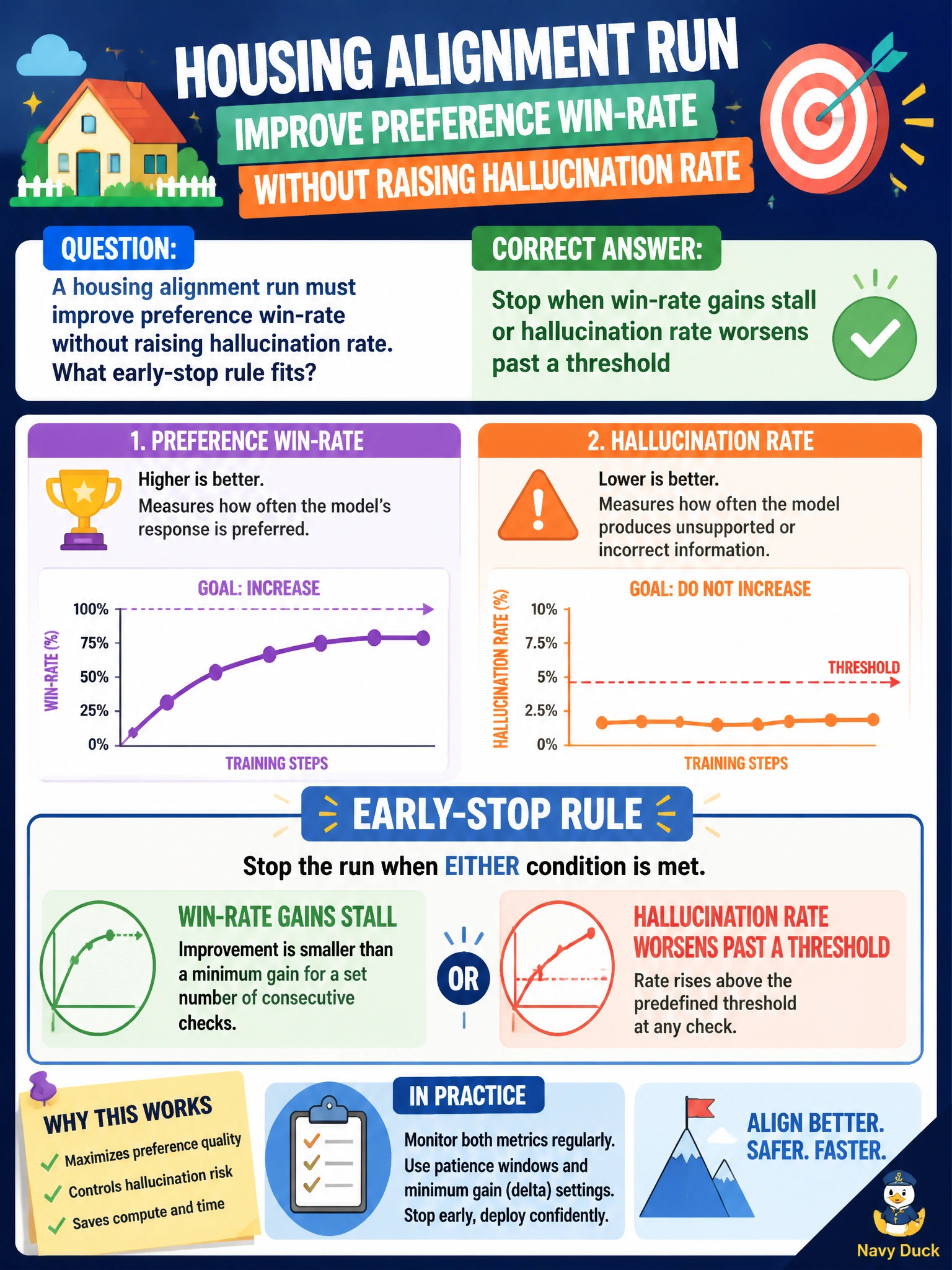
A housing alignment run must improve preference win-rate without raising hallucination rate. What early-stop rule fits?
Select an answer to reveal the explanation.
Short Explanation
Housing answers need to win resident preference contests and still tell the truth. Multi-metric early stop means you quit when win-rate stalls or hallucinations creep up—whichever spoils the deal first.
Full Explanation
A housing alignment run that must improve preference win-rate without raising hallucination rate needs a multi-metric early-stop rule: stop when win-rate gains stall or when hallucination rate worsens past a threshold—whichever trips first. Preference optimization for resident-facing housing answers is not success if the model invents waitlist rules, unit counts, or eligibility facts. Coupling the two metrics encodes the municipal trade-off explicitly in the training loop.
Stopping only when train loss is still decreasing rapidly fails by concept: train loss ignores both preference win-rate and hallucination, so it can keep falling while civic quality stalls or worsens. Stopping solely on peak GPU utilization regardless of quality fails because utilization is a capacity signal, not a preference or safety metric. Never stopping if either metric moves in any direction fails as control design: unbounded runs invite preference hacking, drift, and unsafe factual invention.
Exam caveat: set absolute floors (for example, hallucination must not exceed baseline + δ) so a tiny win-rate bump cannot excuse a large safety regression. Operational check: each eval, record preference win-rate on the housing pairwise set and hallucination rate on a factual housing probe; stop on stall or safety breach; promote only checkpoints that beat baseline win-rate without crossing the hallucination ceiling.