
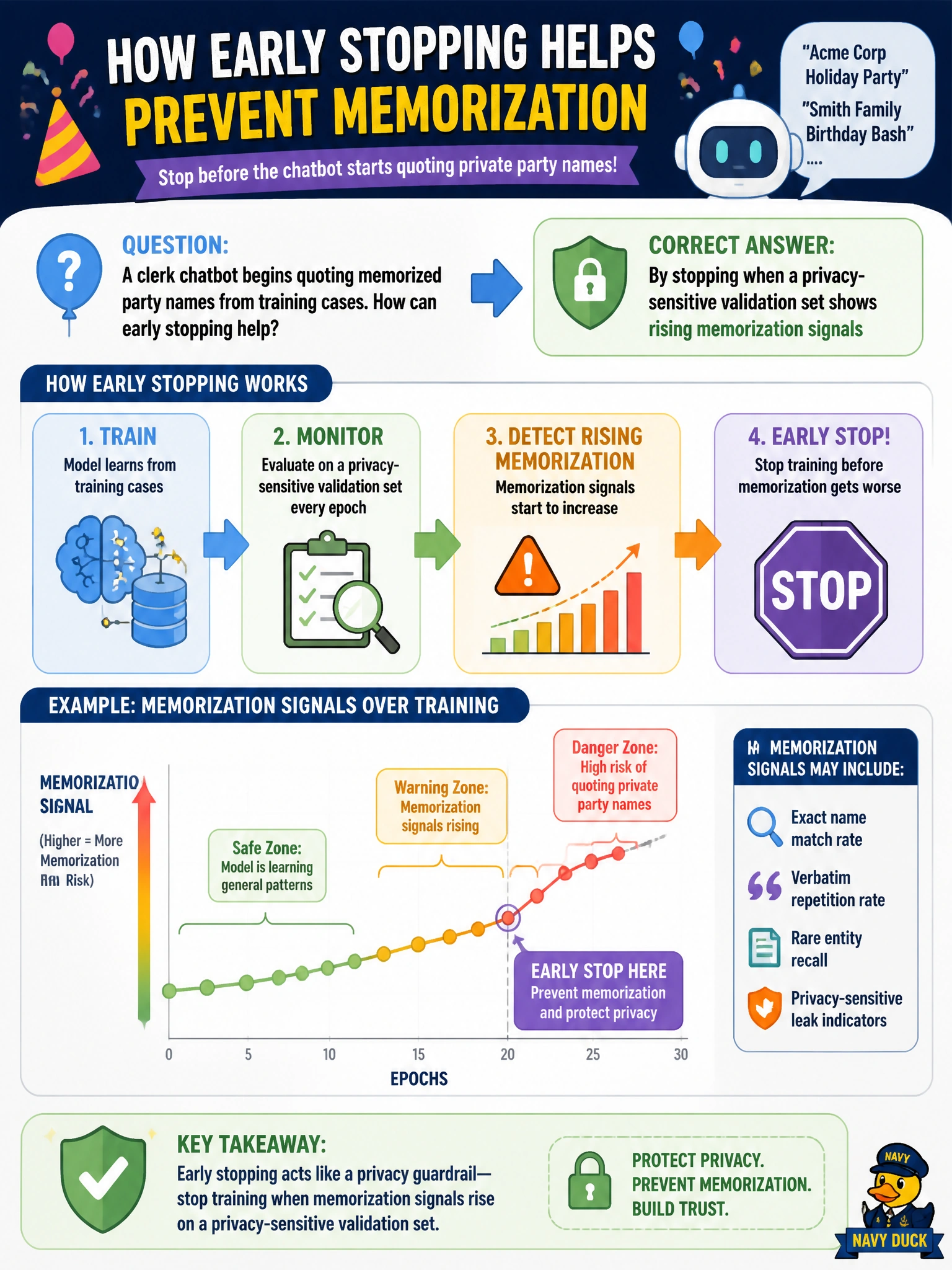
A clerk chatbot begins quoting memorized party names from training cases. How can early stopping help?
Select an answer to reveal the explanation.
Short Explanation
If the bot starts reciting real party names like it memorized the docket, that’s a red flag. Watch a privacy-sensitive validation set and stop training when memorization signals climb—before those names walk out the door.
Full Explanation
When a clerk chatbot begins quoting memorized party names from training cases, early stopping helps only if the stop rule watches a privacy-sensitive validation set for rising memorization signals. Halt training when membership-style probes, canary names, or verbatim-name leak rates climb, even if task accuracy still looks fine. That civic stop prevents shipping a docket-quoting bot that regurgitates litigant identities learned from fine-tune cases.
Rewarding memorization through higher train accuracy targets fails by concept: train accuracy often rises precisely because the model memorizes names and case snippets. Removing all names from production prompts after go-live only fails because prompt scrubbing after deploy does not unlearn weights that already stored party strings; leakage can still appear in free-form answers. Disabling validation so privacy leaks stay invisible fails as governance: you cannot stop what you refuse to measure, and municipal privacy reviews require visible memorization metrics.
Exam caveat: early stopping reduces further memorization growth but does not erase names already burned into earlier checkpoints—promote a pre-spike checkpoint or retrain with stronger privacy mitigations. Operational check: maintain a privacy holdout with synthetic or authorized canary party names, score memorization each eval, stop when the signal rises past threshold, and verify the selected checkpoint no longer emits those names on probe prompts before clerk-facing rollout.