
A floodplain office has only a tiny labeled Q&A set and scarce GPU hours. Which parameter-efficient approach fits best?
Select an answer to reveal the explanation.
Short Explanation
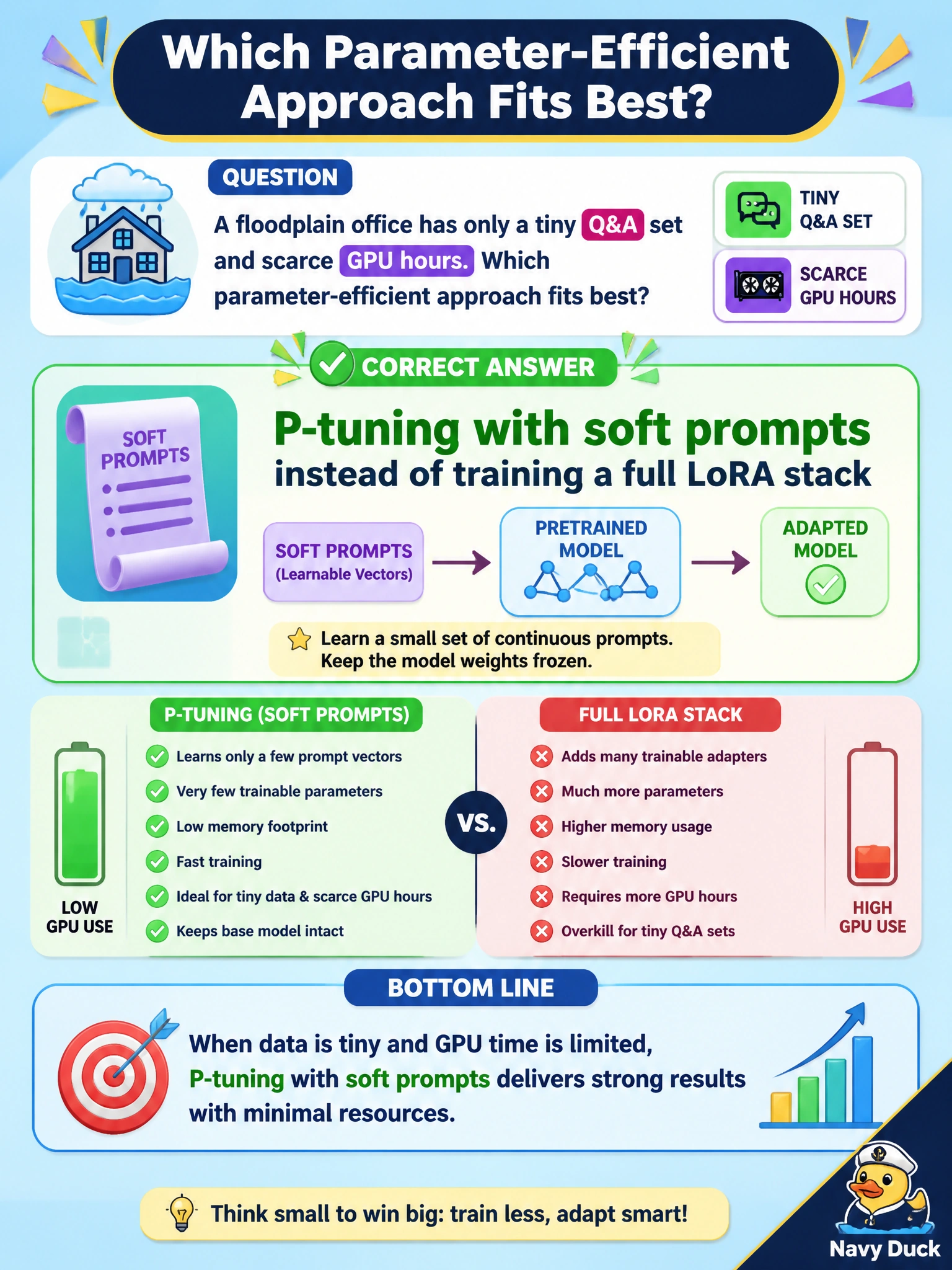
When labels are scarce and GPU time is tight, you don’t need to retrain the whole city model. Soft prompts via P-tuning are a lighter touch than even LoRA—like sticking a sticky note on the binder instead of rewriting the whole policy manual.
Full Explanation
A floodplain office with a tiny labeled Q&A set and scarce GPU hours should prefer the lightest adaptation that still uses the labels. P-tuning (and related soft-prompt methods) learns continuous prompt embeddings while leaving nearly all decoder weights frozen. That concentrates scarce civic compute on a small trainable surface, reduces overfitting risk on a handful of floodplain Q&A examples, and avoids standing up a full LoRA stack when even LoRA would update more parameters than the office can afford to train or validate. Soft prompts act as a municipal sticky note on an otherwise shared foundation—enough to steer floodplain answers without rewriting the whole binder.
Full fine-tuning of every decoder weight on the small set fails by concept: dense updates overfit tiny civic corpora and burn GPU hours the office does not have. Discarding the labels and relying only on random temperature sampling fails because sampling changes decoding randomness, not task adaptation; unlabeled temperature knobs do not teach floodplain Q&A. Retraining a new foundation model from scratch on flood maps alone fails by scale and data: foundation pretraining is orders of magnitude beyond a local office’s budget and map rasters alone do not produce a general language decoder for Q&A.
Exam caveat: P-tuning still needs a held-out floodplain validation slice and a clear promotion bar; soft prompts can overfit just as badly if you train too long on twenty examples. Operational check: train soft prompts on the labeled set with frozen backbone weights, compare exact-match or clerk ratings versus the untuned baseline on a fixed floodplain holdout, and confirm GPU hours and trainable-parameter counts stay far below a LoRA or full-FT run before promoting the prompt pack.