
Library branches need children’s desk help and research-desk help without reloading full model weights. What approach fits?
Select an answer to reveal the explanation.
Short Explanation
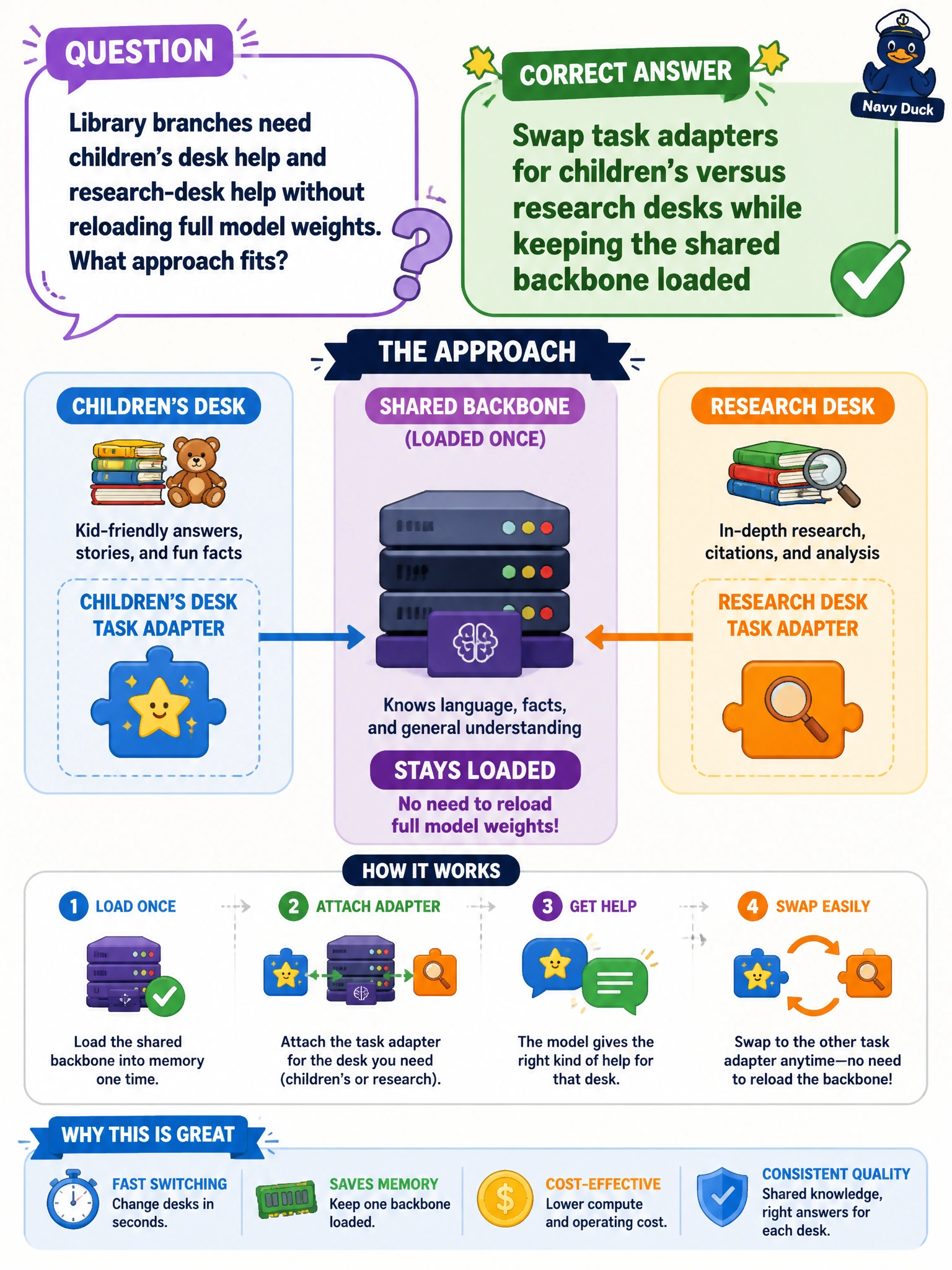
Children’s desk and research desk aren’t the same voice, but they can share one backbone. Swap task adapters like changing hats—no need to reload a whole new model for each desk.
Full Explanation
Library branches that need children’s desk help and research-desk help want different tones and retrieval habits without paying full model reload cost between desks. Swapping task adapters for children’s versus research desks while keeping the shared backbone loaded matches that requirement: adapter weights are small, desk identity becomes an adapter swap, and the municipal backbone stays resident. Reloading a complete unique model checkpoint from disk for every desk change wastes I/O and VRAM and slows branch staff. Training one fused adapter that always mixes children’s and research answers together blurs audiences and can produce age-inappropriate or overly simplistic research replies. Disabling adapters and hand-routing every query to a single generic completion template loses task specialization entirely. On the exam, task-adapter swapping on a shared backbone is the multi-desk PEFT pattern; distractors reload full checkpoints, fuse incompatible tasks, or drop to one generic template. Caveat: routing must select the correct adapter—mis-routed children’s queries to a research adapter (or the reverse) create policy and UX failures, so pair adapter swaps with explicit desk/mode selection. Operational check: load one backbone, hot-swap children’s and research adapters on a branch test host, verify latency stays within desk SLOs, and score age-appropriate versus research-quality rubrics per mode before rollout.