
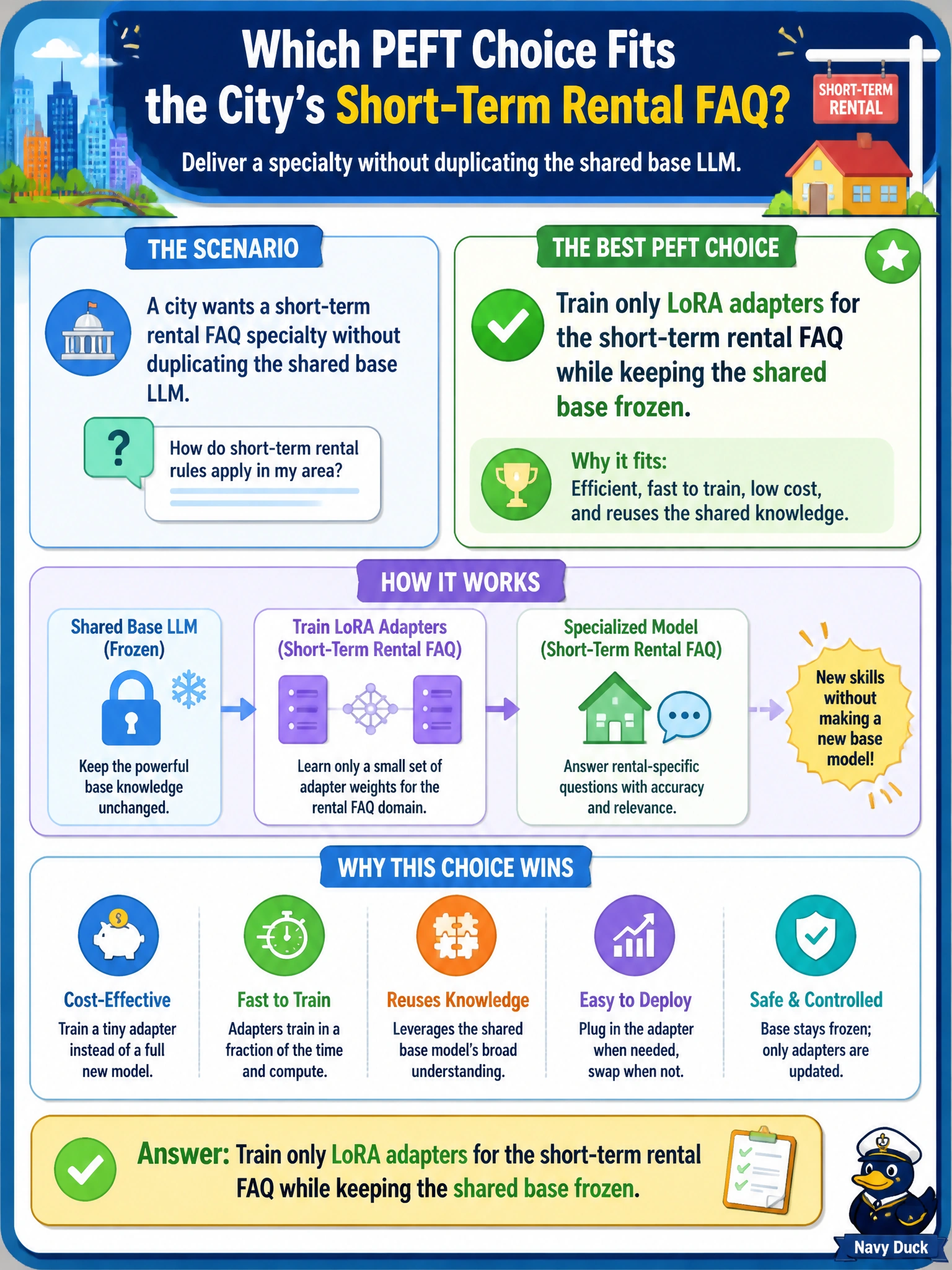
A city wants a short-term rental FAQ specialty without duplicating the shared base LLM. Which PEFT choice fits?
Select an answer to reveal the explanation.
Short Explanation
The city already has a shared LLM—don’t clone the whole thing just for short-term rental FAQs. Slip on a LoRA adapter, keep the base frozen, and you’ve got a specialty without a second full model.
Full Explanation
A city that wants a short-term rental FAQ specialty without duplicating the shared base LLM needs parameter-efficient fine-tuning: train only LoRA adapters for that FAQ domain while keeping the shared base frozen. Residents get specialized answers; operations keep one backbone in memory and swap or load small adapter weights per specialty. Full fine-tuning a separate copy of every base weight for the FAQ alone duplicates the model and defeats the sharing goal. Replacing the shared city LLM with a new randomly initialized network per FAQ topic abandons transfer and multiplies training cost. Distilling the base model into static FAQ HTML and retiring neural inference may help brochure content but removes interactive FAQ capability the specialty likely needs. On the exam, LoRA (PEFT) adapters are the civic specialty add-on that preserves a shared frozen base; distractors full-copy fine-tune, randomize per topic, or retire to static HTML. Caveat: LoRA rank and which modules are adapted affect quality—too-small adapters underfit rental policy nuance; validate on real STR questions and watch for base-policy regressions when adapters compose. Operational check: freeze the shared city LLM, train a LoRA adapter on short-term rental FAQ demos, serve base+adapter, and compare specialty accuracy and VRAM footprint against a full duplicate fine-tune the city is trying to avoid.