
Library catalog blurbs lost quality after sparsity was applied. What ablation helps test whether decoding can recover quality?
Select an answer to reveal the explanation.
Short Explanation
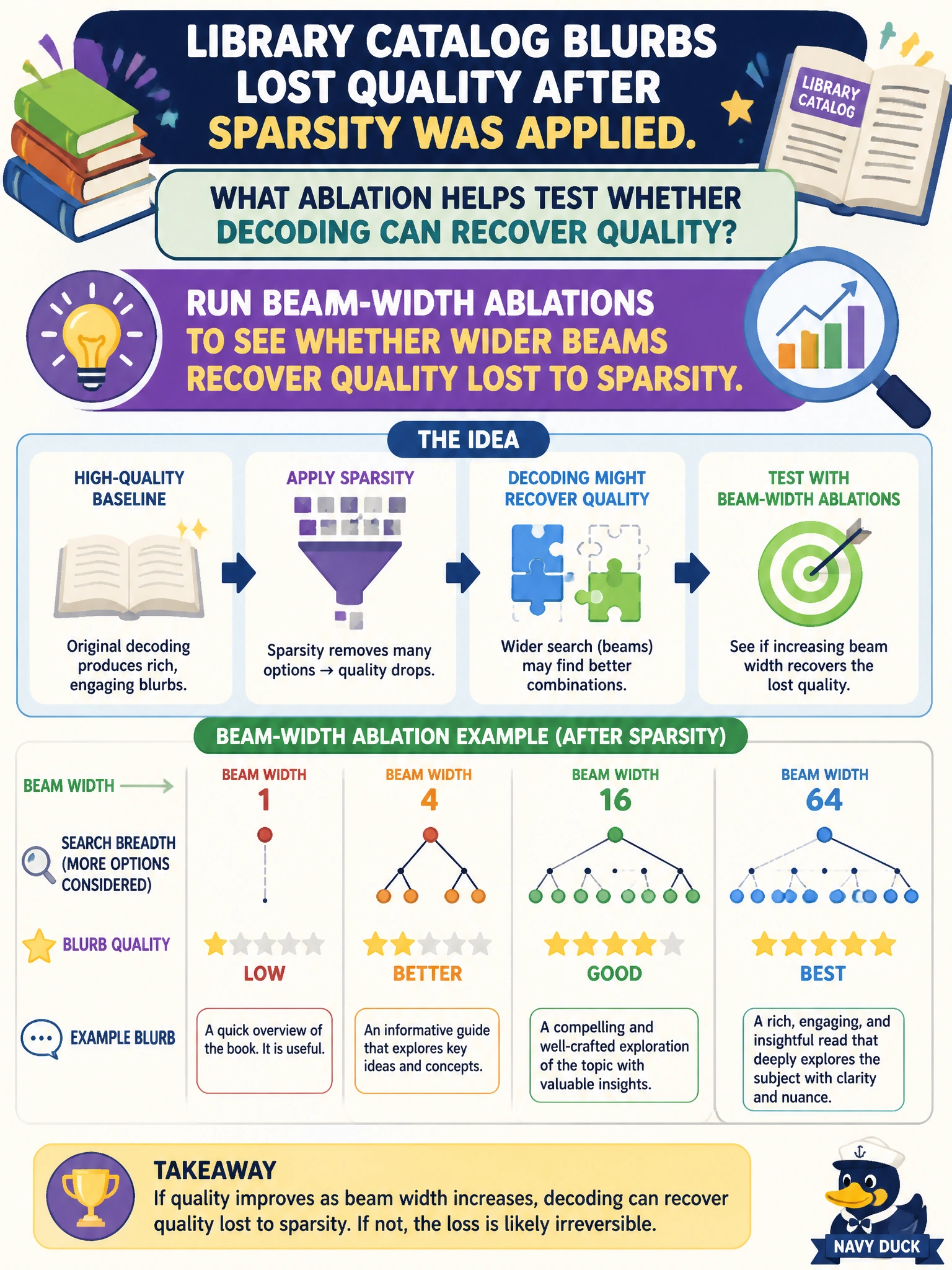
Sparsity trimmed the library blurb model, but wider beams might claw back some quality—or show they can’t. You can use beam-width ablations to test whether decoding offsets what sparsity removed.
Full Explanation
Library blurbs that lose quality after sparsity may still be recoverable if decoding can explore alternate high-probability phrases that a sparse model under-emphasizes at greedy width. Hold sparsity fixed and widen the beam: this tests whether decoding can offset what pruning removed, helping determine whether richer decoding or reversing sparsity is needed for catalog quality. It separates representation damage from limited search. Disabling the catalog and hand-writing blurbs abandons the model under test and measures staffing effort, not recovery. Fixing beam width at 1 and measuring only GPU fan noise confuses hardware telemetry with blurb usefulness to patrons. Increasing sparsity while leaving decoding unchanged worsens the suspected cause without testing the proposed remedy. For the exam, recognize beam-width ablations as the decoding-side test after sparsity harms generation quality; the other approaches substitute human work, use an irrelevant proxy, or intensify sparsity. One caveat: wider beams increase latency and can amplify a wrong but confident catalog fact, so pair quality scores with factual title and author checks and a latency budget for branch kiosks. In practice, sweep beam widths for a fixed sparse checkpoint on held-out blurbs, score librarian rubrics and citation fidelity, and document the smallest width that restores acceptable quality without exceeding kiosk SLOs.