
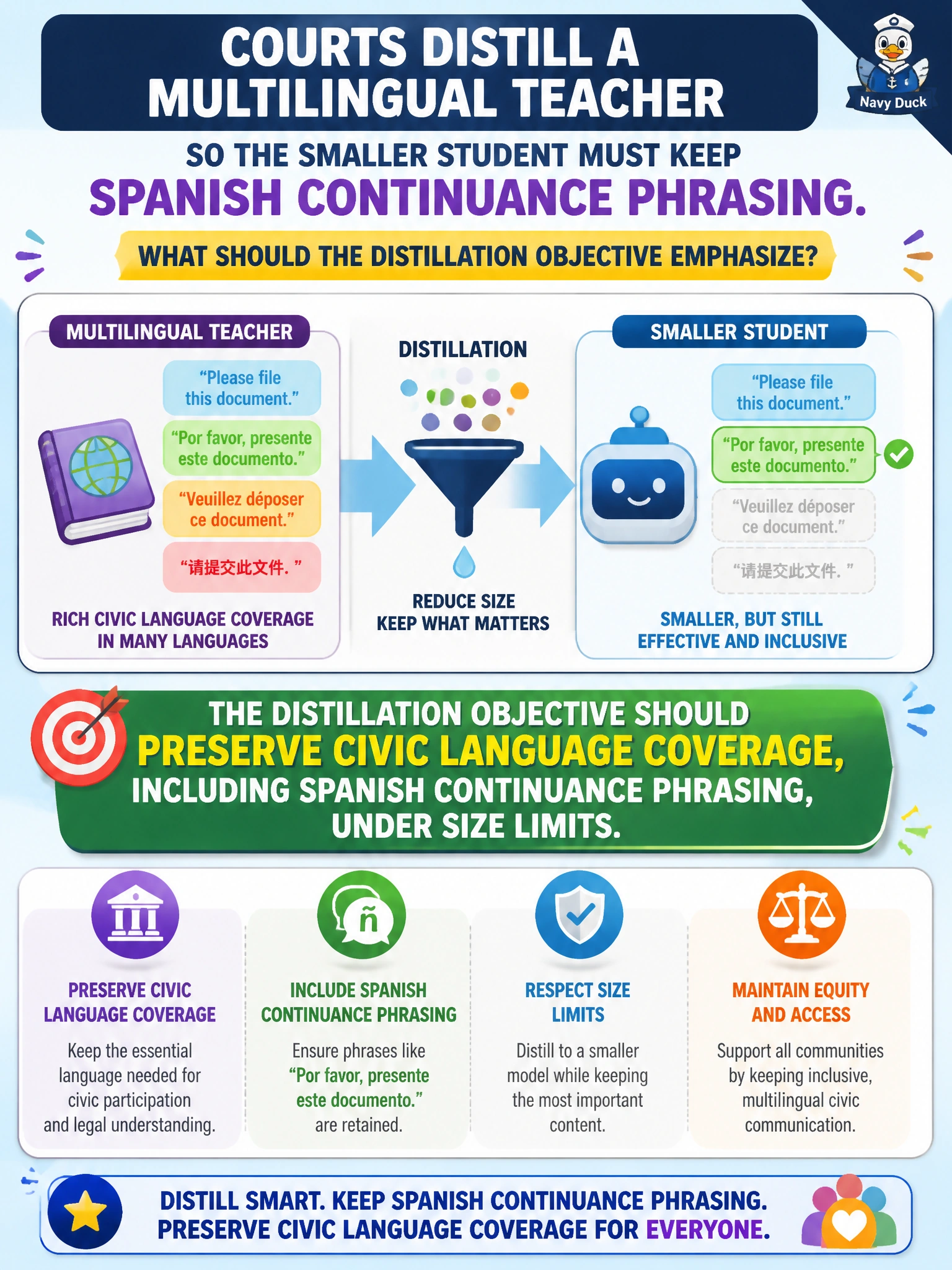
Courts distill a multilingual teacher so the smaller student must keep Spanish continuance phrasing. What should the distillation objective emphasize?
Select an answer to reveal the explanation.
Short Explanation
You need a smaller court model that still understands Spanish continuance phrasing; forgetting it isn’t a useful size reduction. Make language coverage part of distillation so Spanish survives the size limit.
Full Explanation
When you distill a multilingual teacher into a smaller student, the objective should preserve civic language coverage—including Spanish continuance phrasing—within the size limit. Maintaining multilingual coverage in the distillation loss helps ensure equitable access for Spanish-speaking litigants even as the model’s parameter count drops; it is a core justice requirement, not an optional nicety. Maximizing English-only loss and dropping Spanish batches systematically erases phrasing the student must retain, recreating disparate service quality. Optimizing only for token count while ignoring language coverage may produce a compact model that cannot support bilingual court workflows, despite its apparent efficiency. Converting Spanish continuance phrases into machine-transliterated ASCII strings corrupts linguistic signal and teaches the student altered text rather than usable legal Spanish. Exam caveat: preservation still has to fit the size limit; it means measuring parity on Spanish evaluation slices, not keeping a separate full teacher for every language or treating distillation as a substitute for certified translation processes. Practical check: compare teacher and student English and Spanish continuance exact-match and clerk preference scores, and block deployment if Spanish differences exceed the court’s equity threshold on the frozen bilingual continuance set.