
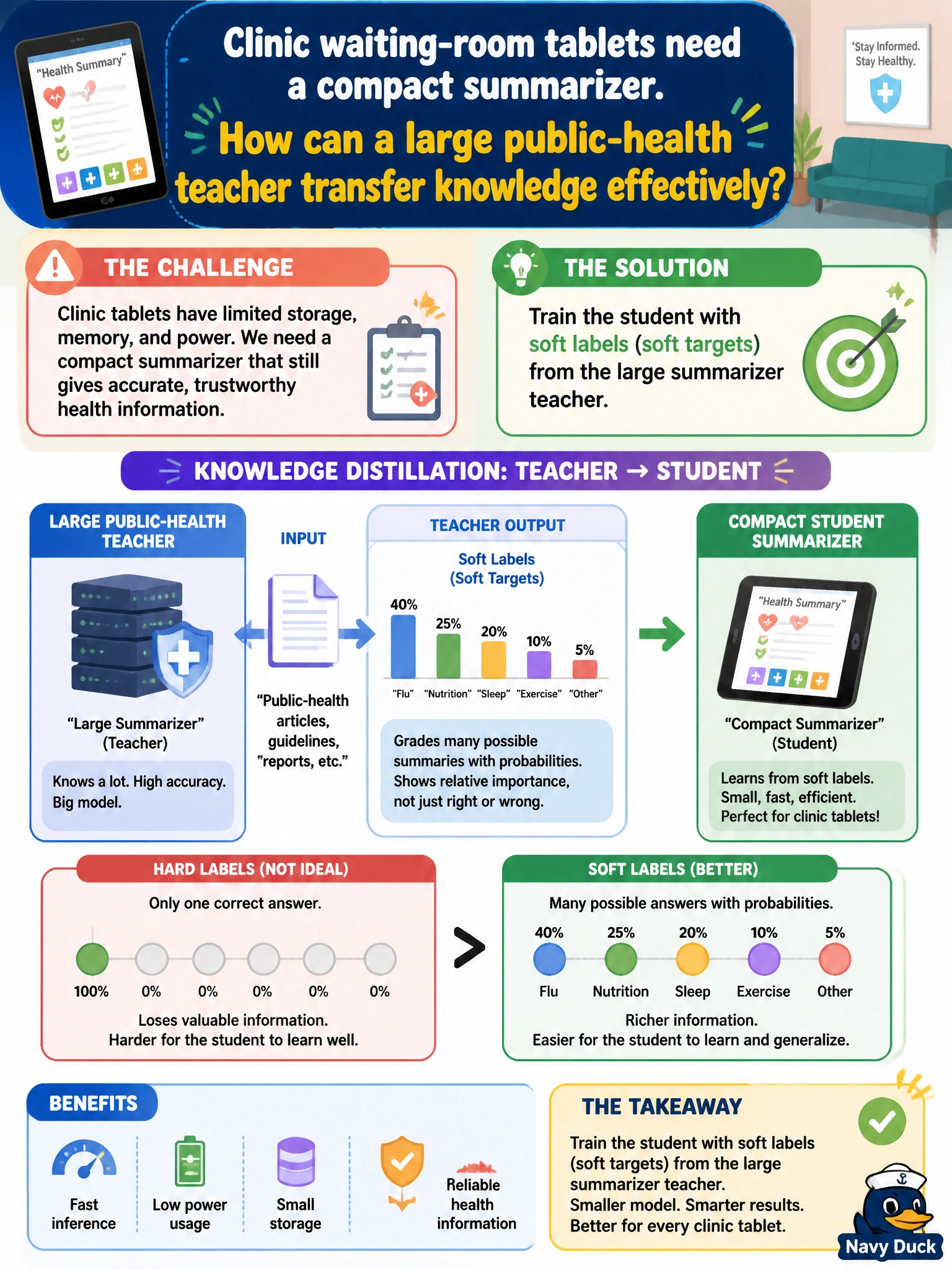
Clinic waiting-room tablets need a compact summarizer. How can a large public-health teacher transfer knowledge effectively?
Select an answer to reveal the explanation.
Short Explanation
The big clinic summarizer already knows the soft probabilities—feed those soft targets to the small tablet model. That’s distillation that actually transfers.
Full Explanation
Clinic waiting-room tablets need compact summarizers that still reflect a large public-health teacher’s distributional knowledge. Training the student with soft labels (soft targets) from the large summarizer teacher transfers probability mass across plausible phrasings—not just hard one-hot answers—so the small model learns richer clinic summary behavior under a distillation loss. Copying hard one-hot labels only and never using teacher probabilities throws away the teacher’s uncertainty structure and typically yields weaker students for nuanced clinical language. Freezing the student randomly each step without a distillation loss is not a knowledge-transfer method. Replacing distillation with doubling the tablet’s screen brightness changes UX visibility, not model capacity or teacher–student learning. Exam caveat: soft targets should be temperature-scaled carefully; excessive temperature can blur clinically distinct entities (medications, dosages) that public-health summaries must keep sharp. Operational check: distill with soft targets, compare ROUGE/clinical entity F1 versus hard-label-only students on waiting-room notes, and confirm the student fits tablet memory at interactive latency.