
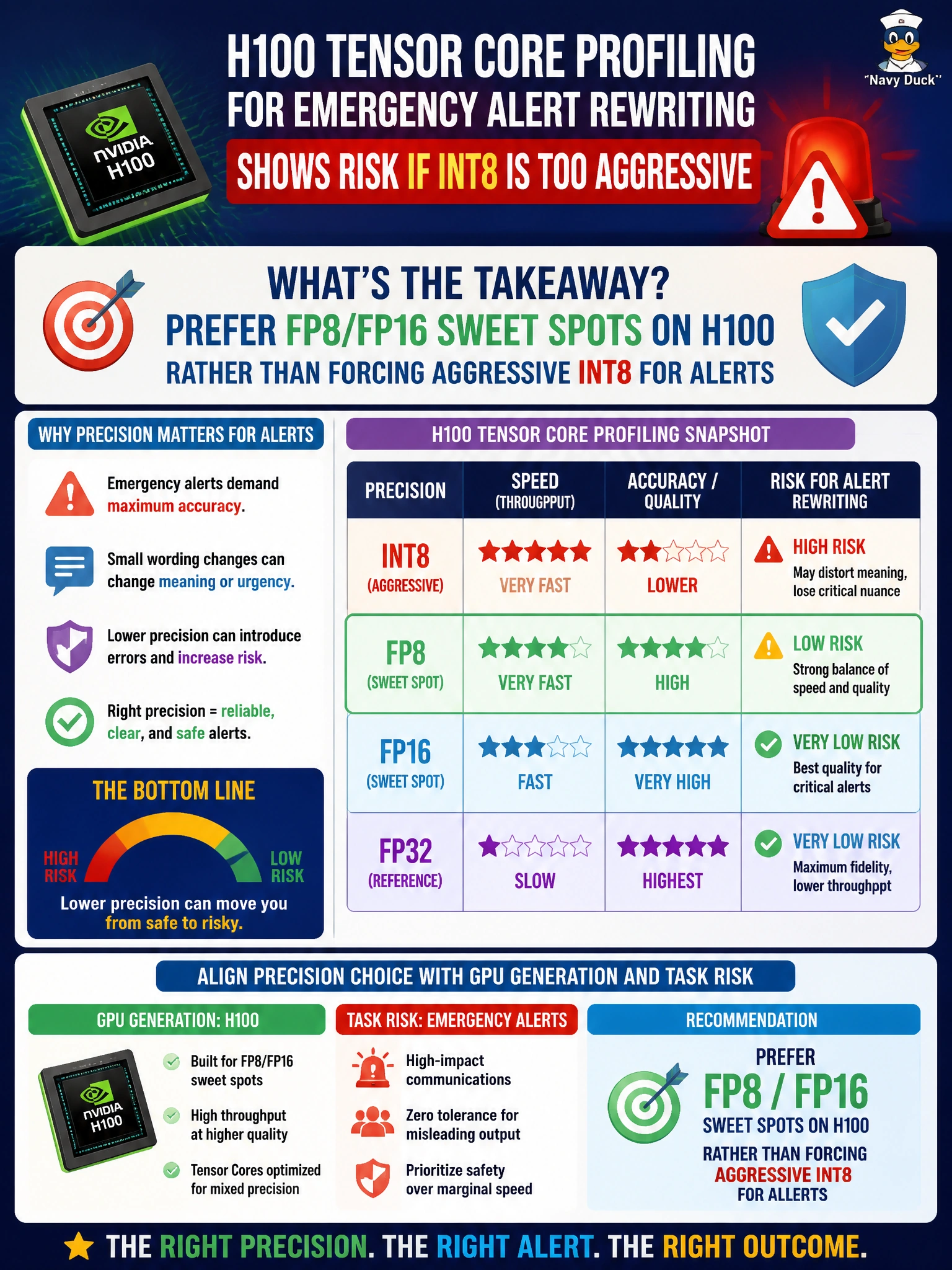
H100 Tensor Core profiling for emergency alert rewriting shows risk if INT8 is too aggressive. What precision choice aligns with GPU generation and task risk?
Select an answer to reveal the explanation.
Short Explanation
Emergency alerts aren’t the place to squeeze every last bit. On H100, ride the FP8/FP16 sweet spot instead of ramming aggressive INT8 into high-risk rewrites.
Full Explanation
Emergency alert rewriting is a high-consequence municipal task: numeric precision choices must respect both H100 Tensor Core capabilities and the cost of error. Preferring FP8/FP16 sweet spots on H100 rather than forcing aggressive INT8 aligns GPU-generation strengths with risk—H100 is built for efficient low-precision floating formats that usually preserve quality better than overly aggressive integer quantization for sensitive public alerts. Mandating INT4 for all emergency text regardless of measured error prioritizes compression over life-safety wording fidelity. Running alerts only in FP64 on CPU to avoid Tensor Cores abandons the accelerator the city provisioned and typically violates latency SLAs for rapid alert issuance. Ignoring profiling and copying an INT8 recipe from an unrelated image model transfers an inappropriate precision recipe across modalities and risk classes. Exam caveat: “prefer FP8/FP16” is not a ban on INT8 everywhere—only a risk-aligned choice when profiling shows aggressive INT8 harming alert rewrite quality on H100. Operational check: A/B rewrite a gold emergency corpus under FP16/FP8 versus aggressive INT8, score critical-slot exactness (shelter addresses, times, hazard type), and select the precision that meets both Tensor Core throughput and zero-critical-slot-error gates.