
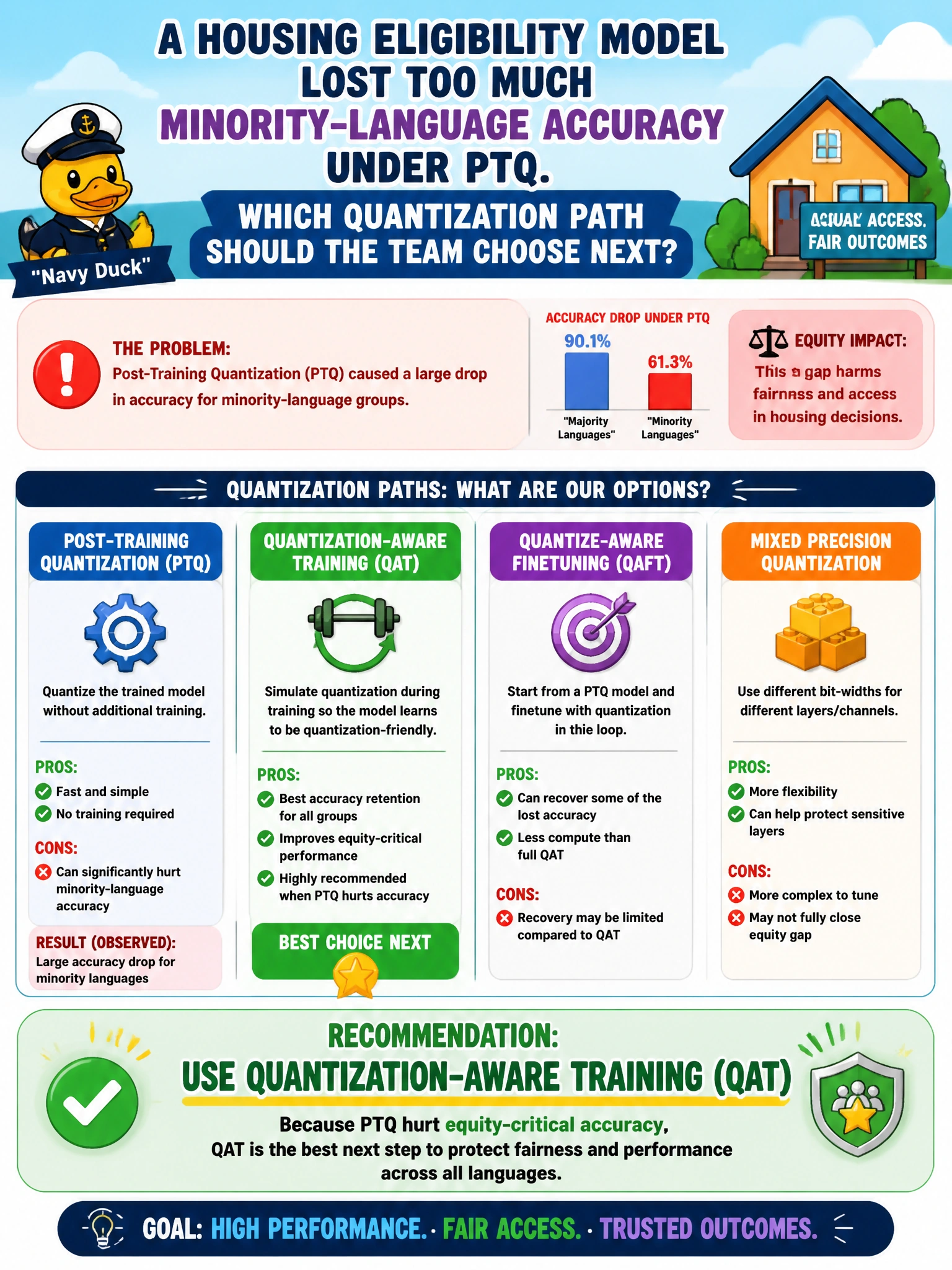
A housing eligibility model lost too much minority-language accuracy under PTQ. Which quantization path should the team choose next?
Select an answer to reveal the explanation.
Short Explanation
When PTQ smashes minority-language housing answers, you don’t paper over it—you train with quantization in the loop. Move to QAT so equity-critical accuracy can recover.
Full Explanation
When post-training quantization damages minority-language accuracy on a housing eligibility model, the team should move to quantization-aware training so the network can adapt to quantized noise during learning. QAT is the appropriate next path because PTQ already proved too lossy for equity-critical civic language performance, and simply keeping the broken INT8 checkpoint is unacceptable for housing access. Keeping the broken PTQ checkpoint and hiding the language gap in dashboards conceals disparate impact rather than remediating it. Disabling all quantization and abandoning hardware acceleration goals may restore accuracy but ignores the deployment constraint that motivated quantization; QAT aims to recover accuracy while retaining lower-precision serving. Applying only tokenizer compression and ignoring weight precision does not address the PTQ weight/activation errors that harmed minority-language eligibility answers. Exam caveat: QAT needs representative multilingual housing prompts in the training loop—without them, the model can re-fit majority language and still fail equity gates. Operational check: compare minority-language eligibility exact-match and false-denial rates across FP16, failed PTQ, and QAT checkpoints on a frozen bilingual eval set before any resident-facing cutover.