
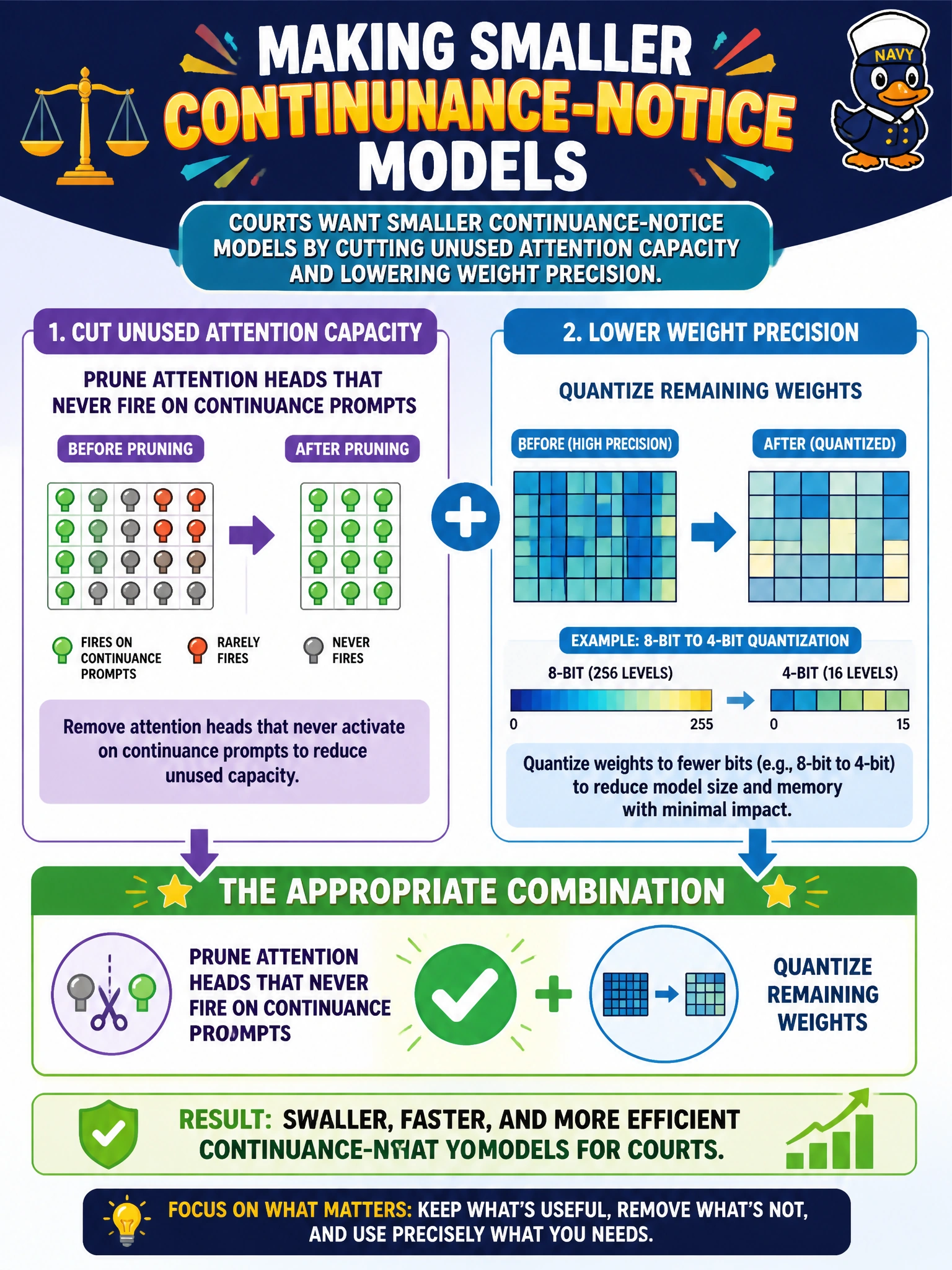
Courts want smaller continuance-notice models by cutting unused attention capacity and lowering weight precision. What combination is appropriate?
Select an answer to reveal the explanation.
Short Explanation
Heads that never wake up on continuance notices are just expensive furniture. Prune those unused heads and quantize what’s left for the courts.
Full Explanation
Court continuance-notice generators can shrink by removing attention capacity that never activates on that civic prompt distribution, then lowering precision on what remains. Pruning attention heads that never fire on continuance prompts and quantizing remaining weights combines structural and numeric compression appropriate for municipal form-generation footprints. Raising precision to FP64 while adding more attention heads increases memory and compute, opposite the size goal. Only rewriting prompts and never changing model capacity or precision may improve wording slightly but does not reduce deployed parameter or activation cost for the courts. Duplicating the full-precision model across idle CPU cores multiplies footprint and still fails to prune unused heads or quantize weights. Exam caveat: “never fire” must be measured on a broad continuance corpus including bilingual and emergency-continuance variants—heads idle on English daytime notices may matter for Spanish or after-hours templates. Operational check: log head activation rates on a held-out continuance set, prune below a documented threshold, apply quantization, then verify citation integrity and clerk acceptance rates before courthouse rollout.