
Public-health overnight jobs want to prune rarely used FFN weights using clinic FAQ statistics. Which pruning approach matches that goal?
Select an answer to reveal the explanation.
Short Explanation
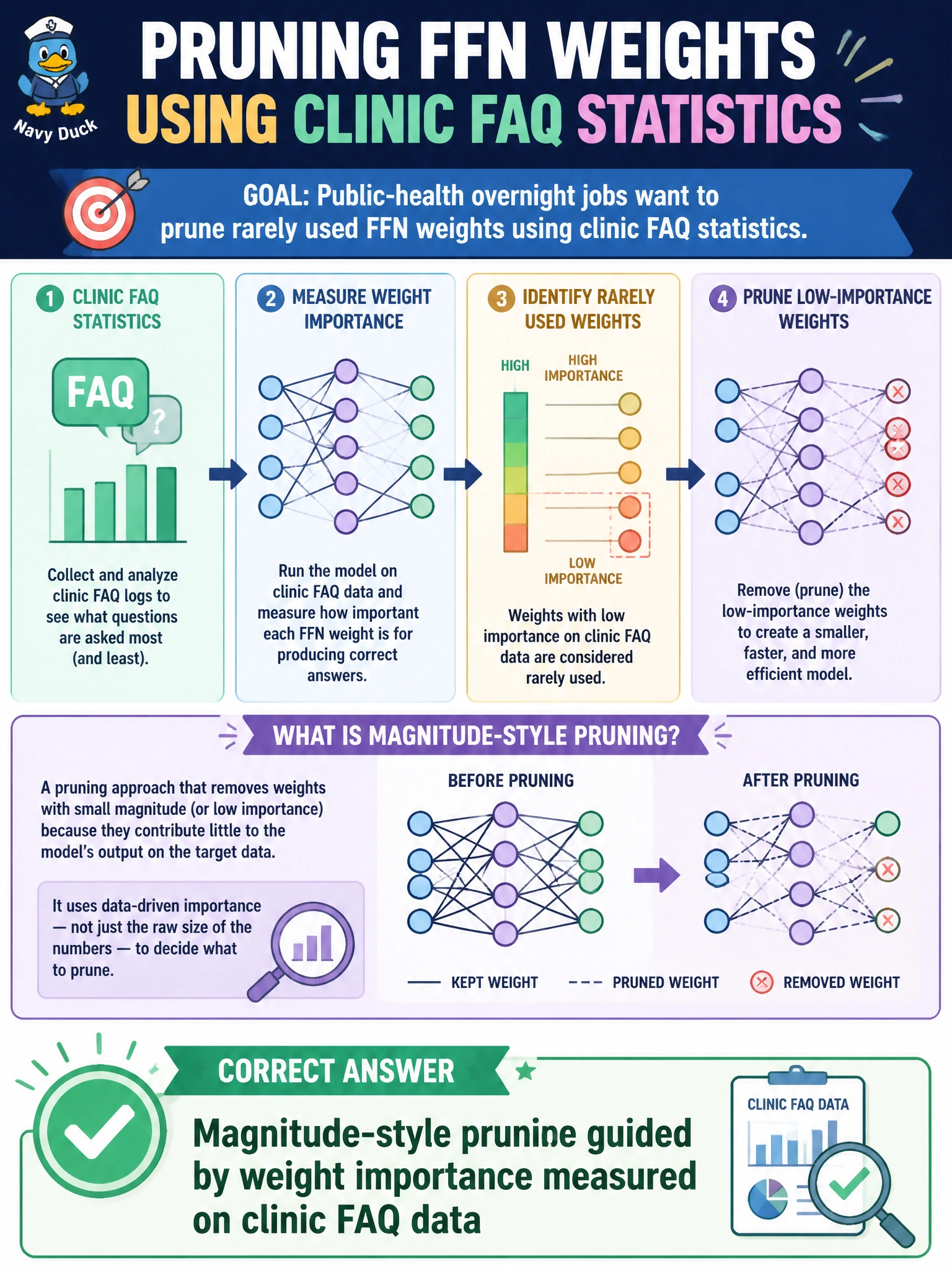
When you use clinic FAQ statistics to identify low-importance FFN weights, magnitude-style pruning can make overnight jobs lighter while preserving useful capacity. You’re matching the pruning signal to the public-health workload.
Full Explanation
For public-health overnight jobs that aim to remove rarely used FFN weights, you should estimate weight importance from representative clinic FAQ traffic rather than prune arbitrarily. Magnitude-style pruning guided by clinic FAQ data removes low-contribution FFN parameters while retaining capacity that matters for municipal health questions, reducing compute for batch runs. Removing whole transformer layers at random ignores both weight magnitudes and clinic FAQ usage; it may discard critical depth without an importance signal and damage FAQ quality. Pruning only the tokenizer vocabulary leaves FFN weights dense, so it does not shrink the feed-forward blocks that account for many transformer FLOPs. Increasing embedding dimensions removes no weights and instead raises memory use and compute, moving opposite to the goal. Exam caveat: clinic FAQs may underrepresent rare outbreak terminology, so protect high-stakes chemical and symptom pathways with masks or lower prune ratios before overnight promotion. Practical check: measure FAQ exact-match or F1 and job wall-clock time before and after magnitude pruning on an overnight corpus slice, and roll back if equity-critical or rare-term recall falls beyond the health department’s threshold.