
Transit edge boxes need sparsity that maps to Tensor Core acceleration for delay explainers. Which choice fits?
Select an answer to reveal the explanation.
Short Explanation
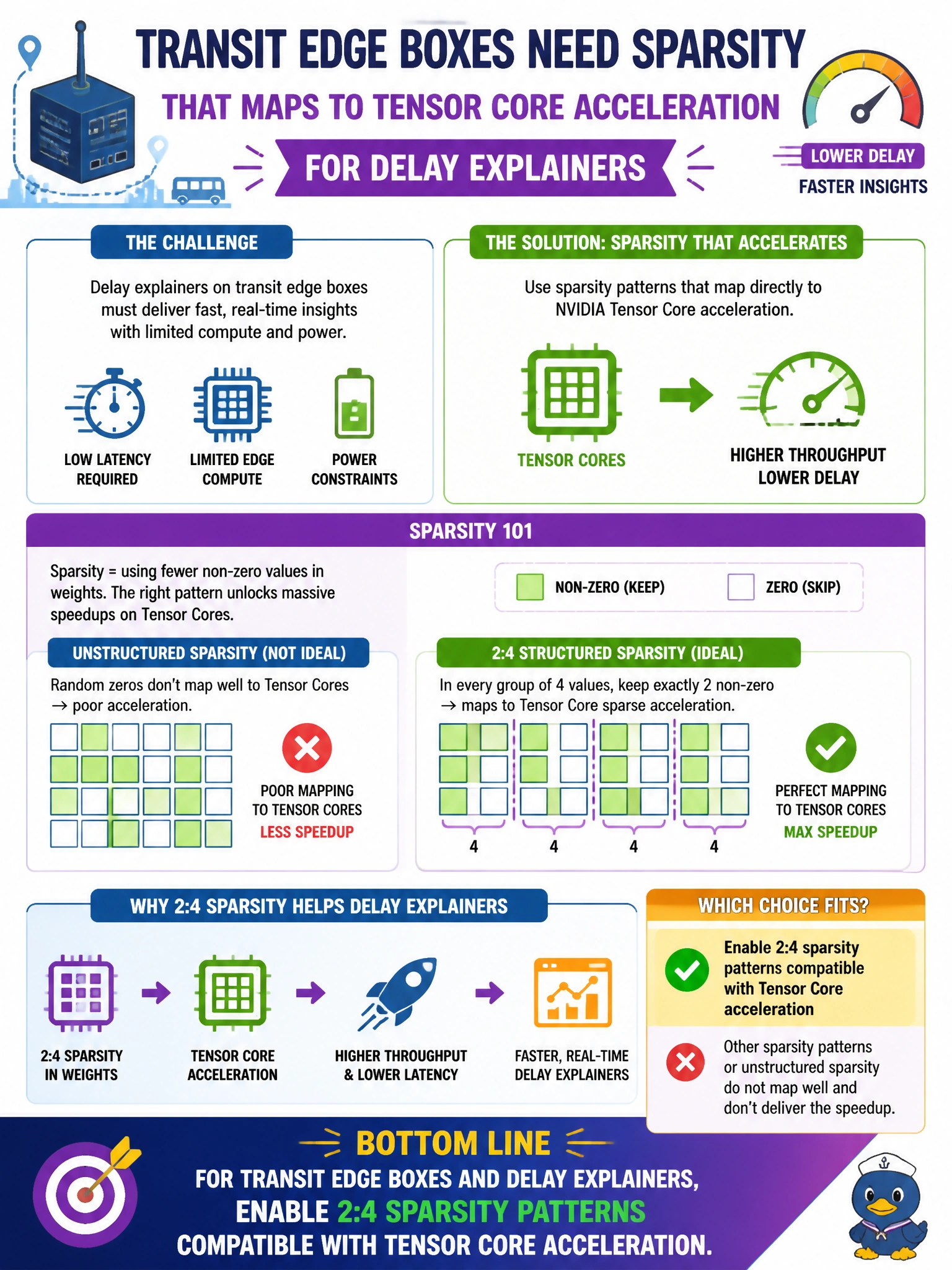
Edge transit boxes love sparsity that the GPU can actually sprint on. Use 2:4 patterns so Tensor Cores speed those delay explainers.
Full Explanation
Transit edge boxes that explain delays need sparsity patterns the GPU can accelerate, not merely statistical zeros. Enabling 2:4 sparsity patterns compatible with Tensor Core acceleration maps structured sparsity onto NVIDIA hardware paths so delay explainers run faster and leaner on constrained edge devices while keeping the model resident in limited VRAM. Random unstructured zeros with no hardware-friendly pattern may reduce theoretical parameter counts but often fail to unlock Tensor Core sparse GEMMs, leaving latency on the table and offering little real throughput gain on the edge box. Dense FP32 weights with sparsity disabled for “accuracy insurance” ignore the edge performance and memory brief entirely and typically cannot meet yard or wayside latency budgets. CPU-only sparse formats that Tensor Cores cannot accelerate push work off the GPU accelerator the edge box was bought to use, defeating the transit deployment model and adding host-side overhead. Exam caveat: 2:4 sparsity still requires accuracy validation on delay narratives and GTFS-linked explanations—hardware-friendly does not automatically mean civic-quality-safe, especially for bilingual rider messages. Operational check: compare tokens/sec and explanation exactness on the edge box with dense versus 2:4 sparse weights under Tensor Core-enabled builds, and ship sparse only if both speed and quality gates clear on a frozen delay-explainer eval set.