
A housing-authority chatbot sometimes drops rent-limit dollar amounts into casual prose where staff cannot parse them reliably. Which wrapper design best improves consistency?
Select an answer to reveal the explanation.
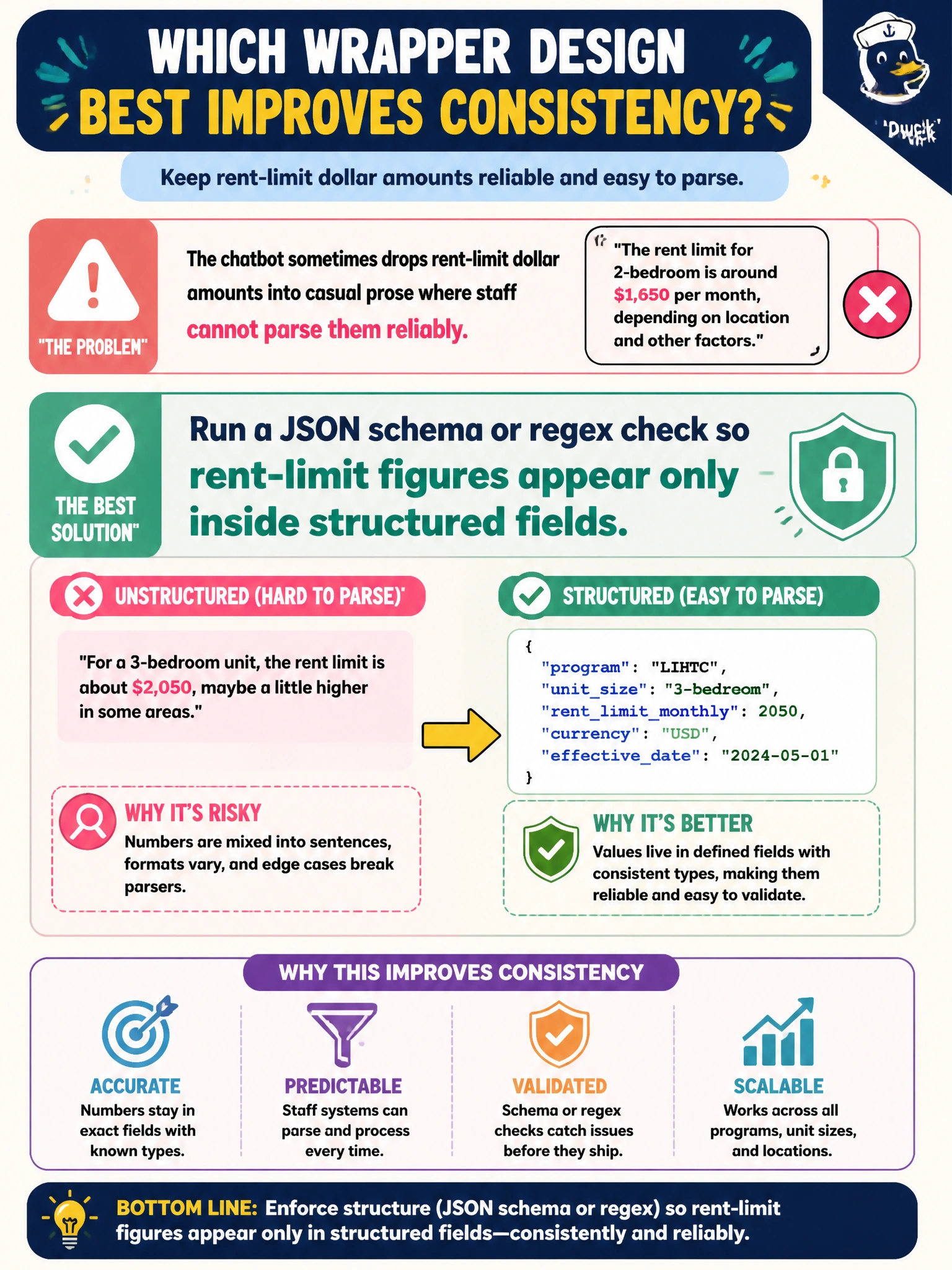
Short Explanation
Money figures wandering through chatty prose are like loose coins in a desk drawer—hard to count. Schema or regex checks push rent limits into labeled fields so housing staff can trust the layout.
Full Explanation
For a housing-authority chatbot that drops rent-limit dollar amounts into casual prose, the wrapper design that best improves consistency is to run a JSON schema or regex check so rent-limit figures appear only inside structured fields. Structured validation separates machine-readable amounts from narrative explanation, letting caseworkers and systems parse limits without hunting through paragraphs. Combining generation with schema/regex checks is a standard specialized-wrapper pattern for civic numeric reliability. Allowing free-form paragraphs and asking caseworkers to highlight numbers manually shifts brittle extraction onto humans and scales poorly under ticket volume. Removing all numeric fields so the model never mentions rent limits avoids formatting chaos by deleting the business content residents and staff need. Lowering the 'learning rate during inference' is a category error—learning rate is a training optimizer hyperparameter, not an inference control for numeric alignment—so it cannot force structured rent-limit fields at serving time. Exam caveat: schema validation enforces where numbers appear and often basic formats; it does not by itself prove the dollar amount matches current housing policy—pair with retrieval of the live rent schedule. Operational check: define a schema with explicit rent-limit fields, reject or repair outputs that bury amounts only in prose, and regression-test against chats that previously scattered dollar figures through casual sentences.