
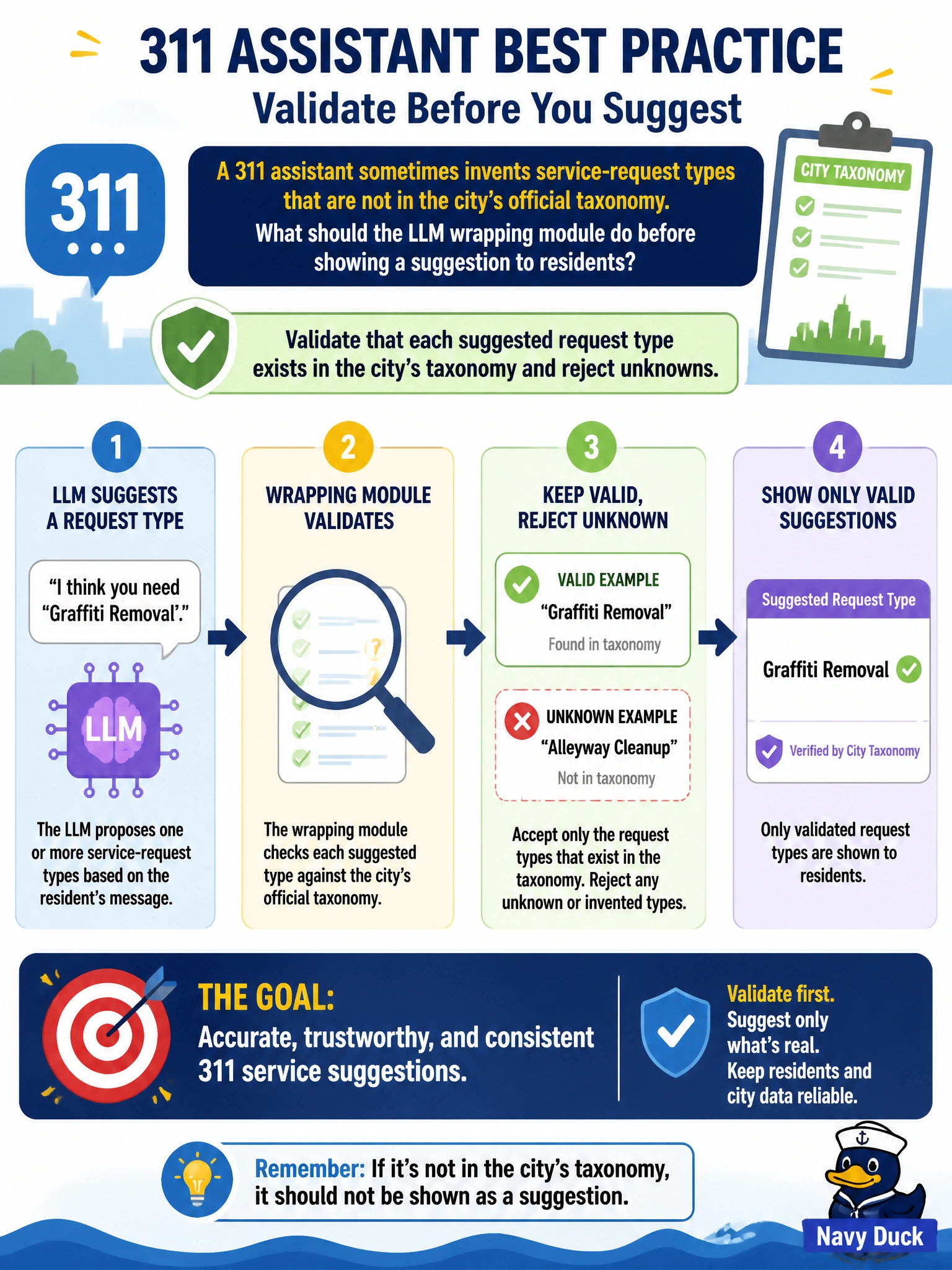
A 311 assistant sometimes invents service-request types that are not in the city’s official taxonomy. What should the LLM wrapping module do before showing a suggestion to residents?
Select an answer to reveal the explanation.
Short Explanation
If the city doesn’t have a bucket called ‘dragon removal,’ the bot shouldn’t invent one for a resident. Validate every suggested 311 type against the official taxonomy and drop the fakes.
Full Explanation
Before a 311 assistant shows a service-request suggestion to residents, the LLM wrapping module should validate that each suggested request type exists in the city's official taxonomy and reject unknowns. Hallucinated categories create tickets that no work-order system can route, frustrate residents, and pollute analytics. Taxonomy validation is a specialized wrapper responsibility: generate candidates, check membership against the authoritative civic list, and only then display. Publishing every invented type immediately so the taxonomy 'grows organically' bypasses governance and floods operations with unowned categories that no crew is staffed to handle. Increasing beam width until a novel category appears more fluent optimizes for fluency of invention rather than for taxonomy fidelity, making hallucinations look more convincing. Disabling logging so hallucinated categories cannot be audited removes the operational feedback loop needed to catch wrapper failures and improves nothing about resident-facing correctness. Exam caveat: validation rejects unknowns; it does not automatically add missing but legitimate request types—those need a governed taxonomy change process with operations and product owners. Operational check: maintain a versioned taxonomy service, unit-test the wrapper with prompts that previously invented types, confirm rejects and fallbacks (clarify or handoff), and monitor logs for attempted unknown categories without showing them to residents.