
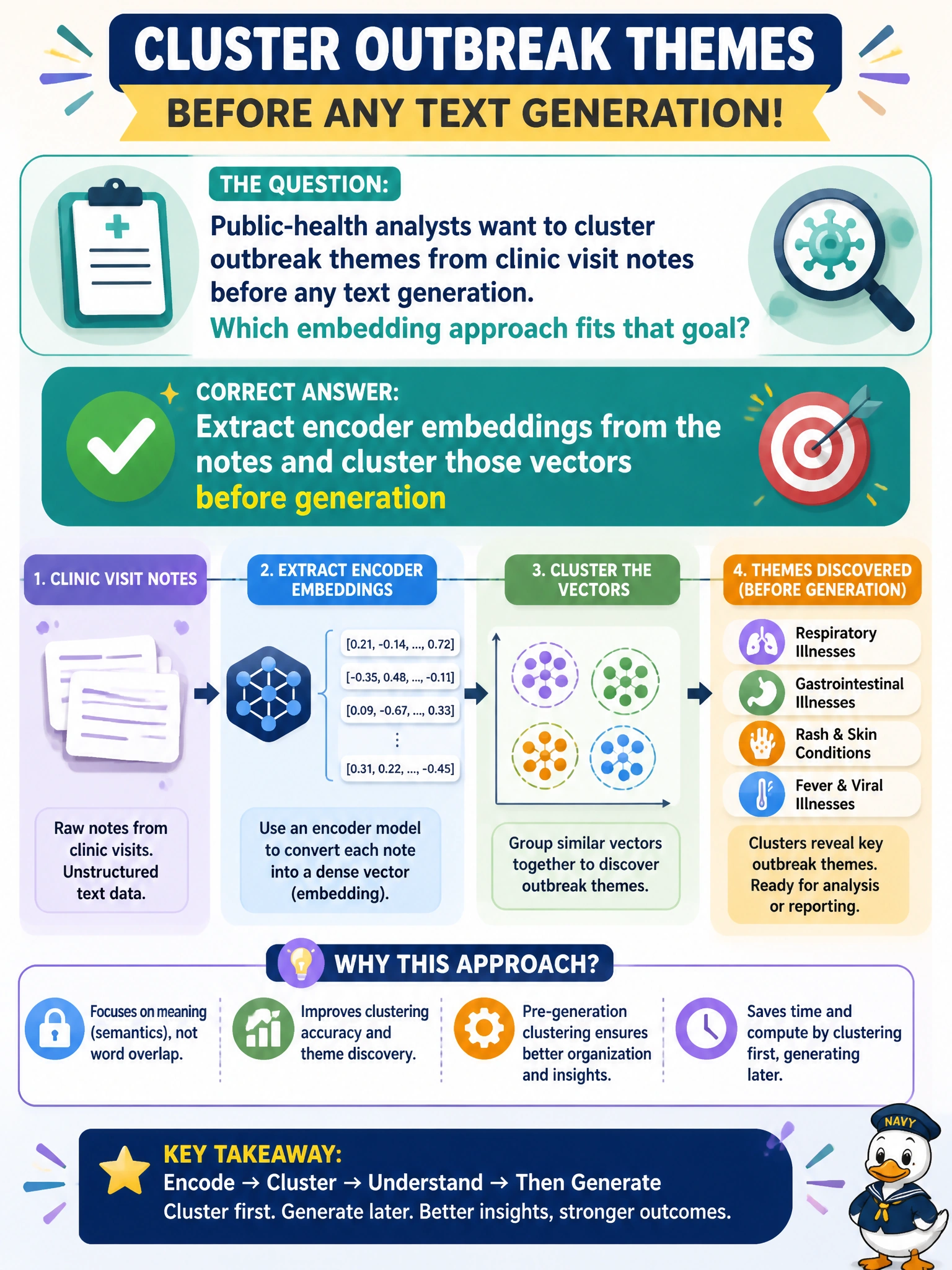
Public-health analysts want to cluster outbreak themes from clinic visit notes before any text generation. Which embedding approach fits that goal?
Select an answer to reveal the explanation.
Short Explanation
You’re looking for where clinic notes sit near one another in meaning-space, not for new sentences yet. Extract encoder embeddings from the notes and cluster those vectors; generation can wait. Temperature sampling invents labels, while random vectors cannot ground outbreak themes in the notes.
Full Explanation
Public-health analysts who want to cluster outbreak themes from clinic visit notes before any text generation need geometric representations of note meaning, not generative sampling. Extracting encoder embeddings, or equivalent contextual vectors, from the notes and clustering those vectors places semantically related visit narratives near each other so theme groups emerge before summaries or alerts are drafted. That order—embed, cluster, then optionally generate—matches the analytical goal. Skipping embeddings and only running temperature sampling invents labels without a principled similarity space over real clinic notes. Using only the decoder’s next-token logits as a substitute confuses predictive distributions for the next word with stable document embeddings for clustering; logits are not designed as note-level theme coordinates. Mapping each clinic note to a fixed random vector discards clinical content entirely, so the resulting clusters cannot reflect outbreak themes. Exam caveat: decoder-only models can still yield usable embeddings from hidden states, but pre-generation clustering still requires embeddings first, not sampling as clustering. Practical check: validate clusters against known syndrome or site labels, measure silhouette or have reviewers assess theme coherence, and keep generation frozen until cluster quality meets public-health review standards.