
School-district IT compares multi-head attention to a single attention head when reading long IEP narrative PDFs. Why prefer multi-head self-attention?
Select an answer to reveal the explanation.
Short Explanation
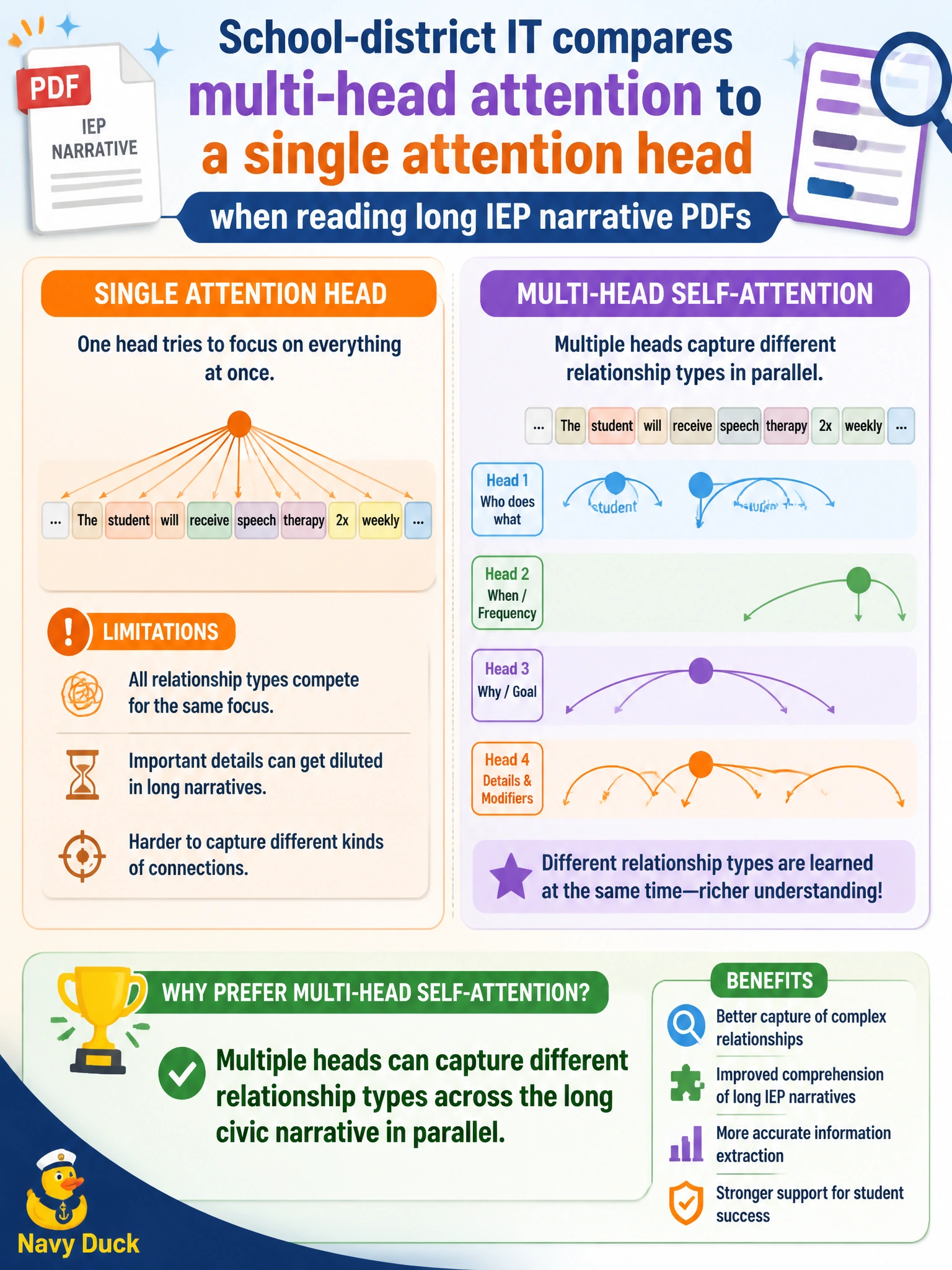
One attention head is like reading an IEP with a single colored highlighter. Multi-head attention hands the model several highlighters at once—one for dates, one for services, one for goals—so different relationship patterns in the long narrative get their own view. That parallel specialization is the point, not deleting positions or skipping the rest of the block.
Full Explanation
When school-district IT reviews long IEP narrative PDFs, multi-head self-attention is preferred because different heads can specialize in different relationship types in parallel—dates versus services, goals versus accommodations, provider names versus legal timelines—within the same civic document pass. Concatenating or combining those head outputs gives a richer mixed representation than a single attention pattern can usually express alone. The claim that a single head always encodes more relationships than many heads combined reverses the design rationale of multi-head attention. Multi-head attention does not exist to delete positional information from IEP text; positions are still injected via positional encodings, and heads use content and position jointly. Multi-head attention also does not remove the need for feed-forward layers; transformer blocks still apply position-wise feed-forward networks after attention. Exam caveat: more heads are not free—width per head, compute, and overfitting on short IEPs matter—but the conceptual win is parallel diverse relational subspaces over long narratives. Operational check: compare single-head versus multi-head quality on long IEP extraction tasks, inspect whether different heads attend to distinct civic entity types, and watch latency/memory budgets for district PDF batch sizes.