
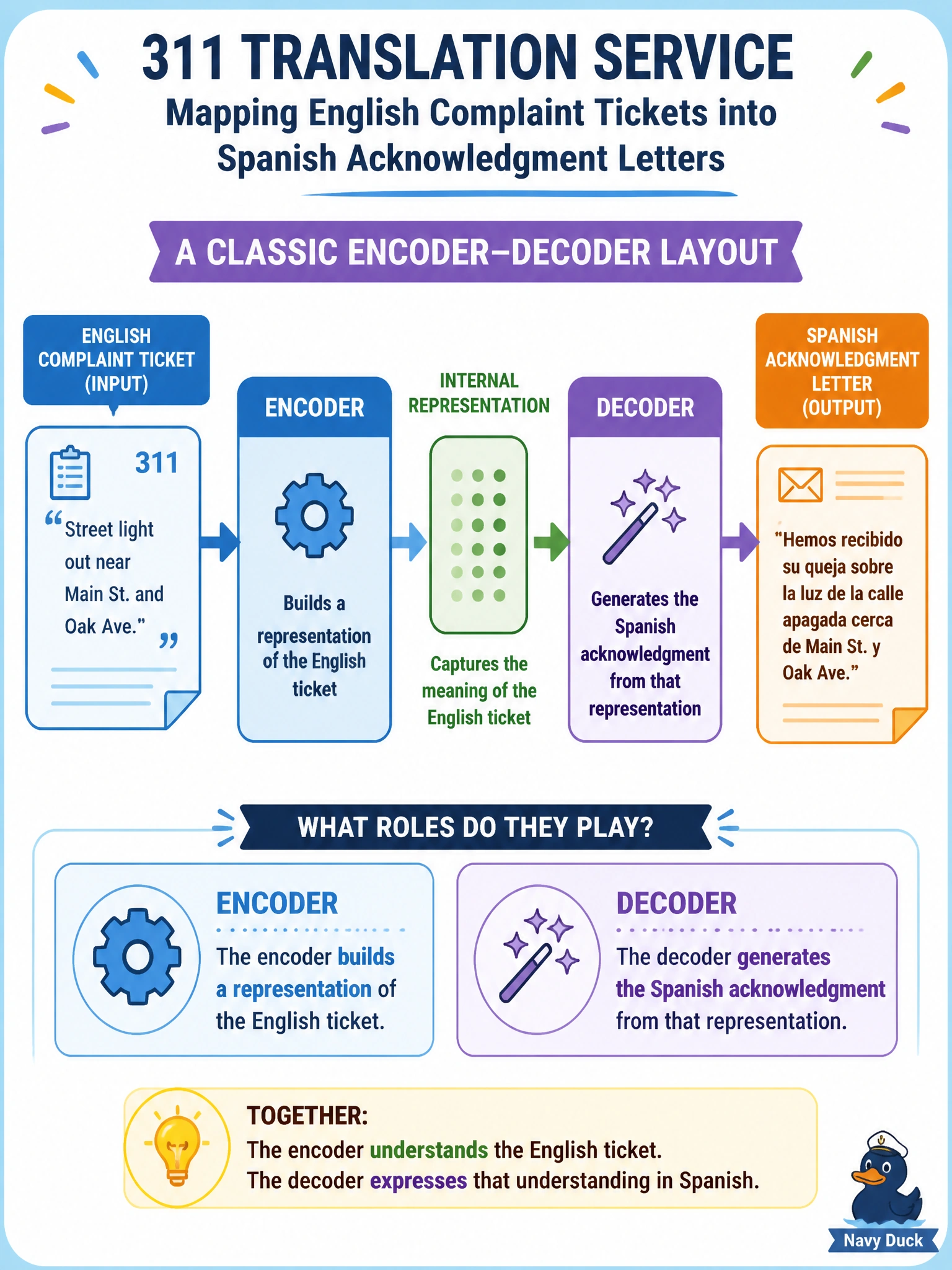
A 311 translation service maps English complaint tickets into Spanish acknowledgment letters using a classic encoder-decoder layout. What roles do the encoder and decoder play?
Select an answer to reveal the explanation.
Short Explanation
Picture a bilingual clerk who first digests the English complaint, then writes the Spanish reply. That is encoder then decoder: encode the ticket into a rich representation, decode the acknowledgment letter. Swapping those roles or treating them as token counters misses how classic seq2seq translation actually flows.
Full Explanation
In a 311 translation service that maps English complaint tickets into Spanish acknowledgment letters with a classic encoder-decoder layout, roles are asymmetric and ordered. The encoder’s job is to read the English civic ticket and build a contextualized representation of that source complaint—entities, location cues, urgency, and requested services—without yet emitting Spanish prose. The decoder’s job is to generate the Spanish acknowledgment letter token by token, conditioned on the encoder representation (and any attention over encoder states). That is the standard sequence-to-sequence contract for municipal bilingual correspondence. Claiming the encoder invents the Spanish letter first reverses the pipeline and leaves the decoder with nothing meaningful to do except store English, which is not how encoder-decoder translation works. Saying both sides only count tokens denies representation learning entirely; token counts are not the civic text understanding the agency needs. Swapping roles so the decoder encodes English while the encoder samples random Spanish phrases is architecturally incoherent and would produce unreliable, ungrounded resident letters. Exam caveat: modern systems may fuse or share parameters, and decoder-only models can translate via prompting, but when the question specifies a classic encoder-decoder layout, keep encoder=understand source and decoder=generate target. Operational check: inspect intermediate encoder outputs for ticket fidelity, audit Spanish acknowledgments against English source fields, and monitor attention that links Spanish phrases back to English complaint spans rather than free invention.