
A county assessor needs bilingual parcel summaries from deed text. The ML lead must choose between a classic encoder-decoder sequence-to-sequence model and a decoder-only LLM. When is the encoder-decoder structure the better architectural fit?
Select an answer to reveal the explanation.
Short Explanation
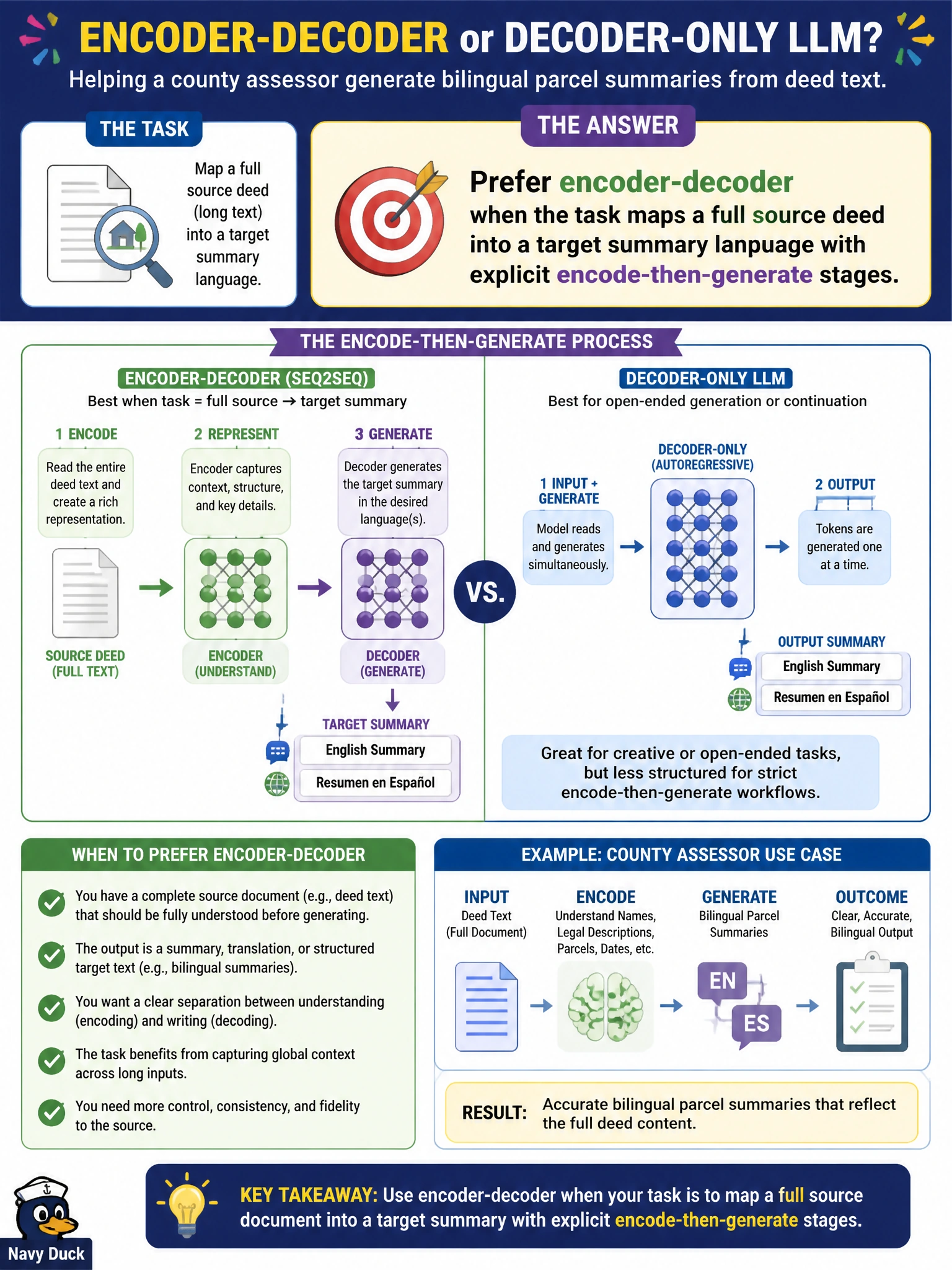
Think of deeds as letters that must be carefully read before you write the summary in another language. An encoder-decoder is built for that read-then-write pipeline—encode the whole source, then decode the bilingual parcel summary. A decoder-only model can still generate, but the classic encode-then-generate split is the cleaner fit when the source document is the clear input.
Full Explanation
For the county assessor’s bilingual parcel-summary workload, the decisive architectural question is whether the pipeline has an explicit full-source document that must be understood before a target-language summary is written. Classic encoder-decoder sequence-to-sequence models are purpose-built for that map: the encoder consumes the entire deed text and forms a contextualized representation of the municipal source, then the decoder generates the parcel summary in the target language conditioned on that representation. That encode-then-generate split matches deed-to-summary translation and summarization better than treating the deed as just another prefix inside a decoder-only completion. Decoder-only LLMs remain capable of summarization via prompting, but they do not supply the same dedicated bidirectional encoder stage over the full source when the design goal is a clean source-to-target municipal transform. Preferring decoder-only always because “encoders cannot read deed language” is false—encoders are specifically designed to read source text, including specialized municipal legalese once trained or adapted. Choosing encoder-decoder only when the county forbids self-attention confuses attention with architecture family; modern encoder-decoder and decoder-only stacks both rely on attention. Preferring encoder-decoder because it supposedly cannot produce embeddings is also wrong: encoder outputs are routinely used as embeddings for later retrieval. Exam caveat: many production assessor tools now use decoder-only LLMs successfully; the test point is fit of the classic encode-then-generate pattern for explicit source-to-target mapping, not a ban on decoder-only systems. Operational check: confirm the deed is treated as a complete source document, measure whether encode-then-decode latency and quality beat a decoder-only baseline on the same bilingual parcel pairs, and verify that encoder hidden states remain available if the assessor later needs deed retrieval.