
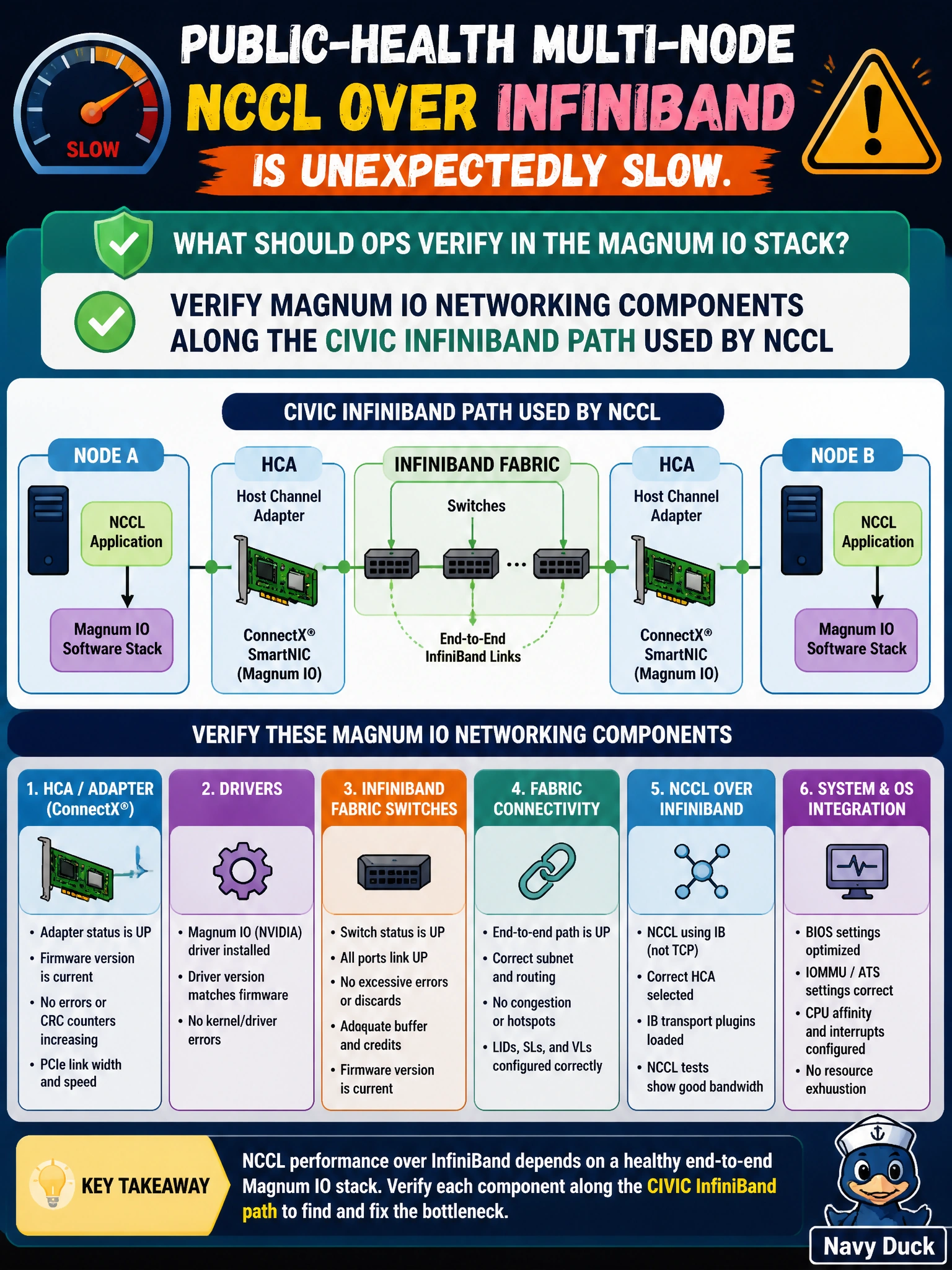
Public-health multi-node NCCL over InfiniBand is unexpectedly slow. What should ops verify in the Magnum IO stack?
Select an answer to reveal the explanation.
Short Explanation
When NCCL crawls over IB, check Magnum IO networking pieces on that civic path before blaming the model. USB sticks and permanently killing IB are not multi-node triage.
Full Explanation
Public-health multi-node NCCL traffic over InfiniBand depends on a healthy Magnum IO networking stack along that IB path. Unexpectedly slow allreduce or broadcast often traces to misconfigured Magnum IO networking components, fabric issues, or disabled acceleration rather than the model itself. Verifying Magnum IO networking along the civic InfiniBand path used by NCCL is the correct first-line troubleshooting step before changing batch size or abandoning IB.
Assuming NCCL is always slow and doubling the batch size without checking the fabric can increase memory pressure while leaving the real networking bottleneck untouched. Replacing InfiniBand with USB sticks between training nodes is not a viable multi-node interconnect and cannot carry NCCL at cluster scale. Disabling IB entirely so NCCL falls back to unmanaged Ethernet forever typically collapses bandwidth and latency characteristics required for multi-node public-health training.
Exam caveat: slow NCCL on IB is a fabric/Magnum IO verification problem first; software batch tweaks are secondary. Capture NCCL debug and IB counters so municipal tickets show path evidence, not guesses. Operational check: confirm Magnum IO networking components and IB link state on the training path, run a known-good NCCL test across the same public-health nodes, compare bandwidth/latency to baseline, and only then tune application parameters if the fabric path proves healthy.