
Public-health BCM alerts flood the NOC with non-actionable noise. What should ops tune?
Select an answer to reveal the explanation.
Short Explanation
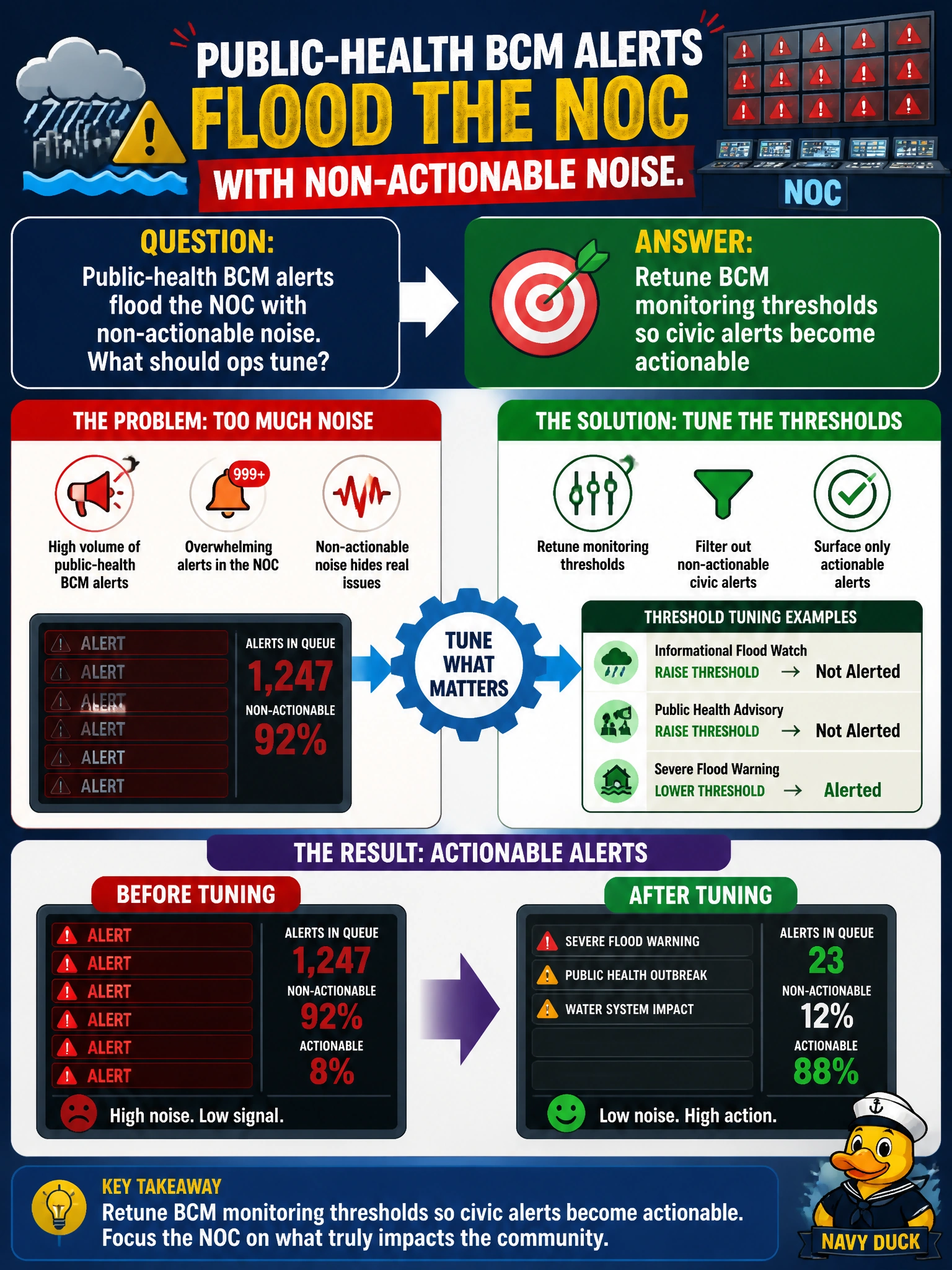
When BCM cries wolf all night, retune the thresholds until public-health alerts mean something. Muting the NOC or deleting monitoring is how real outages sneak past.
Full Explanation
BCM monitoring that floods the public-health NOC with non-actionable noise usually reflects mistuned thresholds, overly broad severity, or informational events promoted to pages. Retuning BCM monitoring thresholds so civic alerts become actionable restores signal-to-noise: engineers can trust pages and still see real municipal incidents. Threshold work should map to SLOs for GPU health, fabric, storage, and head-node services rather than default sensitivity that treats every Base View tip as critical.
Muting the entire municipal NOC permanently hides both noise and genuine outages, which is unacceptable for public-health workloads. Deleting all BCM monitoring so no alerts ever fire removes observability that BCM and Base View are meant to provide. Paging every on-call engineer for every informational Base View tip institutionalizes alert fatigue and guarantees delayed response when a real civic incident appears.
Exam caveat: alert hygiene is a first-class troubleshooting skill—tuning thresholds is preferred over deleting monitoring or silencing the NOC. Document severity mappings so municipal on-call rotations stay consistent across shifts. Operational check: sample a day of BCM alerts, classify actionable versus informational, raise thresholds or demote severities for the noisy classes, keep critical GPU and fabric pages intact, and confirm the next on-call shift receives fewer pages with higher true-positive rate.