
Emergency retrain on an NVSwitch rack fails until fabric manager matches the driver branch. What alignment fits?
Select an answer to reveal the explanation.
Short Explanation
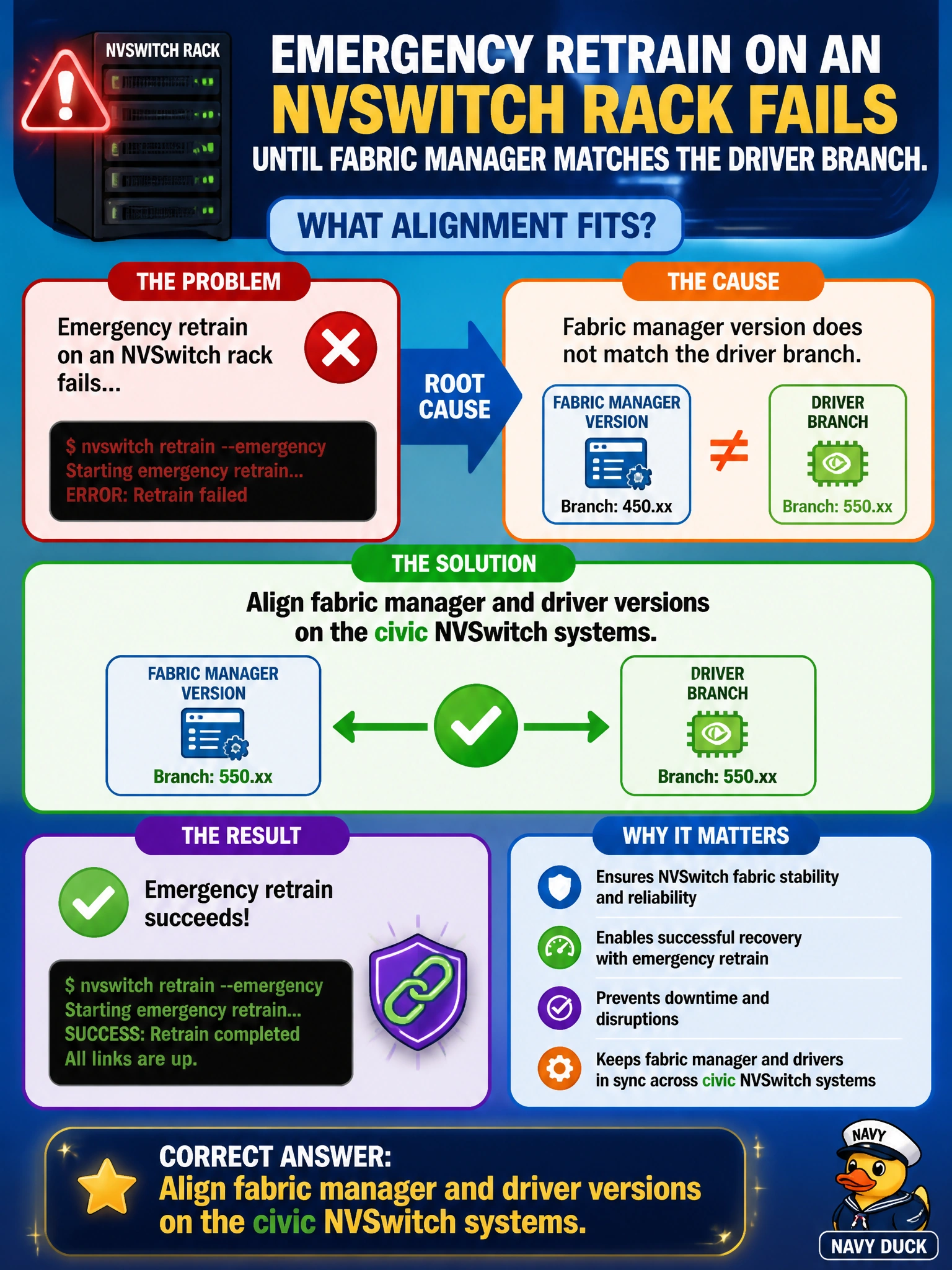
You can restore reliable emergency retrains by aligning fabric manager and driver versions on the civic NVSwitch systems, like pairing keys with locks. Restarting the job by luck will not correct version skew.
Full Explanation
Emergency retrains on an NVSwitch rack that fail until fabric manager matches the driver branch call for aligning fabric manager and driver versions on the civic NVSwitch systems. Fabric manager is tightly coupled to the NVIDIA driver release train; version skew can cause startup failures, incomplete fabric initialization, or unstable links that abort multi-GPU emergency jobs. Matching versions restores a supported fabric bring-up path. Keeping fabric manager pinned to an unrelated, much older driver branch fails because permanent skew can cause recurring initialization failures as drivers advance. Ignoring skew and restarting until the job succeeds by luck fails on reliability: luck is not an emergency operations strategy. Unpinning drivers weekly so versions never match deliberately creates avoidable breakage and undermines change control. Exam caveat: align fabric manager and drivers as a pair, while accounting for CUDA user-stack expectations in containers; do not chase only the newest driver. Site pin policies should update fabric manager when drivers update. Practical check: inventory both package versions on the emergency rack, verify they match, confirm fabric manager is active and the NVSwitch topology is healthy, then relaunch the retrain with an NCCL smoke gate before the full data load.