
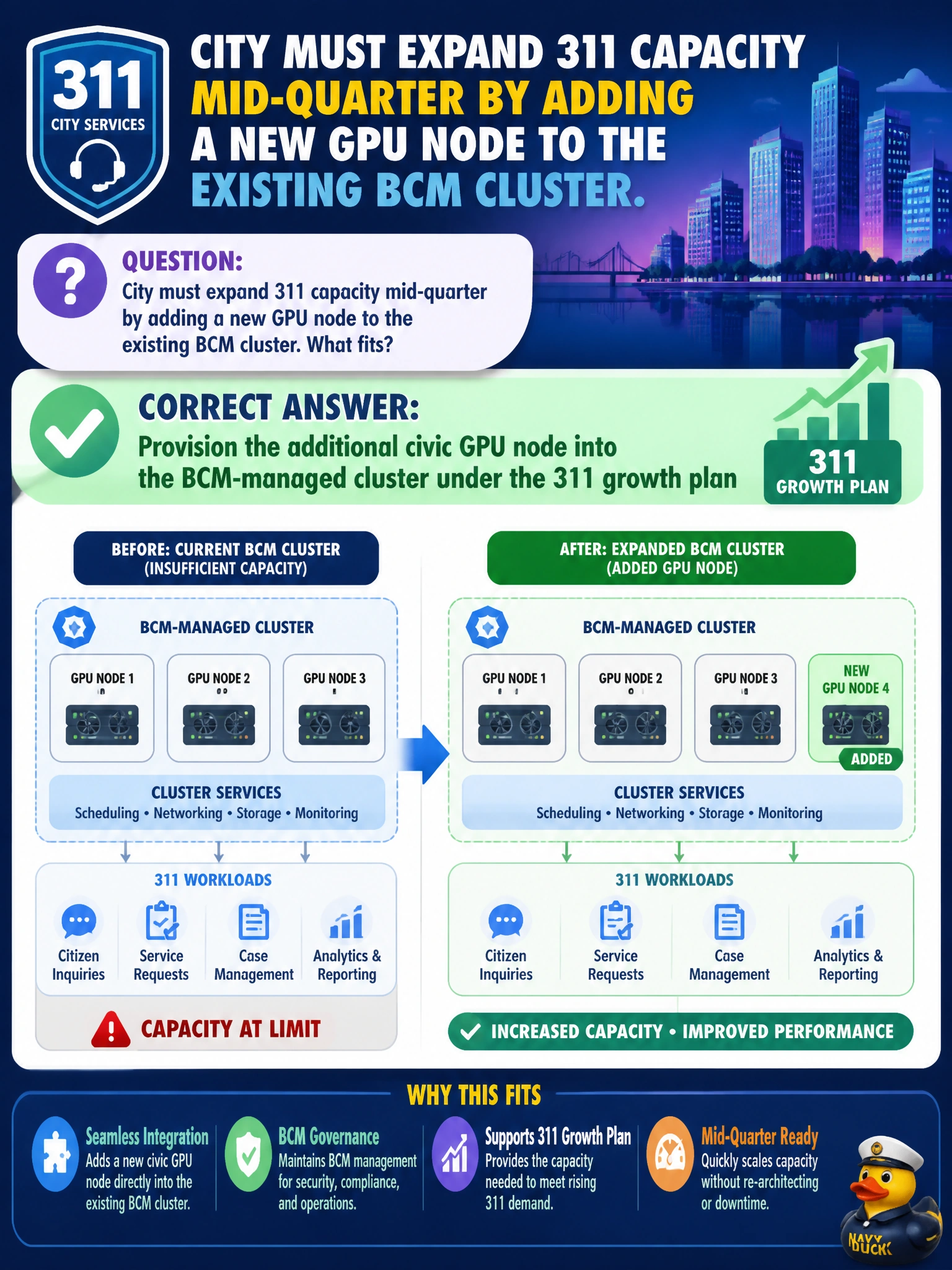
City must expand 311 capacity mid-quarter by adding a new GPU node to the existing BCM cluster. What fits?
Select an answer to reveal the explanation.
Short Explanation
You can meet mid-quarter 311 growth by provisioning the new GPU node into the BCM-managed cluster, where the scheduler can use it. Keeping it powered off or attaching it only to a developer laptop won’t add capacity for the 311 queue.
Full Explanation
Mid-quarter 311 growth is a capacity problem solved by provisioning the additional civic GPU node into the existing BCM-managed cluster under the growth plan. BCM is the municipal control plane for imaging, category placement, and scheduler visibility; once the node is provisioned into the correct cluster membership, the workload manager can allocate new inference or batch capacity without rebuilding the platform. This lets the city expand service levels while retaining governance. Leaving the node powered off fails because hardware that has not joined BCM and the scheduler provides no usable capacity; the scheduler cannot create capacity from an inactive node. Attaching the node only to a developer laptop outside BCM leaves it invisible to municipal scheduling, monitoring, and change control, creating an unsupported shadow path for production-like load. Deleting half the 311 pods fails the growth objective because it reduces offered load rather than increasing supply; it may clear queues temporarily while violating service-level intent. Exam caveat: adding a node to BCM is not complete until category, image, networking, and GPU enablement succeed; racking or powering it on is not enough. Also distinguish managed cluster expansion from an unmanaged island, so policy and observability remain consistent. Practical check: provision the node to the 311 workload category, confirm it is healthy in Base View or an equivalent view, verify GPU resources are advertised to the scheduler, and place a canary 311 inference pod or job. Then update capacity-plan metrics so mid-quarter growth is reflected in autoscaling and queue SLOs.