
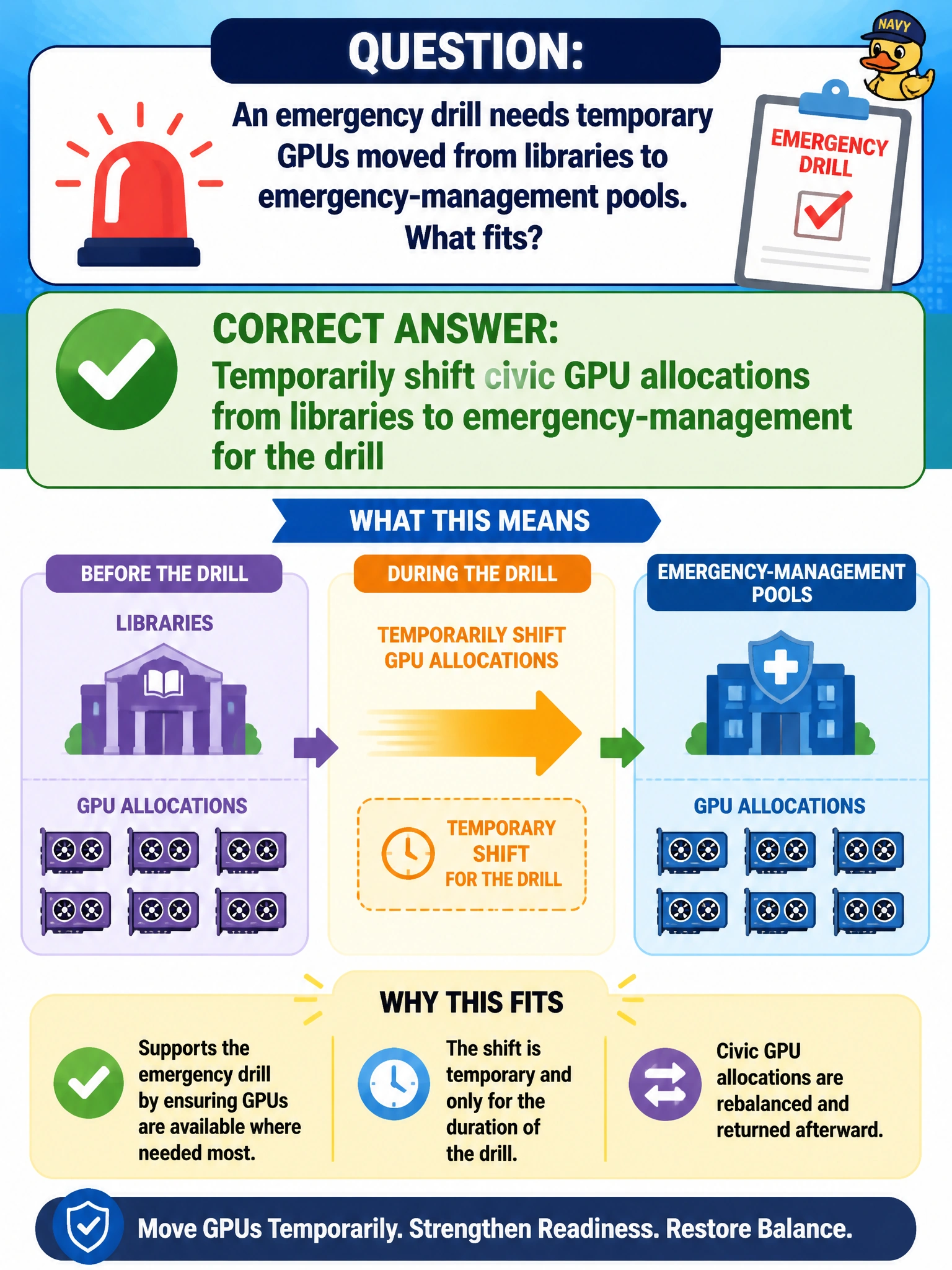
An emergency drill needs temporary GPUs moved from libraries to emergency-management pools. What fits?
Select an answer to reveal the explanation.
Short Explanation
Drill day is a temporary lane change—shift library GPUs to emergency-management, then shift back. Permanent library deletion and powering nodes off are blunt instruments.
Full Explanation
Temporarily shifting civic GPU allocations from libraries to emergency-management for the drill fits because emergency priority is time-bounded. Schedulers and platform quotas can move capacity for the drill window and restore library allocations afterward, preserving both emergency readiness and the libraries' ongoing mission without destroying projects.
Permanently deleting the libraries project so GPUs can never return fails by reversibility: drills are temporary; project deletion is not a reallocation tool. Ignoring the drill and leaving allocations unchanged fails by priority—emergency exercises require intentional capacity shifts. Powering off library nodes instead of reallocating through schedulers fails by mechanism: power-offs reduce capacity for everyone and skip governed reassignment.
Exam caveat: temporary shift should be documented with start/end, owners, and restore criteria. Preemptible library jobs may yield during the window; critical library services need explicit protection if they must stay up. The exam idea is temporary reallocation through controls, not permanent deletion or crude power-offs.
Operational check: raise emergency-management quota/reservation and reduce libraries for the drill interval, verify emergency jobs run, then restore library allocations and confirm library workloads resume without recreating projects from scratch.