
After budget hearings, the city must split GPUs across 311, health, and transit on Run:ai. What allocation fits?
Select an answer to reveal the explanation.
Short Explanation
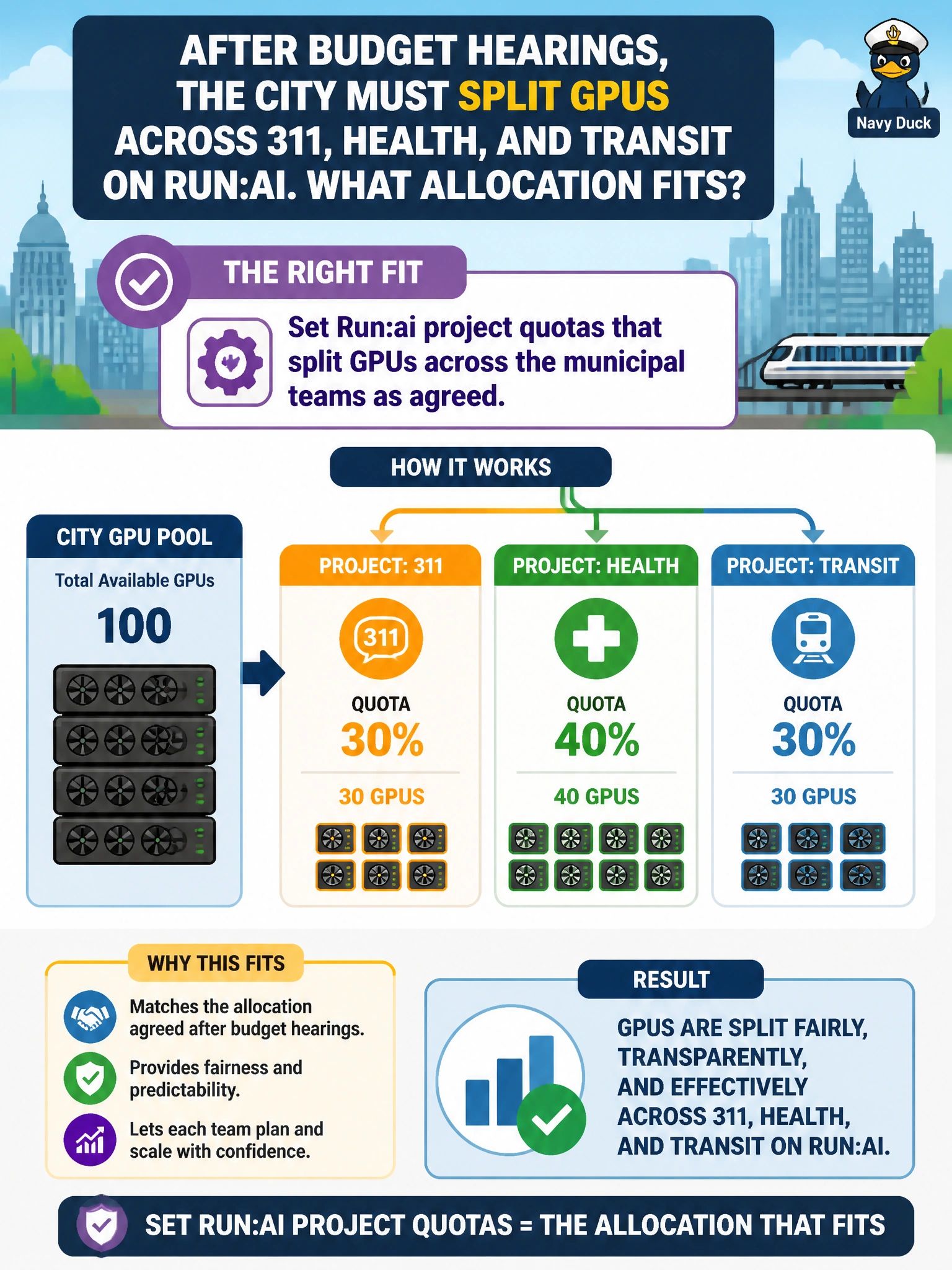
You can turn the budget agreement into a fair allocation by setting Run:ai project quotas for 311, health, and transit. Letting the first team take the whole pool or setting other departments’ quotas to zero would undo that agreement.
Full Explanation
Setting Run:ai project quotas that split GPUs across 311, health, and transit as agreed is the allocation that fits the budget hearing. Quotas turn political and operational agreements into enforceable scheduler limits, giving each department its share and preventing one team from silently consuming the entire pool. Letting whichever team submits first take the entire municipal GPU pool fails on fairness: first-come access is not the agreed split. Giving one department unlimited GPUs and setting the other departments’ quotas to zero forever fails by exclusivity, nullifying the agreement to share resources across teams. Scheduling GPU access only for council meetings and leaving the cluster idle at other times fails on utilization and service continuity; production AI work does not run only on a meeting schedule. Exam caveat: quotas encode the agreement, but they need periodic review when budgets or demand change. Practical check: configure Run:ai projects for 311, health, and transit with the agreed quotas, then submit contention tests from each project and verify that no team exceeds its share while the others retain their guaranteed capacity.