
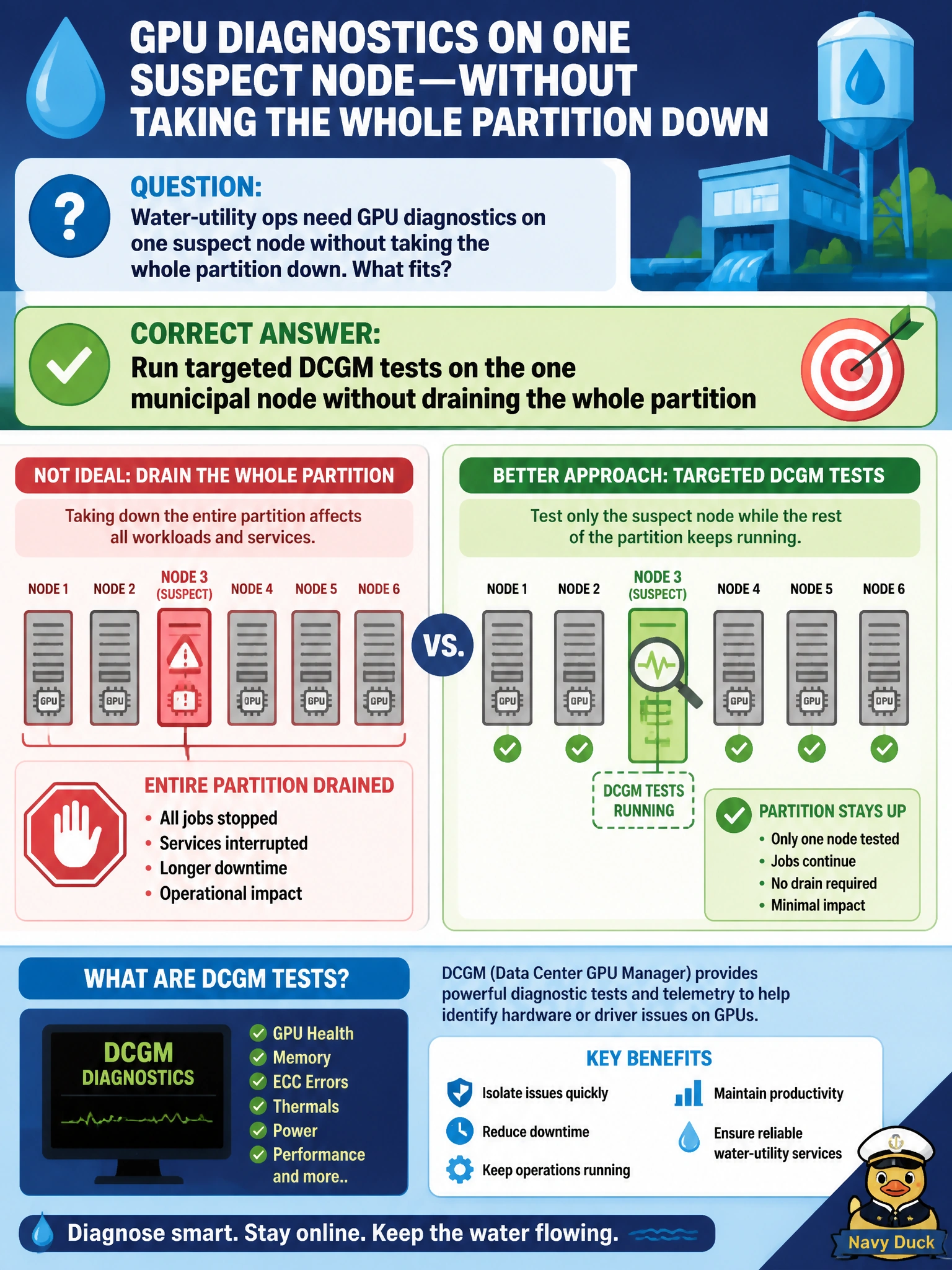
Water-utility ops need GPU diagnostics on one suspect node without taking the whole partition down. What fits?
Select an answer to reveal the explanation.
Short Explanation
Targeted DCGM on one water node is a spot check—not a campus blackout. Draining every partition for one suspect GPU is overkill municipal maintenance.
Full Explanation
Running targeted DCGM tests on the one municipal node without draining the whole partition fits water-utility ops that need diagnostics on a suspect GPU host. Scoped diagnostics limit blast radius: other nodes keep serving training and inference while the suspect node is tested. That is standard municipal maintenance hygiene—verify locally before declaring a partition outage.
Draining every civic partition before any single-node diagnostic fails by overbroad change window: whole-fleet drains are for planned major work, not routine one-node checks. Power-cycling the entire water campus to reset one GPU's metrics fails by blast radius and evidence destruction. Skipping diagnostics and marking all neighboring nodes failed by association fails by fault isolation—association is not diagnosis.
Exam caveat: targeted tests may still require cordoning or draining that single node if the diagnostic is disruptive. The contrast is single-node scope versus campus-wide outage. Also ensure the job scheduler stops placing new work on the suspect node during invasive tests.
Operational check: identify the suspect water node, cordon/drain only that node if required, run DCGM diagnostics there, record pass/fail, restore the node or ticket RMA, and keep neighboring nodes in service unless evidence expands the fault domain.