
County ops want weekly GPU health trends in the municipal observability stack. What integration fits?
Select an answer to reveal the explanation.
Short Explanation
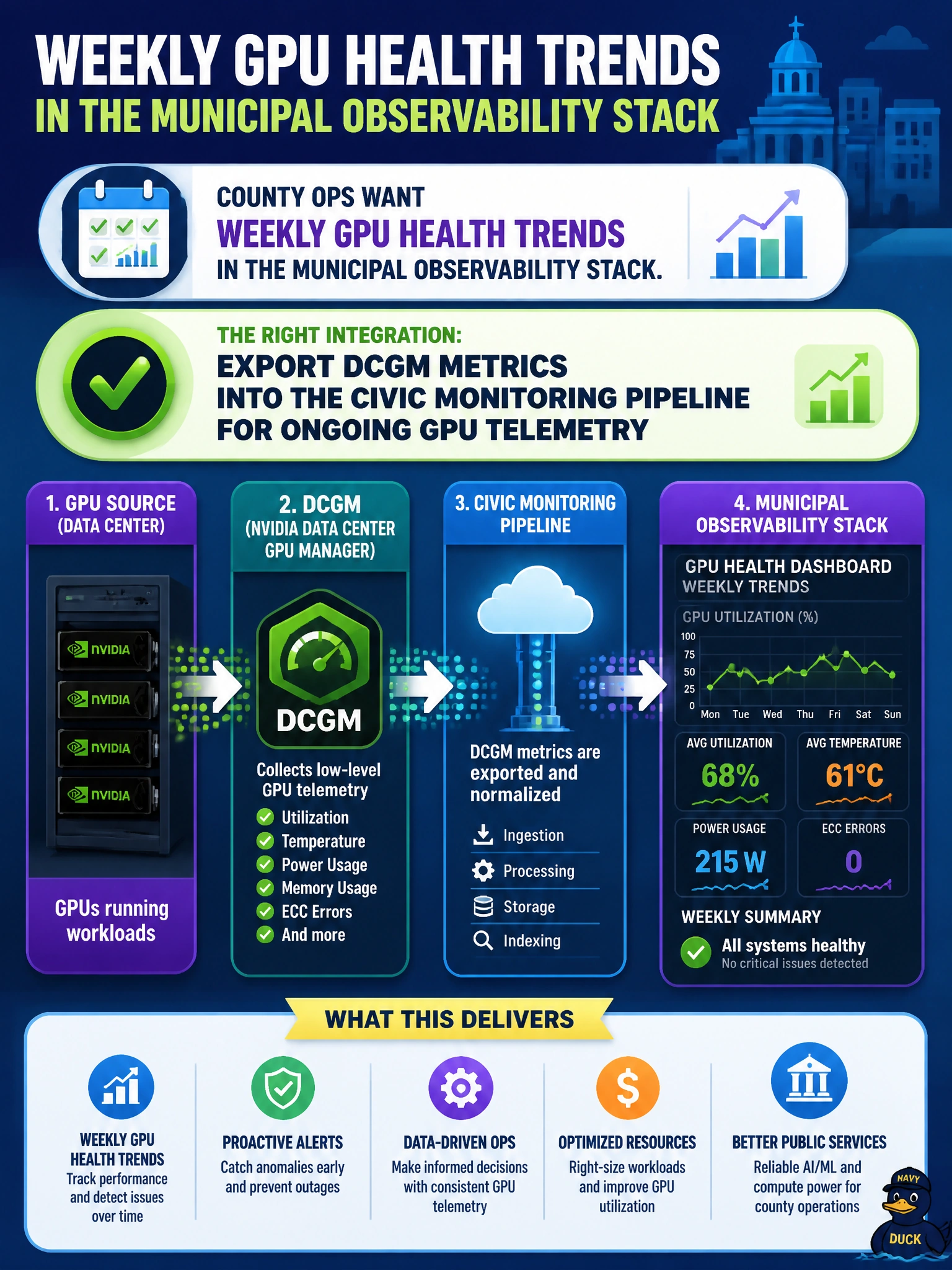
Pipe DCGM into the county observability stack—GPU vitals on the same dashboard as everything else. Sticky notes and nightly SSH screenshots are not a monitoring pipeline.
Full Explanation
Exporting DCGM metrics into the civic monitoring pipeline fits county ops that want weekly GPU health trends because durable telemetry requires integration with the municipal observability stack—Prometheus-compatible exporters, dashboards, retention, and alerting—not one-off human collection. DCGM provides the GPU signals; the monitoring pipeline stores history so trends, regressions, and capacity reviews are evidence-based.
Storing GPU stats only on sticky notes on the data-center door fails by durability and queryability: paper cannot trend weekly ECC or util. Forbidding metric export so each team SSHs nightly for nvidia-smi screenshots fails by scale and consistency—manual screenshots are not a pipeline. Replacing DCGM with anonymous CSV files emailed without timestamps fails by time-series integrity: without timestamps and identity, weekly trends are meaningless.
Exam caveat: export does not replace on-node tools for live triage; nvidia-smi remains useful interactively. The exam point is ongoing trend visibility via DCGM into monitoring, not abandoning all CLI diagnostics.
Operational check: enable DCGM exporter or equivalent, scrape into the county stack, build a weekly GPU health dashboard (util, temp, ECC, XID if available), and verify retention covers the review window before the next capacity meeting.