
Housing-authority fine-tunes must shrink when inference priority rises. What Run:ai training pattern fits?
Select an answer to reveal the explanation.
Short Explanation
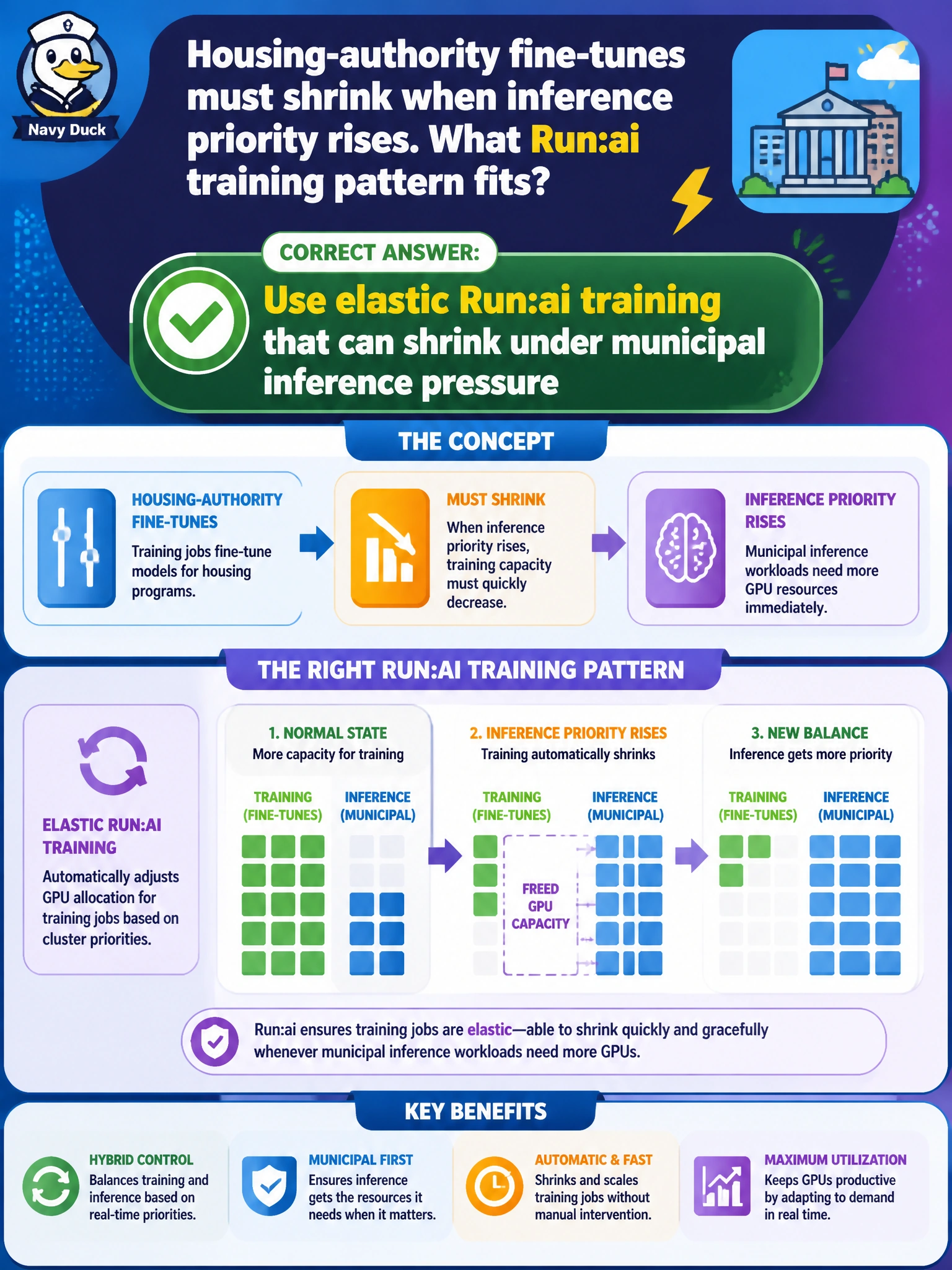
Elastic Run:ai training is a stretchy housing tape measure—shrink when inference needs the floor. Forever exclusive leases and killing serving for every fine-tune fight civic priorities.
Full Explanation
Elastic Run:ai training that can shrink under municipal inference pressure fits housing-authority fine-tunes because shared civic clusters must protect serving when inference priority rises. Elastic training patterns allow jobs to scale GPU count down (and sometimes up) as cluster conditions change, so fine-tuning yields capacity instead of pinning exclusive forever leases that freeze inference. That preserves housing model improvement without forcing a hard outage of resident-facing services.
Pinning every training job to exclusive forever leases that never yield fails by elasticity and priority concept: exclusive non-yielding holds starve inference during peaks. Disabling inference entirely whenever any housing train starts fails by service-continuity concept—training should not veto serving as policy. Doubling GPU requests during inference peaks so trains crowd out serving fails by priority inversion: peak demand is when serving needs protection, not when trains should inflate asks.
Exam caveat: elastic shrink is not the same as guaranteed zero-GPU completion or uncontrolled preemption without checkpoints. Well-run civic jobs checkpoint so a shrink or pause does not lose all progress; the exam point is choosing a training pattern that can contract under inference pressure rather than exclusive non-yielding leases.
Operational check: configure the housing fine-tune as elastic/preemptible within Run:ai policy, raise inference priority or guaranteed quota during peaks, and verify training GPU count decreases while serving pods remain healthy and within SLOs.