
Public-health needs a multi-node fine-tune on the civic Slurm cluster. How should the training workload be deployed?
Select an answer to reveal the explanation.
Short Explanation
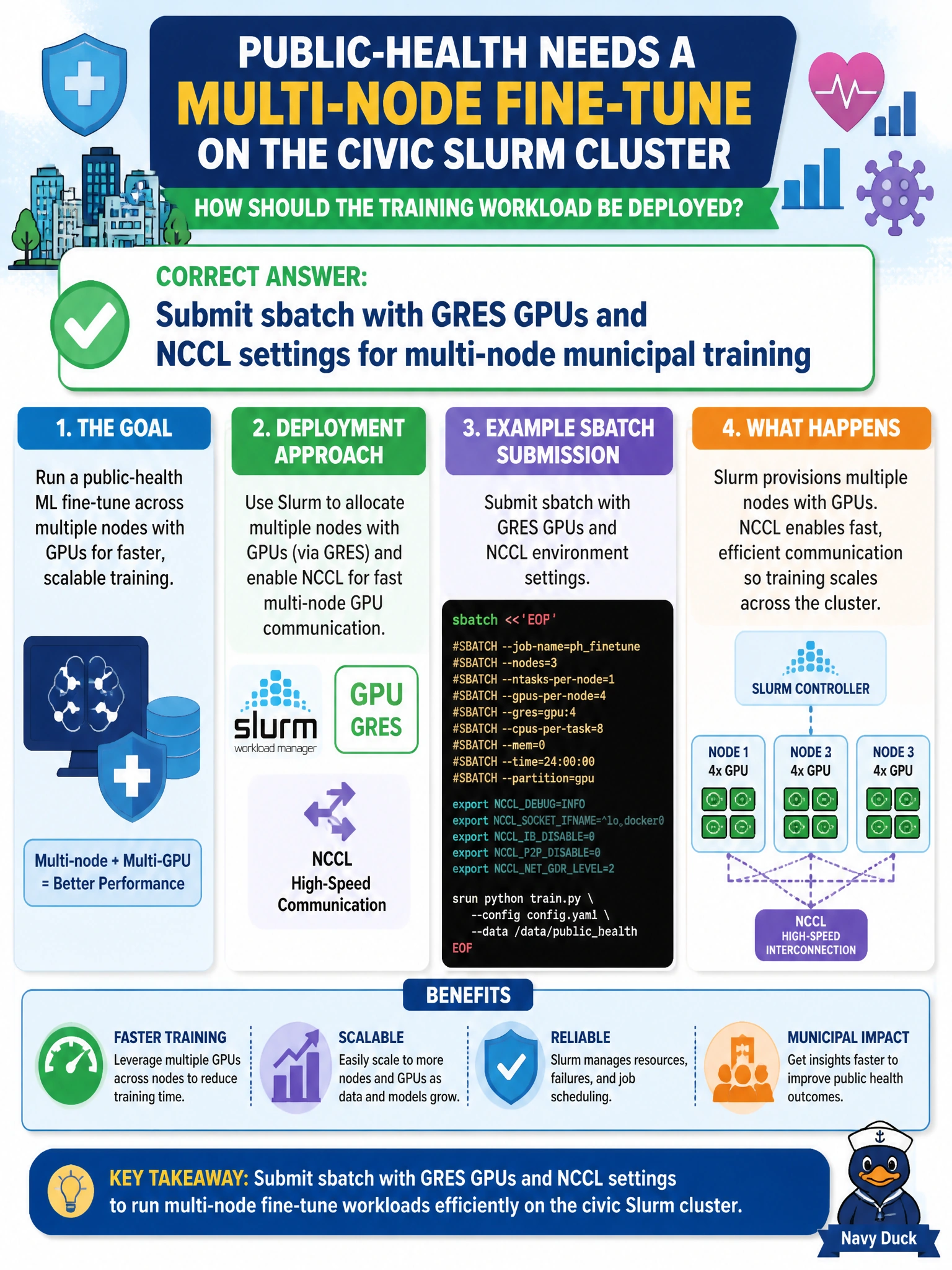
Multi-node public-health fine-tunes need sbatch with GRES GPUs and sane NCCL—team training across racks, not one lonely laptop. Zero-GPU batches and jammed single-node ranks miss the point.
Full Explanation
Submit an sbatch job that requests GRES GPUs and configures NCCL for multi-node public-health fine-tuning on the civic Slurm cluster. GRES allocates GPUs cleanly through Slurm; NCCL enables efficient multi-GPU/multi-node gradient exchange. Together they are the standard packaging for distributed municipal training rather than ad-hoc laptop runs.
Launching training only on a single laptop GPU with no batch script neither scales nor enters the cluster's fairshare accounting. An sbatch that requests zero GPUs and relies on CPU loops wastes the overnight window for large models. Disabling NCCL and forcing all ranks onto one overcrowded node creates communication bottlenecks and memory pressure that defeat multi-node design.
Exam caveat: NCCL needs working inter-node fabric (IB/RoCE/Ethernet) and consistent env vars (NCCL_DEBUG for triage, correct interfaces). Match --nodes, --ntasks-per-node, and --gres=gpu:N to the training framework's world size. Containers/modules must expose GPU bindings Slurm expects (e.g., Pyxis/enroot or module stacks).
Operational check: run a short multi-node NCCL allreduce smoke test, then the fine-tune with GRES; confirm squeue/scontrol show GPUs allocated across nodes and that utilization is balanced. Capture job scripts in version control for PHI-area reproducibility.