
Transit platform policy must stay centralized for ETA inference serving. What deployment approach should ops choose?
Select an answer to reveal the explanation.
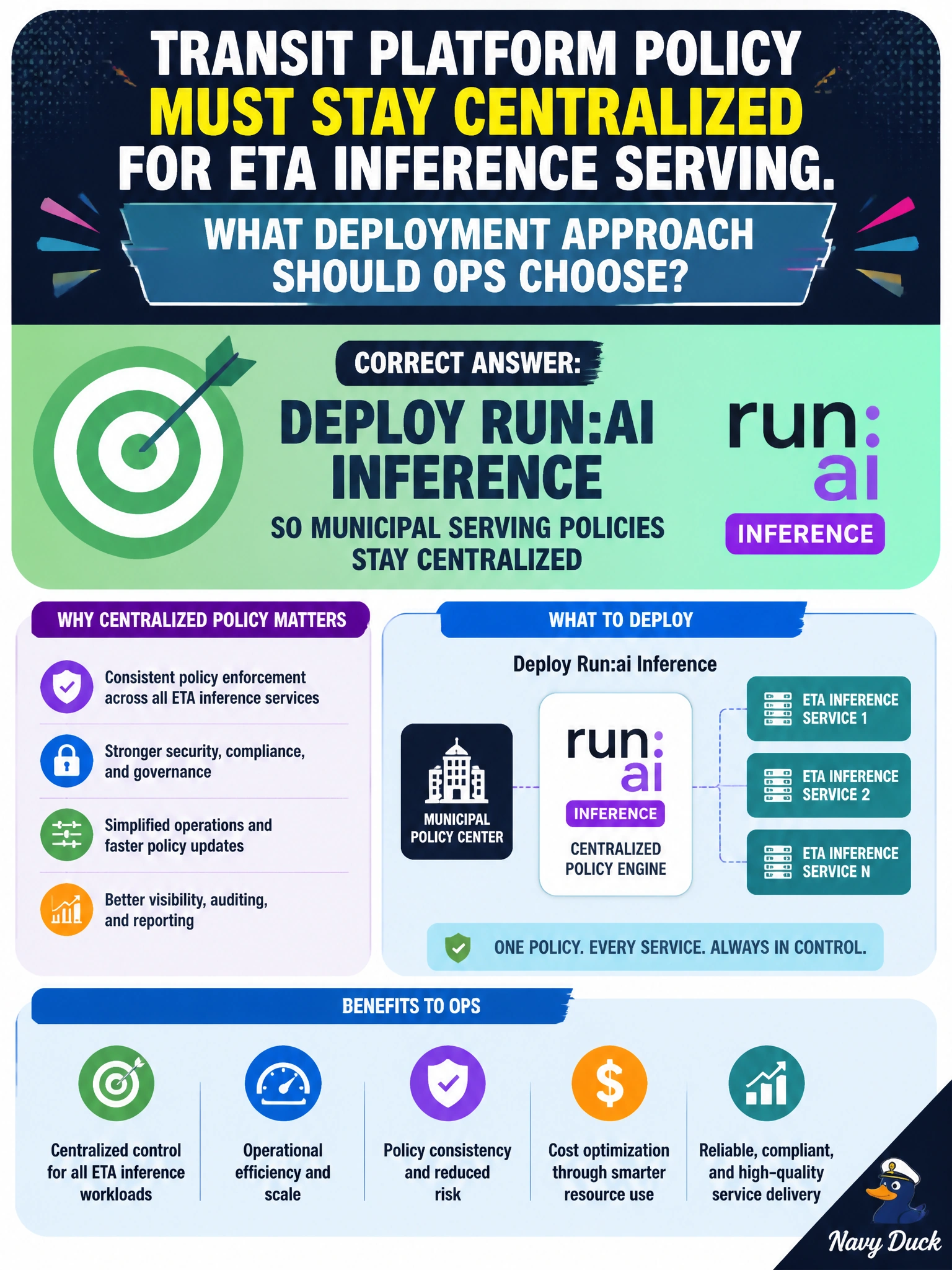
Short Explanation
Run:ai keeps transit serving policies in one control room instead of a pile of one-off YAML at every depot. Private schedulers and laptop Docker skip civic governance.
Full Explanation
Deploy Run:ai inference so municipal serving policies for transit ETA stay centralized. A shared platform applies project quotas, scheduling rules, image policies, and rollout controls consistently across depots instead of leaving each site to invent YAML. Centralization is how platform policy remains auditable for civic governance.
Scattering raw Kubernetes YAML per depot with no shared platform controls drifts configs, duplicates bugs, and bypasses org-wide guardrails. Allowing each depot to invent private schedulers outside governance fractures capacity planning and security review. Serving ETA models only from unmanaged desktop Docker on laptops fails HA, patching, and policy enforcement outright.
Exam caveat: centralization does not forbid regional node pools—Run:ai can schedule across pools while policy remains central. Avoid a single GPU SPOF by still spreading replicas; platform control and HA topology are complementary. GitOps for Run:ai/Kubernetes manifests should be the change path, not SSH edits.
Operational check: compare serving policy (quota, priority, allowed images) across depots and confirm they inherit from the central Run:ai configuration; attempt a noncompliant submit and verify admission denial; review that laptop Docker paths are blocked by network/policy.