
Emergency-management drills must preempt low-priority library jobs in Run:ai. What should admins configure?
Select an answer to reveal the explanation.
Short Explanation
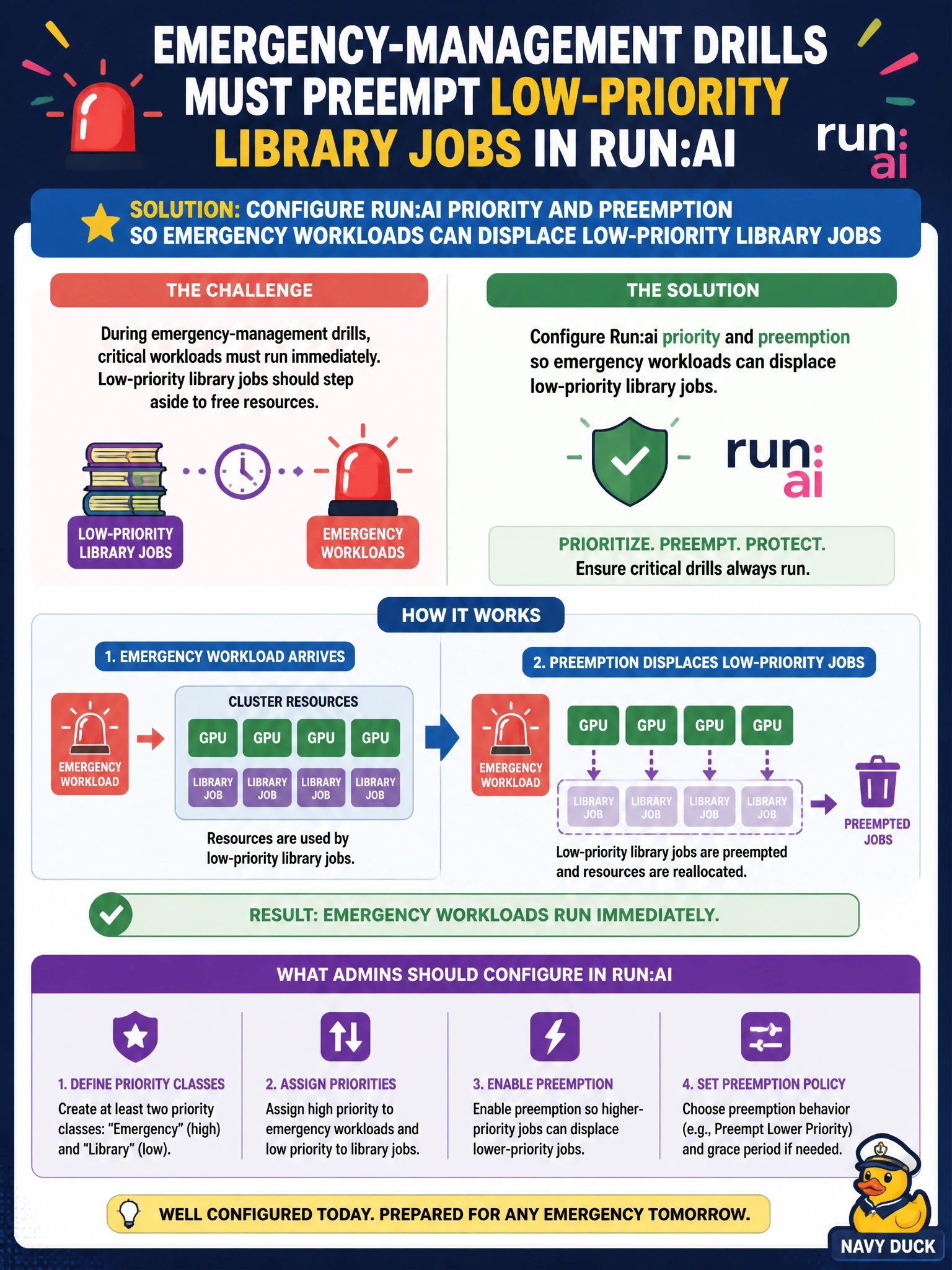
You can give emergency drills the right-of-way by configuring priority and preemption to displace low-priority library jobs when GPUs are scarce. Making library jobs outrank drills, treating every job equally, or canceling the emergency project would not achieve that goal.
Full Explanation
Emergency-management drills must be able to displace low-priority library jobs when GPUs are scarce. Configure Run:ai priority and preemption so emergency workloads outrank and can preempt those library jobs; priority without preemption may help only when the cluster has room, while preemption can free busy GPUs for drills. Making library jobs always outrank emergency drills reverses the intended mission priority. Disabling priority classes so every job is equal removes the ranking mechanism needed to give drills precedence. Canceling the emergency-management project avoids contention by eliminating the workload that must run during incidents, so it does not meet the requirement. Exam caveat: mark only truly low-priority library work as preemptible, and do not let emergency jobs evict other life-safety inference without an explicit hierarchy. As a practical check, submit a low-priority library GPU job, then an emergency drill job that needs those GPUs, and confirm that the library job is preempted; restore library work after the drill window. Document which library job classes are preemptible and which catalog services must stay up, and notify library operators when drills will reclaim GPUs. Priority and preemption work well when policy is explicit, tested in drills, and restored cleanly afterward—not when every job competes as an equal.