
County wants training favored on weekends and inference on weekdays in Run:ai. What should admins tune?
Select an answer to reveal the explanation.
Short Explanation
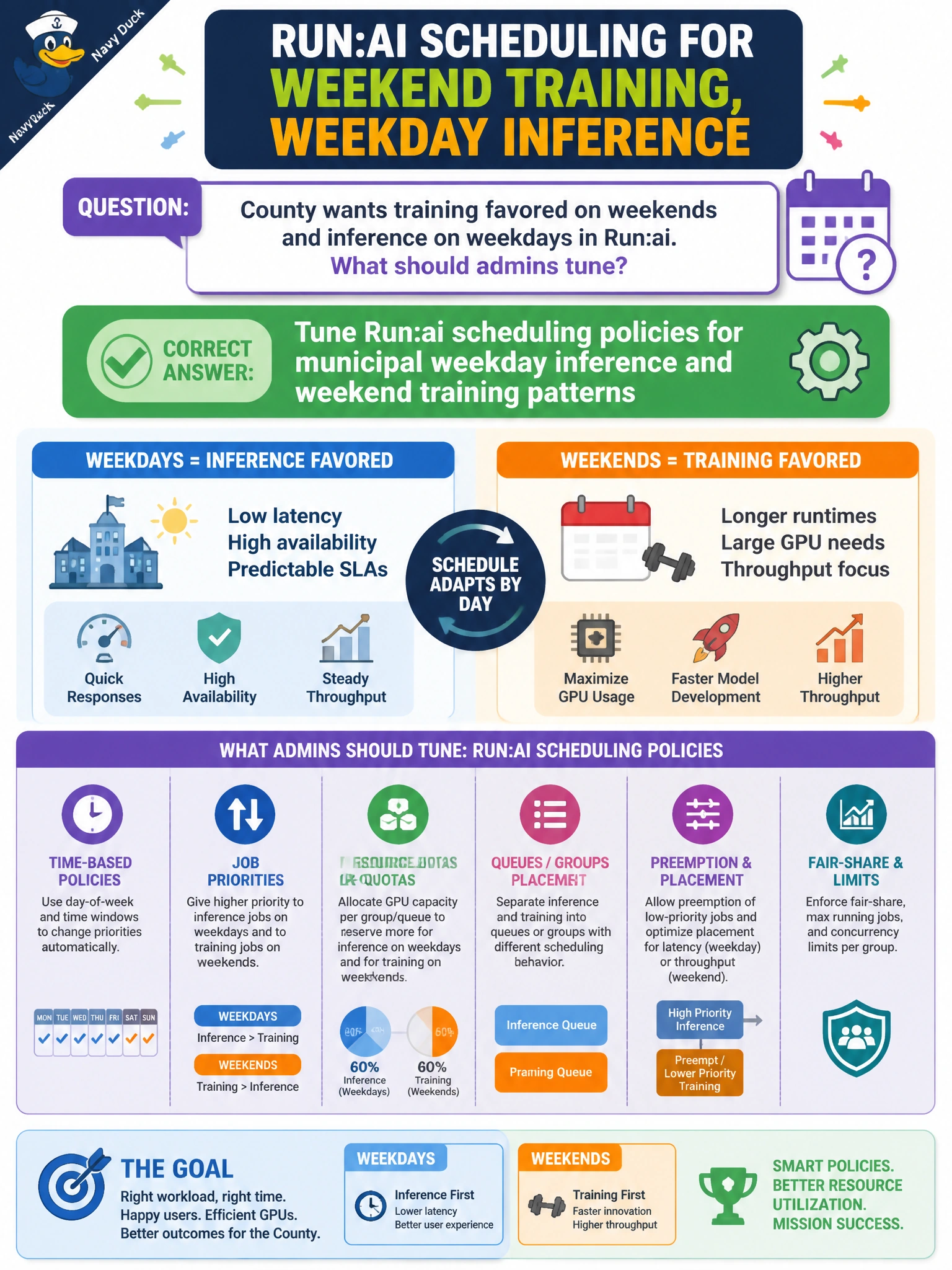
Tune the scheduler to the city’s clock—inference weekdays, heavier training weekends. A static free-for-all ignores the pattern. Permanently deleting inference or stomping critical serving each morning is not policy.
Full Explanation
Counties often need inference capacity on weekdays for public services and heavier training on weekends when interactive demand drops. Admins should tune Run:ai scheduling policies (priority, quotas, or time-based rules) so municipal weekday inference is favored and weekend windows open more GPU capacity for training—matching policy to the civic clock rather than a static free-for-all. Ignoring time-of-day with a single static free-for-all leaves weekday inference unprotected and weekend GPUs under-planned. Deleting weekday inference deployments every Friday night permanently destroys services instead of shifting capacity temporarily. Forcing training to preempt 911-adjacent inference every weekday morning endangers critical serving during peak civic hours. Exam caveat: time-based policies must not starve emergencies—carve out protected pools for 911-adjacent inference even on weekend training surges. Operational check: apply weekday vs weekend scheduling rules, verify inference priority during a weekday load test, confirm training obtains more GPUs in a weekend window, and ensure critical inference remains non-preemptible. Encode the weekday/weekend pattern as versioned policy with change tickets so auditors can see why transit inference held GPUs Tuesday morning and why housing training expanded Saturday. Static free-for-alls fail civic fairness reviews; time-aware Run:ai policies with protected critical inference pass them.