
Emergency AI must jump ahead of batch library jobs during a surge. What Slurm administration fits?
Select an answer to reveal the explanation.
Short Explanation
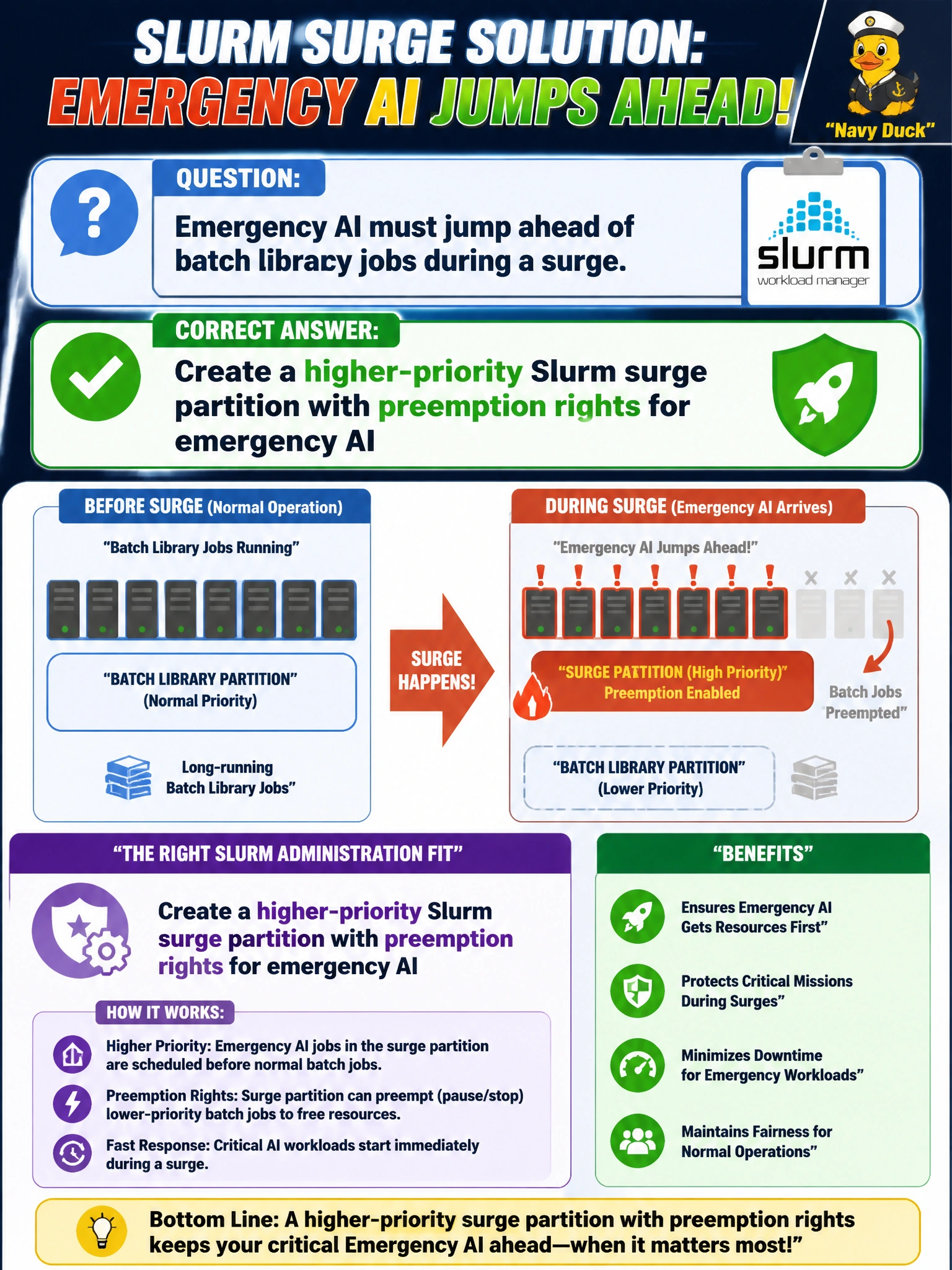
You can give emergency AI a surge partition with higher priority and preemption, so it can take capacity from routine library jobs when needed. Lowering emergency priority or banning emergency accounts works against the goal. Permanently deleting library queues is excessive for a temporary surge.
Full Explanation
During a civic emergency surge, AI workloads supporting response must outrank routine batch library jobs. Creating a higher-priority Slurm surge partition with preemption rights lets emergency jobs move ahead of library batch work, and permits running lower-priority jobs to be preempted under policy so GPUs become available quickly. This provides temporary crisis capacity without permanently removing other queues. Lowering emergency priority below library scrapers does the opposite of the requirement and can leave emergency jobs waiting during the surge. Banning emergency accounts from submitting removes the submission path crisis AI needs. Permanently deleting library queues whenever a drill starts is excessive and harms normal municipal library operations after the time-bounded event. Exam caveat: preemption requires a defined PreemptMode and reclaimable victim jobs; a high-priority partition without preemption can use idle capacity but cannot displace long library trainings on a busy cluster. Practical check: create the surge partition, submit a library GPU job followed by an emergency job, verify preferential start or preemption in squeue, and confirm the library queues remain after the drill window ends.