
Water-utility multi-node GPU jobs land on poorly connected hosts. What should Slurm admins configure?
Select an answer to reveal the explanation.
Short Explanation
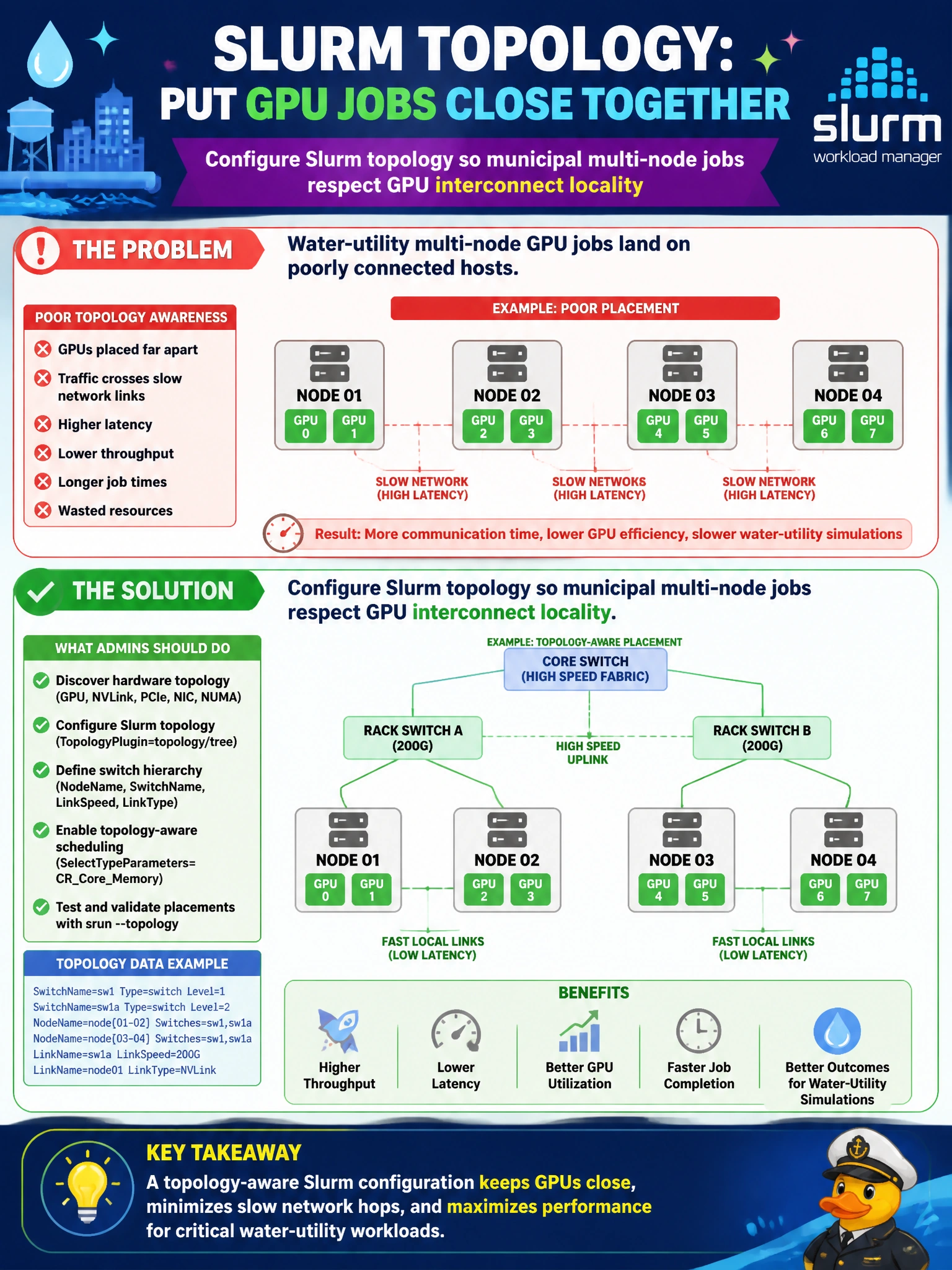
Topology tells Slurm which GPUs actually talk fast—like seating a crew on the same radio net. Blind placement slows water-utility all-reduce. Laptops and ripping IB drivers do not fix municipal multi-node locality.
Full Explanation
Water-utility multi-node GPU jobs (training or distributed analytics) depend on fast east-west paths between ranks. Slurm topology configuration lets administrators encode switch/leaf locality and GPU interconnect neighborhoods so municipal multi-node allocations prefer tightly coupled hosts instead of spreading ranks across poorly connected machines. Correct topology data reduces all-reduce and collective latency when the utility runs large jobs across several nodes. Ignoring placement and hoping all-reduce stays fast leaves performance to chance and typically yields stragglers when ranks land across distant ToRs. Forcing every job onto a single laptop outside the cluster abandons the municipal GPU fabric and cannot host legitimate multi-node water workloads. Removing InfiniBand drivers may simplify a mistaken inventory view but destroys the interconnect the jobs need and makes topology-aware scheduling moot. Exam caveat: topology helps only if the described fabric matches reality—stale topology.conf or missing NVLink/IB domains can still schedule 'valid' but slow placements; validate against actual switch maps. Operational check: enable or refresh topology, launch a representative multi-node water job, confirm allocated nodes share the intended switch/GPU domain via scontrol/sinfo, and compare all-reduce timing against a deliberately cross-rack bad placement.