
Clerk OCR needs Slurm maintenance, but 311 Kubernetes inference must keep running on other nodes. What should admins do?
Select an answer to reveal the explanation.
Short Explanation
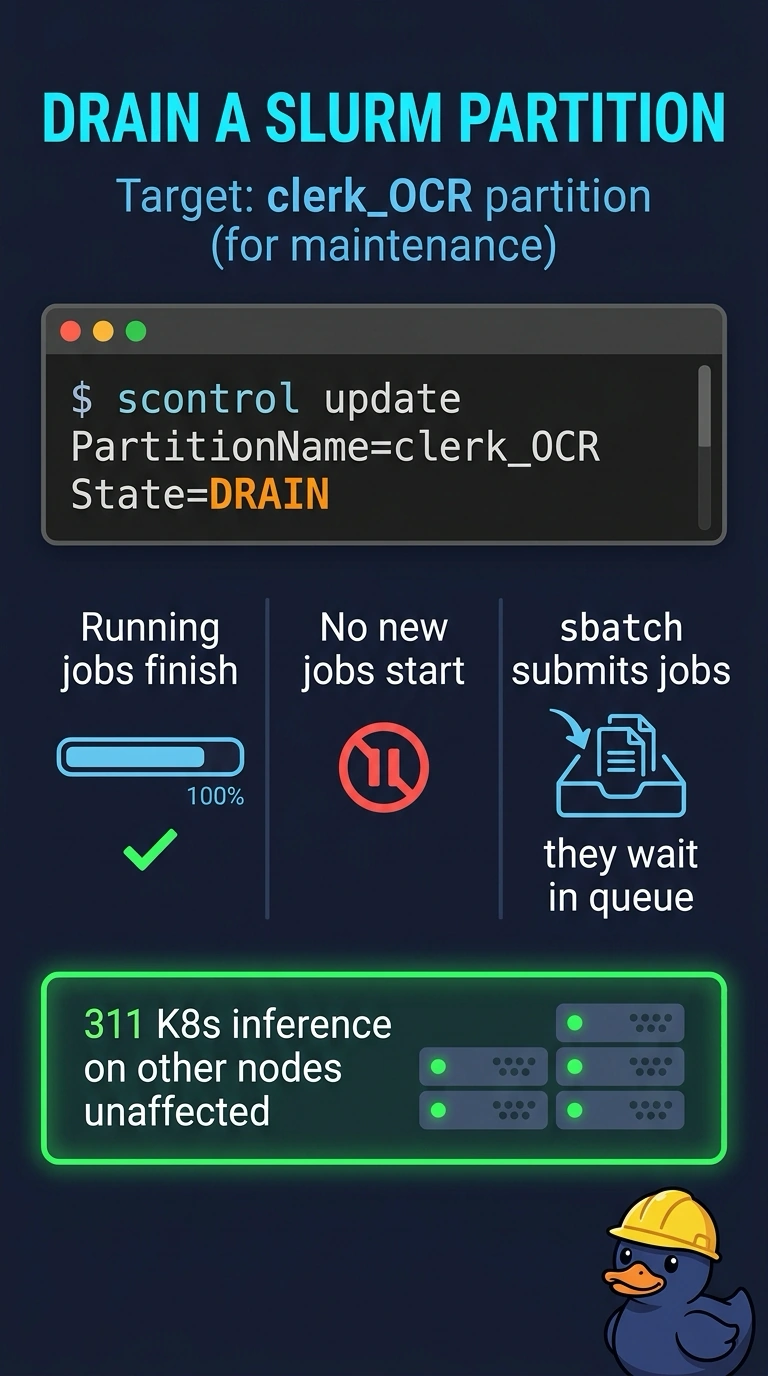
Drain just the clerk OCR Slurm partition—close that wing, leave 311 K8s open. Whole-DC power offs, reimaging inference nodes, or killing every pod are overkill for a Slurm maintenance window.
Full Explanation
Draining the clerk OCR Slurm partition for maintenance without disrupting 311 Kubernetes inference on other nodes is the correct scoped maintenance action. Partition drain (or node drain limited to the OCR Slurm set) stops new OCR admissions and evacuates that scheduling domain while leaving K8s worker nodes that serve 311 inference untouched. Civic ops close one wing for maintenance and leave citizen-facing inference open on the other.
Powering off the entire municipal data center including K8s nodes fails by concept because whole-DC shutdown is massively overscoped for Slurm partition maintenance and needlessly breaks 311. Reimaging every GPU node including those serving 311 inference fails because reimage of inference workers is unrelated to a Slurm OCR maintenance window and causes avoidable outage. Killing every Kubernetes pod cluster-wide as a shortcut fails because it weaponizes K8s against an unrelated Slurm maintenance need.
Exam caveat: mixed Slurm/Kubernetes estates require scoped maintenance boundaries—drain the right scheduler domain, not the whole site. Confirm node membership carefully so dual-purpose nodes are handled intentionally. Communicate OCR job pause windows to clerks while verifying 311 Service/Deployment health stays Ready.
Operational check: identify nodes solely in the clerk OCR Slurm partition, drain/update only those, confirm squeue shows OCR jobs held/drained as expected, watch 311 Kubernetes inference endpoints and pod readiness on non-maintenance nodes throughout, then undrain OCR nodes after maintenance validation.