
County assessor array jobs flood the Slurm controller. What should civic admins do?
Select an answer to reveal the explanation.
Short Explanation
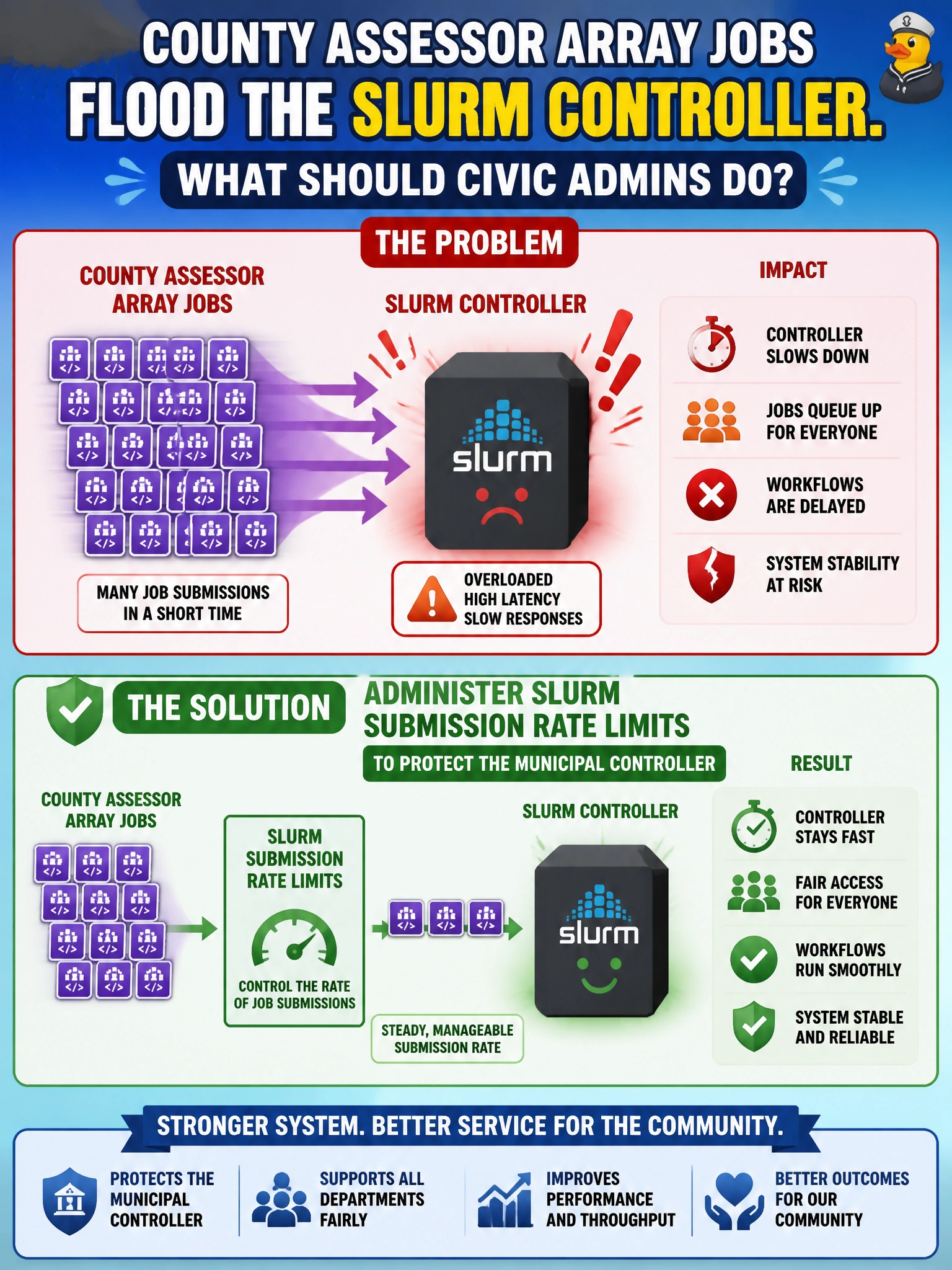
Assessor arrays hammering Slurm? Rate-limit submits—like a ticket gate at city hall. Ignoring load or infinite concurrency invites a meltdown. A desk-drawer controller is not HA.
Full Explanation
Administering Slurm submission rate limits protects the municipal controller when county assessor array jobs flood submissions. Rate limits (and related submit throttles / MaxSubmit constraints as configured in your environment) keep the controller responsive under bursty array fan-out so scheduling continues for all tenants. Civic admins gate the ticket line at city hall rather than letting infinite concurrent submits panic the head node.
Ignoring controller load until the head node panics fails by concept because waiting for failure is not protection. Adding infinite concurrent submits with no limits fails because it is the overload pattern itself. Moving the controller onto an unmonitored desktop under a desk fails because an unmonitored desktop is not a resilient, observable control plane for county HPC.
Exam caveat: array storms are a classic Slurm operations failure mode—limits, max array sizes, and submit rates matter as much as raw node count. Rate limiting should be paired with user education and possibly partition-specific policies for assessor bursts. Do not confuse submission limits with fair-share; both may be needed.
Operational check: watch Slurm controller CPU, threads, and queue depth during an assessor array burst, apply submission rate / MaxSubmit (or equivalent) limits for the assessor account, retest a large array for controlled admission without controller meltdown, and keep monitoring/alerts on the head node—not a desk drawer.