
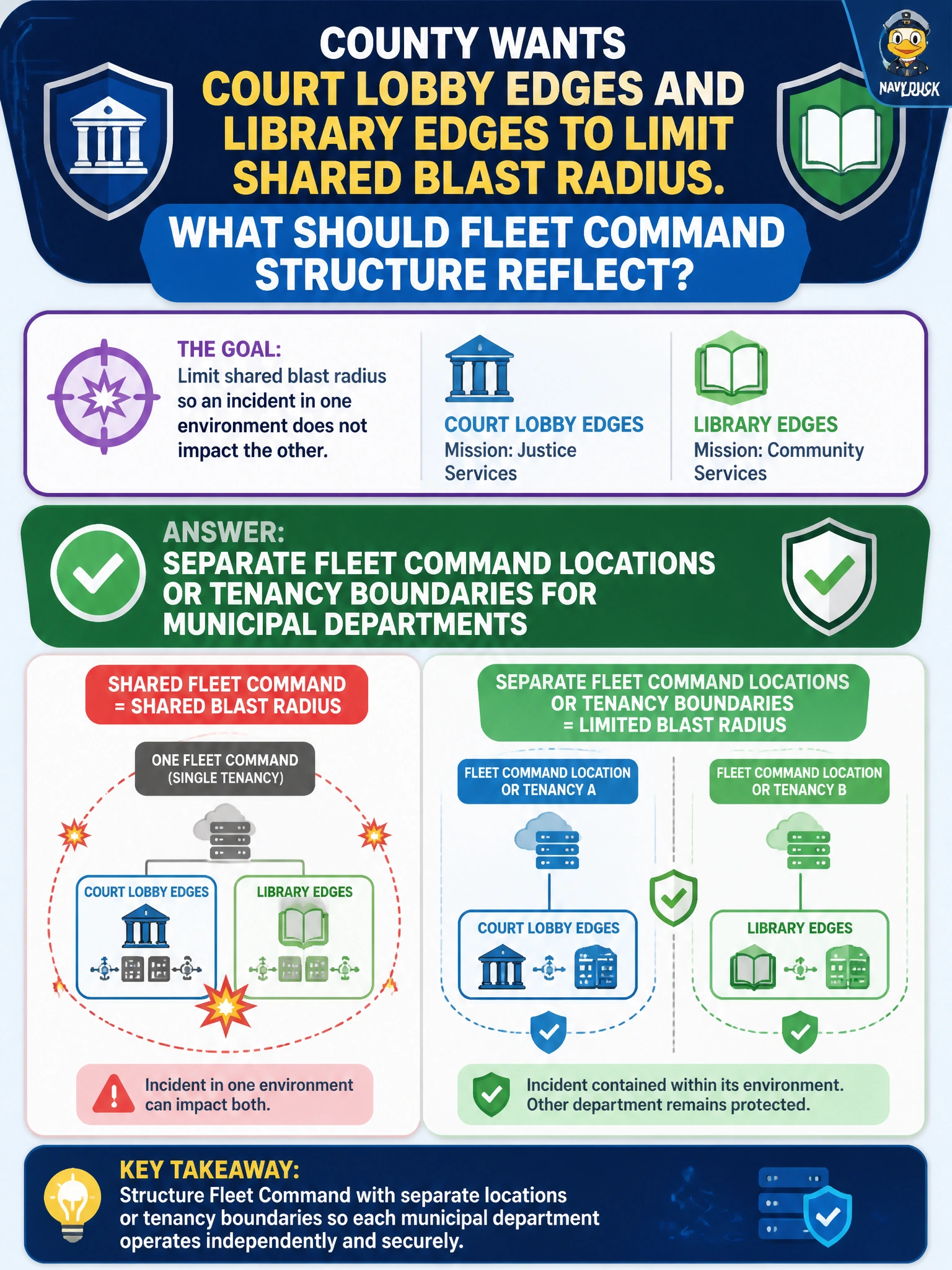
County wants court lobby edges and library edges to limit shared blast radius. What should Fleet Command structure reflect?
Select an answer to reveal the explanation.
Short Explanation
Split court and library edges into separate Fleet Command locations—different blast doors for different buildings. One mega-group and taped passwords invite shared outages. Separation is the civic tenancy move.
Full Explanation
Separate Fleet Command locations or tenancy boundaries for municipal departments limit shared blast radius between court lobby edges and library edges. Location/tenancy separation scopes updates, policies, and sometimes credentials so a bad court push or misconfig does not automatically blanket library devices. Civic tenancy mirrors building blast doors: different departments get different failure domains.
One giant unmanaged group mixing every department device fails by concept because a single unmanaged pool maximizes blast radius and confuses ownership. A single shared password taped to every gateway fails because shared credentials destroy accountability and turn any leak into a countywide edge compromise. Identical configs forced with no location separation fail because identical forced configs across departments ignore data sensitivity and operational schedules and still couple failure domains.
Exam caveat: Fleet Command structure questions test isolation and least blast radius, not maximum convenience. Separation does not remove the need for baselines; departments can share golden images while remaining in distinct locations/tenancy. Over-separation without naming standards can also create ops debt—use clear municipal location taxonomy.
Operational check: create distinct Fleet Command locations (or equivalent tenancy boundaries) for courts and libraries, move devices into the correct boundary, verify update rings cannot cross accidentally, and test that a canary update in courts does not appear as a pending change on library gateways.